After Netflix price hike last year
Coupang raised Wow Membership from 2,900 to 4,990 KRW last month
Tving also reduced Naver Membership partnership this year
If subscriber loyalty is low, there may be backlash from churn
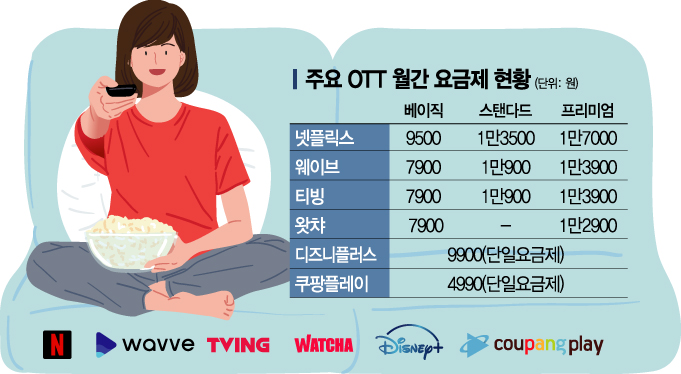
[Asia Economy Reporter Eunmo Koo] Following Netflix's sudden announcement of a price increase at the end of last year, domestic online video services (OTT) in South Korea have recently shown signs of raising their fees by changing their pricing structures. These companies argue that the increase is inevitable due to rising content production costs, but the growing monthly expenses are burdensome for users. However, since a price hike requires strong content competitiveness and customer loyalty as prerequisites, it seems unlikely that domestic OTTs will immediately propose additional increases.
Netflix, Coupang Play, and TVING Raise Prices One After Another
According to the OTT industry on the 11th, since Netflix announced a price increase in November last year, domestic OTTs such as Coupang Play and TVING have also started raising their fees. Netflix, which took the lead, announced on November 18 last year that the Standard plan would increase from 12,000 KRW to 13,500 KRW per month, and the Premium plan from 14,500 KRW to 17,000 KRW per month. These represent increases of 12.5% and 17.2%, respectively.
Recently, domestic companies like Coupang and TVING have also changed their pricing structures. Coupang raised the fee for its paid membership 'Wow Membership,' which is linked to online shopping, from 2,900 KRW to 4,990 KRW per month on the 30th of last month. To use the OTT service Coupang Play, users must subscribe to Wow Membership, which includes services such as early morning delivery 'Rocket Fresh' and free shipping 'Rocket Direct Purchase.' Currently, this applies to new subscribers, and price increases for existing subscribers are expected to be implemented gradually later.
TVING also reduced the content viewing range for Naver Plus Membership subscribers starting from the 1st of this month. Due to changes in the membership's partnership scope, original content was removed from the list of available content. To watch original content, users must subscribe to one of the paid plans: Basic (3,000 KRW/month), Standard (6,000 KRW/month), or Premium (9,000 KRW/month).
Netflix maintains that price increases are unavoidable to sustain content investment and service maintenance. Other providers are also facing rising content prices amid intensified competition, making it necessary to consider price hikes to escape deficits and improve profitability relative to investments. Additionally, rising labor costs and inflation are among various factors pressuring fee increases.
As major OTTs continue to raise prices, consumer burdens are growing. According to the 'Content Usage Trend Study in the Digital Transformation Era' published by the Korea Creative Content Agency (KOCCA) on the 5th, OTT users cited 'economic burden (42.5%)' as the most inconvenient aspect of using the service. This figure is more than double those for technical issues (21.0%) and content diversity (20.0%).

OTT in a Dilemma... Concerns Over Subscriber Churn
Contrary to consumer concerns, the likelihood of domestic OTTs immediately proposing price increases is relatively low. Due to the price sensitivity of the OTT market, raising fees prematurely without strong content competitiveness and high customer loyalty could lead to subscriber churn as a backlash.
Cheon Hye-seon, head of the Media Management Center at the Media Future Research Institute, explained, "To prevent customer churn despite price increases, companies need to have highly loyal content or build a business model that offers various benefits beyond content, like Coupang. However, most domestic OTTs do not yet have such a stable structure, so they are currently in a dilemma."

In KOCCA's survey, when asked about a '10% price increase' on their subscribed platform, 51.2% of respondents said they would continue using the existing platform. This indicates that if preferred content is clearly available, users are willing to tolerate a certain level of increase. However, about half of the respondents said they would switch to another platform (37.6%) or stop using the service altogether (11.2%).
Wave and Watcha are also not considering price increases within this year. Wave stated, "Rather than raising prices immediately to improve profitability, we plan to focus on actively investing in content and expanding overseas to increase subscriber numbers, thereby enabling smooth investment again." Watcha also responded, "For now, we plan to concentrate on strengthening content capabilities and viewing experience." Wave and Watcha have kept their prices frozen since 2019 and 2016, respectively.
© The Asia Business Daily(www.asiae.co.kr). All rights reserved.
![User Who Sold Erroneously Deposited Bitcoins to Repay Debt and Fund Entertainment... What Did the Supreme Court Decide in 2021? [Legal Issue Check]](https://cwcontent.asiae.co.kr/asiaresize/183/2026020910431234020_1770601391.png)


















