Key Initiatives for the 2022 Business Plan
Expansion of Recycling for Transparent PET Bottles and Others · Implementation of Deposit System for Disposable Cups
'Climate Change Impact Assessment System' to be Implemented in September This Year
Promotion of International Methane Pledge Implementation
Bold Promotion of Zero-Emission Vehicle Distribution…Targeting 500,000 Units Cumulative
Establishment of Smart Flood Response System
Expansion of Flood Risk Map Production Nationwide
Reduction of Fine Dust Emissions by More Than 30% by 2024
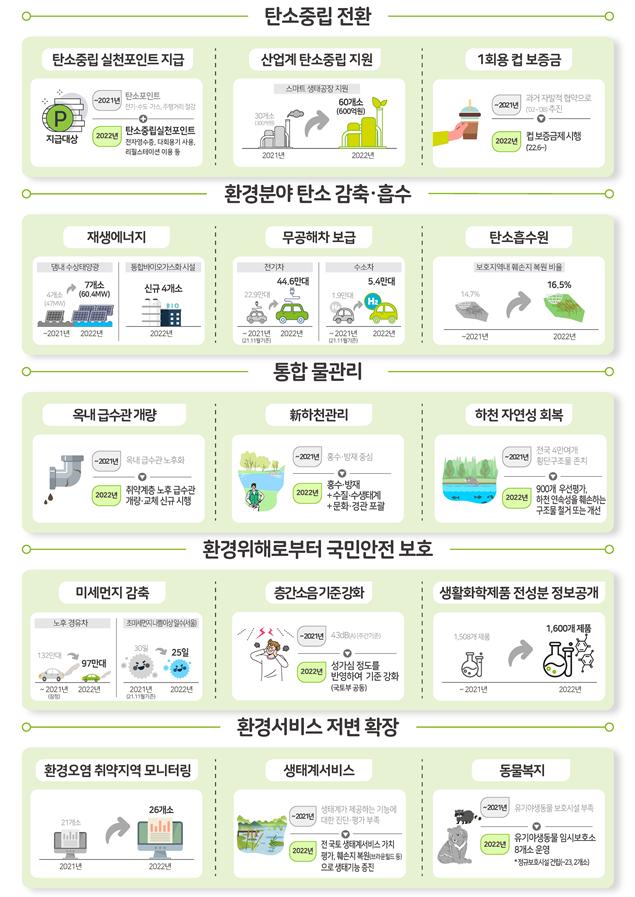
[Sejong=Asia Economy Reporter Ju Sang-don] The Ministry of Environment has decided to comprehensively promote the carbon-neutral transition of social and economic structures through support for carbon-neutral facilities at workplaces, green policy finance interest subsidies for the industrial sector's green transition, and the introduction of the 'Carbon Neutral Practice Points System,' which accumulates points when using electronic receipts and reusable containers and converts them into cash or gift certificates for use.
On the 11th, the Ministry of Environment announced the 'Key Tasks for 2022 Work Plan' containing these details. The Ministry selected three core tasks for this year: ▲Full-scale implementation of carbon neutrality ▲Expansion of integrated water management achievements ▲Expansion of inclusive environmental services, and prepared detailed plans accordingly.
◆Full-scale Implementation of Carbon Neutrality= First, it supports the industrial sector's green transition and fosters promising green companies that lead this effort. It also promotes investment by the financial sector in low-carbon industries and technologies through pilot application of the Korean Green Taxonomy (K-Taxonomy) and expansion of environmental information disclosure targets.
To realize carbon neutrality in daily life, the Carbon Neutral Practice Points System will be introduced, which converts points accumulated through electronic receipts, refill stations (for detergents, shampoos, etc.), reusable container use, and eco-friendly car rentals into cash and gift certificates. Nationwide promotion and campaigns will establish a culture of carbon-neutral living, and carbon-neutral support centers will be designated and operated in 17 metropolitan cities and provinces to strengthen local governments' carbon-neutral capabilities and assist implementation.
Furthermore, to support carbon neutrality through a circular economy, high value-added recycling of waste resources such as transparent PET bottles will be expanded, and waste reduction across all stages of production, distribution, and consumption will be promoted, including the implementation of a deposit system for disposable cups.
From an institutional perspective, the national carbon neutrality and green growth strategy (draft) and basic plan (draft) will be established to achieve '2050 Carbon Neutrality' and the '2030 National Greenhouse Gas Reduction Target (NDC).' The Climate Change Impact Assessment System will be implemented in September this year, and the 'Greenhouse Gas Reduction-Aware Budget System,' which analyzes how budgets and funds affect greenhouse gas reduction and reflects this in their operation, will be piloted this year and officially introduced next year.
Additionally, to obtain renewable energy from latent and avoided environmental resources, the distribution of thermal energy and floating solar power will be expanded, and organic waste resources such as livestock manure, food wastewater, and sewage sludge will be integrated and converted into biogas. To reduce methane, a potent greenhouse gas, gas collection facilities at waste landfills will be operated, and outdated unsanitary landfills (three sites as of 2022) will be reorganized, promoting the implementation of the international methane pledge joined last November.
The Ministry plans to accelerate carbon neutrality in the transportation sector by boldly promoting zero-emission vehicle distribution to open the era of 500,000 cumulative units. To this end, the zero-emission vehicle distribution targets for automobile manufacturers will be raised from 4?10% in 2021 to 8?12% in 2022, and detailed plans for the 'distribution contribution fee' imposed if targets are not met will be prepared to promote supply. Additionally, public sector new vehicles will be mandated to purchase zero-emission vehicles to expand the demand base.
To promote the spread of high-performance and mass-market vehicles, the subsidy ceiling will be adjusted from the existing 60 million KRW to 55 million KRW. Electric chargers (160,000 units cumulative) will be expanded preferentially at major transportation hubs and residential areas using big data, and hydrogen charging stations (310 units cumulative) will be installed nationwide in a balanced manner through proactive administrative support.
◆Expansion of Integrated Water Management Achievements= This year, the Ministry will manage water quality and quantity in real-time throughout the entire process from water intake and purification to supply. It will newly support indoor water pipe improvement and replacement for vulnerable groups (8,214 households in 2022) and promote the integration of water supply businesses to eliminate regional disparities in fees and quality.
To ensure safety from climate and disasters, flood forecasting will be automated using artificial intelligence, flood warning points will be expanded (from 75 in 2021 to 218 in 2025), and a digital twin-based dam-river flood simulation will be introduced to establish a smart flood response system.
Flood response foundations will be strengthened through adjustment and maintenance of flood standards and securing additional flood control capacity. To prevent urban flooding, flood risk map production, previously concentrated in the Four Major Rivers region, will be expanded nationwide. To proactively respond to extreme droughts, drought vulnerability maps will be created using artificial intelligence, and drought overcoming services will be enhanced by adjusting water supply systems in expected shortage areas and expanding emergency linkage supply bases between metropolitan and local waterworks.
◆Expansion of Inclusive Environmental Services= The Ministry plans to significantly reduce fine dust and improve living comfort this year. To stabilize the trend of fine dust concentration improvement, the goal is to reduce emissions by more than 30% by 2024 compared to 2019 through active financial support and technology development in the industrial and power sectors.
In the transportation and daily life sectors, the early scrapping of old diesel vehicles will be expanded from 340,000 units in 2021 to 350,000 units this year, measures to prevent repurchasing diesel vehicles will be prepared, and the distribution of eco-friendly boilers for households (230,000 units in 2021 to 610,000 units in 2022) and the gas heat pump (GHP) heating and cooling system remodeling project (1 billion KRW in 2021 to 4.7 billion KRW in 2022) will be expanded. International cooperation for fine dust response will also be strengthened, including the completion of a joint environmental satellite data utilization platform among 13 Asian countries.
Alongside this, proactive services for environmentally vulnerable areas and groups will be provided, and ecosystem health will be promoted. Using governance and big data, 26 environmentally vulnerable areas will be proactively surveyed in 2022 to prepare environmental improvement plans. Environmental health services will be provided to vulnerable groups through small-scale improvements of children's activity spaces (100 sites such as daycare centers) and environmental diagnosis and facility improvements for vulnerable households (400 sites). For areas at risk of environmental pollution damage, resident health management projects and community healing and regeneration support will be conducted. Regarding humidifier disinfectant damage, additional contributions will be collected from manufacturers, and private mediation support between victims and companies will continue to provide relief.
Additionally, closed or idle brownfields (former Janghang smelter site) will be restored as wildlife sanctuaries and ecological education centers. To manage wildlife diseases, management will be strengthened throughout the entire process of import, distribution, and storage, and animal welfare will be promoted by ending bear breeding and establishing a protection system for abandoned wildlife.
Minister of Environment Han Jeong-ae stated, "Last year, the 2050 carbon neutrality scenario and the upward revision of the 2030 national greenhouse gas reduction target were confirmed, making 2022 a very important year for full-scale implementation. We will take full responsibility to ensure that steps toward carbon neutrality and an eco-friendly society continue without stopping."
© The Asia Business Daily(www.asiae.co.kr). All rights reserved.
![User Who Sold Erroneously Deposited Bitcoins to Repay Debt and Fund Entertainment... What Did the Supreme Court Decide in 2021? [Legal Issue Check]](https://cwcontent.asiae.co.kr/asiaresize/183/2026020910431234020_1770601391.png)