Construction Industry Research Institute Presents Six Key Strategies for Construction Companies
As the era of carbon neutrality begins in earnest, construction companies face unavoidable challenging tasks, and it has been suggested that they must secure core competencies to prepare for this.
On the 10th, the Korea Research Institute for Construction Industry announced through the report "2050 Carbon Neutrality Scenario: Challenges and Tasks for the Construction Industry" that it presented six major strategies for construction companies to respond to the 2050 carbon neutrality scenario and emphasized the urgent need for strategic responses from construction companies.
The response strategies proposed by the institute can be divided into six strategies across three areas: ▲reducing carbon emissions at the individual construction company level, ▲reducing carbon emissions per construction product life cycle, and ▲responding to changes in the construction market due to carbon neutrality.
The strategies for reducing carbon emissions at the individual construction company level include energy savings and expanding the share of renewable energy in buildings/transportation means, as well as energy savings and waste reduction at construction sites. The strategies for reducing carbon emissions per construction product life cycle include expanding the proportion of carbon-reducing material purchases and strengthening the capability to provide solutions for carbon emission reduction construction products.
Finally, the strategies for responding to changes in the construction market due to carbon neutrality are entering new growth markets under a carbon-neutral environment and strategically responding to shrinking markets under a carbon-neutral environment.
Looking at the main sectoral contents of the 2050 carbon neutrality scenario announced by the government, it is judged that the energy transition, industry, buildings, and waste sectors will impact the construction industry.
Construction products have the highest carbon emission share of over 90% at the construction material manufacturing stage in the value chain, while carbon emissions are low at the construction stage, which is the domain of domestic general construction companies, making carbon reduction at the individual construction company level relatively easier compared to construction material manufacturers.
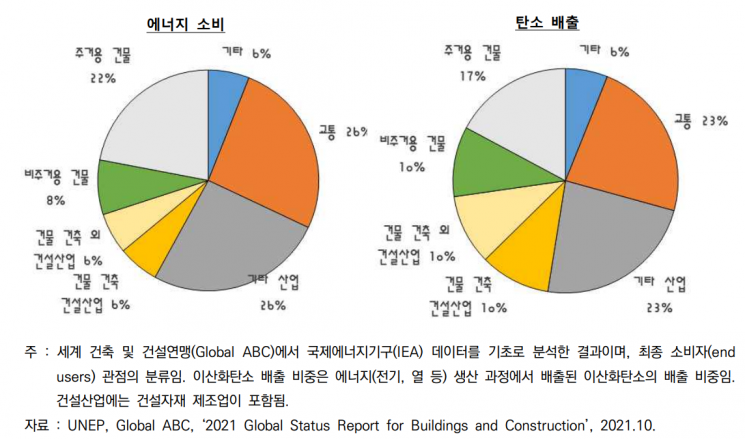
However, from the perspective of the total life cycle of construction products, the construction industry emits 25% of global greenhouse gases and 47% of carbon dioxide in the entire value chain including construction material production processes and building operation sectors, making carbon neutrality a considerably challenging task for construction companies.
Researcher Hong-Il Lee said, "In the mid-to-long term, companies that succeed in establishing and implementing decarbonization strategies from the perspective of the entire value chain and the total life cycle of construction products will secure core competitive advantages in the carbon-neutral era." He added, "Especially, unlike infrastructure facilities, in the case of buildings, the carbon emission share by life cycle exceeds 75% at the operation stage, so the capability to reduce operational carbon will be a key competitive advantage."
He continued, "Since the core competitive advantage factors pointed out in the report are not easy to secure in a short period, they will be important means to secure competitive advantages over other companies under a carbon-neutral environment. As seen in the cases of advanced overseas construction companies pursuing carbon neutrality including indirect greenhouse gas emissions from corporate activities, it is necessary to promote mid-to-long-term decarbonization strategies to become a leading decarbonized company," he added.
Strategic responses to markets expected to grow and shrink according to the carbon neutrality scenario were also pointed out as important parts.
The growing markets are carbon emission reduction construction products such as renewable energy plants and zero-energy buildings due to energy transition. On the other hand, fossil fuel power plants are expected to inevitably shrink.
Carbon reduction construction products include zero-energy buildings, passive houses, long-life buildings and infrastructure, energy-saving infrastructure, and greenhouse gas reduction urban development/transport system construction. In particular, the expansion of targets and upgrading of application grades for zero-energy buildings are expected to accelerate gradually, with market growth anticipated after 2025 when grade application begins for private buildings.
© The Asia Business Daily(www.asiae.co.kr). All rights reserved.

















