Korea Institute of Materials Science Develops Multifunctional Carbon Nanotube Fibers Usable for Both Body and Battery

[Asia Economy Reporter Kim Bong-su] The core components of electric vehicles and drones, which are gaining attention as eco-friendly transportation means in the 21st-century carbon-neutral era, are batteries. However, domestic researchers have developed a basic material that can store electricity directly in the main body without a battery. This technology is noteworthy as it can save costs and resources, leading to weight reduction and increased travel distance.
The Korea Institute of Materials Science (KIMS) announced on the 10th that Dr. Kim Tae-hoon’s research team at the Functional Composite Materials Research Lab of the Composite Materials Research Division, together with Professor Yang Seung-jae’s team at Inha University, succeeded for the first time in the world in developing a 'multifunctional carbon nanotube fiber' that improves the existing high-strength characteristics to store a large amount of electricity.
Currently used energy storage and structural materials mostly possess either high strength or high energy storage capability, but not both. For example, lithium-ion secondary batteries can store electricity but cannot withstand mechanical loads by themselves. On the other hand, iron, aluminum, and conventional single-function carbon nanotube fibers are strong enough to be used as structural materials for car bodies and exteriors but cannot store energy.
The multifunctional carbon nanotube fiber developed by the research team is lightweight and strong enough to be used as material for exteriors and main bodies, while also having excellent electrical conductivity, allowing it to be used as an energy storage device replacing batteries.
The research team produced a high-strength fiber-type supercapacitor by surface-treating carbon nanotube fibers and then growing porous carbon. Through this, they synthesized a new fiber-type material that maintains the strength of carbon nanotube fibers while also providing energy storage properties. The developed fiber-type supercapacitor was confirmed to operate normally even while supporting heavy weights. The thin, thread-like fiber-type supercapacitor was able to support a weight of 10 kg while charging and discharging normally.
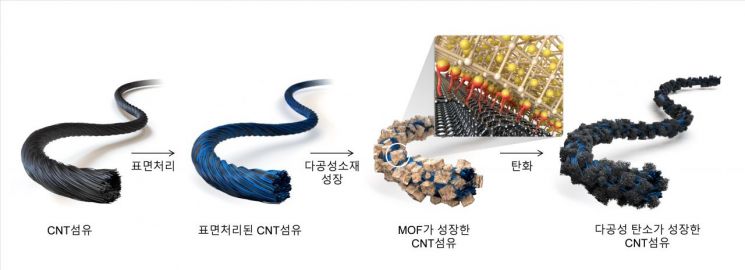 A schematic diagram illustrating the process of manufacturing multifunctional carbon nanotube fibers capable of energy storage using carbon nanotube fibers.
Existing technology required separate materials for batteries and load-bearing structures, but the material developed in this study can replace both with one. This is significant as it presents a new direction for developing lightweight materials. In particular, the multifunctional carbon nanotube fiber technology is expected to be utilized in electric vehicles, drones, and aerospace fields where weight reduction is required. Carbon nanotube fibers are attracting attention as next-generation new materials, and currently, only one company in the United States is applying them to products through mass production. This research outcome is expected to enable import substitution through localization and also allow exports overseas.
Dr. Kim explained, "Applying this to the exterior of vehicles and drones can remove existing batteries, enabling weight reduction and increasing travel distance," adding, "A new material that is lightweight, mechanically strong, and electrically conductive was required, and the only material that met these requirements was carbon nanotube fiber."
He continued, "Using multifunctional carbon nanotube fibers can greatly help improve the driving range of future mobility such as drones," and said, "It is expected to be applicable not only to energy storage materials but also to aerospace, aviation, and defense sectors that require lightweight, high strength, and high conductivity." The research team is conducting follow-up studies to utilize this material in bulletproof and ultra-lightweight composite materials, as well as mass production of CNT fibers and development of CNT fibers for electromagnetic wave shielding.
The research results were published on the 5th in the international journal 'Science Advances.'
© The Asia Business Daily(www.asiae.co.kr). All rights reserved.