
[Asia Economy Reporter Kang Nahum] Naver Whale continues its growth by expanding its usability beyond just a browser to educational platforms and more, based on a user-first strategy and unique web technology. This year, it plans to extend its usability into video conferencing and mobility sectors, moving one step closer to its goal of becoming the "No. 1 browser in Korea."
◆Dominant Position in the Education Market= According to market research firm StatCounter on the 10th, Whale's domestic browser market share rose from 7.57% in October to 8.34% in December last year. In comparison, Chrome's share decreased from 54.77% to 54.23%, and Internet Explorer (IE) dropped from 1.71% to 1.43% during the same period, which is considered a "solid performance."
The increase in Whale browser's market share is attributed to the success of "Whale Space" and the launch of "Whalebook." Whale Space is a platform that provides various web-based educational services on the Whale browser, allowing teachers and students to conveniently use all services with a single Whale account. Teachers can preset the browser interface, linked programs, bookmarks, and more according to the lesson's purpose, enabling students to experience the same learning environment without separate browser settings.
Instead of installing applications on each device, Whale Space allows teachers to organize necessary programs (web solutions), URLs, and more for classes within the platform, which students can access to run programs and check materials.
Naver is expanding Whale Space's usability through agreements with education offices across the country. Last year, it established partnerships with 10 metropolitan and provincial education offices, with 550,000 users across approximately 8,000 schools. Notably, it offers features that allow each education office to freely customize branding. For example, Whale Space is used under the brand name "iTalkTalk" in the Gyeongsangnam-do Office of Education and "Majueon" in Chungcheongnam-do. This is Whale's policy tailored to the characteristics of educational sites.
Whalebook, released in the second half of last year, was jointly developed with LG Electronics to maximize synergy with Whale Space and improve class efficiency. It supports platform accounts based on Whale Space at the educational institution level and can be equipped with various services that meet the demands of the Korean education field.
A Naver official explained, "Through Whalebook, schools can now provide smart education services using smart devices," adding, "It is meaningful that AI can now be actively utilized in our educational environment through the Clova Assistant service pre-installed on Whalebook."
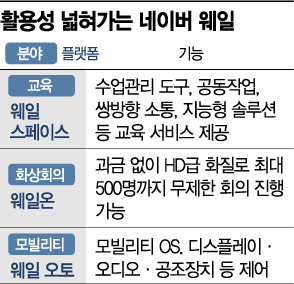
◆Expansion into Business and Mobility= While Whale browser stood out in the education sector last year, it plans to expand usability into video conferencing and mobility fields this year. In particular, as many video conferencing platforms have recently decided to charge fees, "Whale On," which allows video meetings without charges, is attracting industry attention.
Whale On is the world's first video conferencing solution directly embedded in a browser. Anyone can easily start a meeting by clicking the video camera-shaped "Whale On" button located at the top of the Whale browser whenever a meeting is needed. It is available on both PC and mobile, supports HD quality, and can host unlimited meetings with up to 500 participants without additional charges. It could be an efficient alternative for companies and institutions seeking substitutes for "Zoom," which recently introduced paid plans.
Expansion into the mobility sector is also anticipated. The Naver Whale team is developing a vehicle platform called "Whale Auto" (tentative name) in collaboration with the vehicle software development startup "DreamAce." Naver is developing Whale Auto, vehicle apps, and an app store, while DreamAce is setting the OS on the mainboard that operates these and creating a vehicle testing environment.
Whale Auto is structured as containers, where technologies are separately packaged according to functional areas such as display, audio, and air conditioning. Even if an error occurs in one area, it does not interfere with other functions, ensuring safety. Additionally, manufacturers or users can choose to install Whale Auto's functions only in desired areas during the adoption process.
Technical leader Ahn Young-gi of the Naver Whale team explained, "We developed Whale Auto-exclusive apps that can control seats and air conditioning inside vehicles and confirmed successful operation of Whale Auto through experiments in a standardized environment."
However, Whale Auto is still in the experimental stage, and commercialization is expected to take some time. Leader Ahn said, "We plan to conduct various experiments with multiple companies and will do our best to make Whale OS a foundational technology that provides convenience to users across diverse device environments."
© The Asia Business Daily(www.asiae.co.kr). All rights reserved.