December CPI Expected to Rise 7%
US Economists Deeply Concerned Across Factions
Senate Confirmation Hearing on 11th... Market Shock Inevitable if Hawkish Tilt Occurs
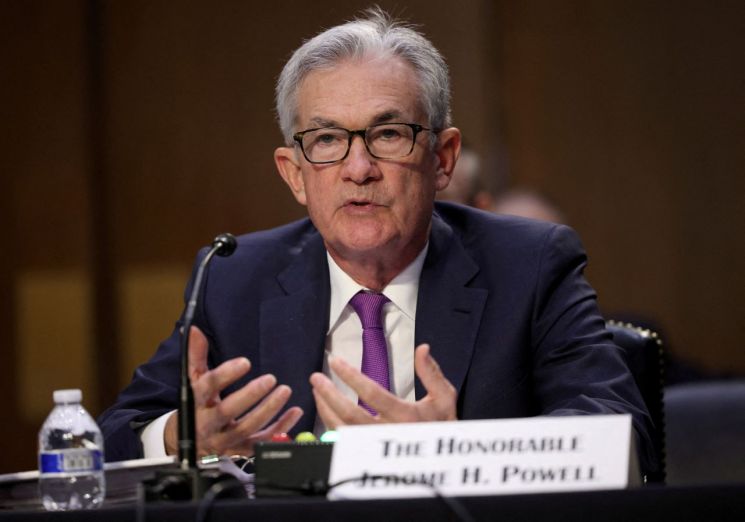
[Asia Economy New York=Special Correspondent Baek Jong-min] Attention is focused on what views Jerome Powell, Chairman of the U.S. Federal Reserve (Fed), will present in response to inflation, which is expected to rise by as much as 7% in the United States.
If Chairman Powell leans more hawkish, it could cause another major upheaval in the global financial markets, which have already plunged due to concerns over early interest rate hikes and quantitative tightening.
According to a Bloomberg survey on the 9th (local time), market experts expect the U.S. Consumer Price Index (CPI) for December last year, to be announced on the 12th, to rise 7% year-on-year. This is a larger increase compared to 6.8% in the previous month. This would be the largest increase since 1982.
Chairman Powell will attend a Senate confirmation hearing on the 11th, one day before the CPI announcement. His remarks will be the first since the release of the minutes of the Federal Open Market Committee (FOMC) regular meeting in December last year, which hinted at a rate hike in March and quantitative tightening within the year.
CNBC predicted that Powell’s confirmation hearing would be a "highlight" to confirm the Fed’s response to inflation.
Experts have already criticized the Fed’s response to the sharp rise in inflation. Economists gathered at the annual meeting of the American Economic Association on the 7th expressed inflation concerns regardless of their progressive or conservative affiliations.
Lawrence Summers, former Treasury Secretary and a Democrat supporter but critical of the Joe Biden administration’s economic policies; Jason Furman, Harvard University professor who has been an absolute supporter of the current administration’s economic policies; and John Taylor, Stanford University professor and a Republican well known for the "Taylor Rule," all emphasized responding to inflation through interest rate hikes.
Professor Furman projected that the core Personal Consumption Expenditures (PCE) price index will rise 3.2% this year, significantly exceeding the Fed’s forecast of a 2.7% increase made last month.
Professor Furman also expressed concern that the three individuals being considered by President Biden for Fed board positions are excessively dovish compared to existing members.
Professor Taylor argued that the Fed is already behind in responding to inflation and that the benchmark interest rate should be between 3% and 6%.
Professor Summers forecasted that Treasury yields will rise further. The U.S. 10-year Treasury yield recorded the 1.8% range last week, showing a record increase within a week. Professor Summers predicted, "Interest rates will rise significantly over the next year and a half." He also said, "It would be surprising if inflation stays at 7%, but it would be surprising if it falls to 2%."
Gregory Mankiw, Harvard University professor famous for "Mankiw’s Economics," expressed concern that although the inflation rise may be due to temporary supply shortages, wage increases are now having an impact.
Alan Blinder, Princeton University professor and former Fed Vice Chairman under the Bill Clinton administration, also said, "It may take time for bottleneck inflation to ease." He criticized the Fed for being slow to recognize inflationary pressures.
Glen Hubbard, Columbia University professor and a Republican, doubted whether the three rate hikes forecast by the Fed this year would ease inflationary pressures, and gave an unusual warning that "the Fed will have to be lucky and smart."
Bloomberg reported that Joseph Stiglitz, Nobel laureate and Columbia University professor, argued that inflation cannot be curbed by rate hikes alone amid supply chain disruptions, but this view remained a minority opinion.
Professors Summers and Stiglitz also engaged in a debate over their differing views on inflation.
© The Asia Business Daily(www.asiae.co.kr). All rights reserved.