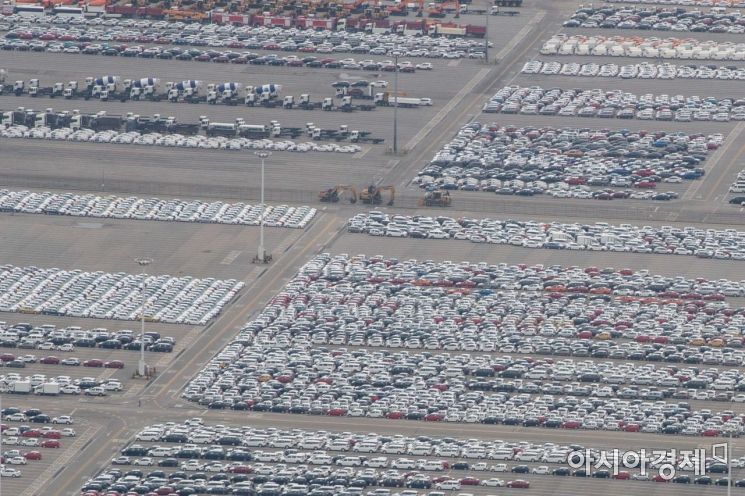
 Export vehicles are waiting to be loaded at Pyeongtaek Port in Gyeonggi Province on the 11th, two days before Chuseok, the largest traditional holiday of the Korean people. (Aerial photography cooperation: Sergeant Lee Yong-gil, Aviation Unit, Seoul Metropolitan Police Agency; Inspector Park Hyung-sik, Northern Gyeonggi Provincial Police Agency) / Photo by Jinhyung Kang aymsdream@
[Asia Economy Reporter Yu Je-hoon] This year, the global automotive industry is expected to face key challenges such as ▲value chain transformation ▲the mainstreaming of electric vehicles ▲China's rise ▲differentiation strategies ▲digital transformation amid a recovery centered on eco-friendly vehicles and ongoing production disruptions caused by semiconductor supply shortages.
The Korea Automotive Technology Institute (KATRI) stated in its report titled "Five Global Automotive Industry Trends to Watch in 2022," published on the 10th, that "the current automotive industry is experiencing complex changes including competition among major countries to secure new growth engines in future vehicles, the influx of new technologies from other industries, and strategic choices for survival by existing players."
According to KATRI, the automotive market this year is predicted to show steady growth centered on eco-friendly vehicles. In fact, the proportion of eco-friendly vehicles in global new car sales surged from 3.9% in 2017 to an estimated 13.5% last year.
On the negative side, the semiconductor supply shortage is expected to continue impacting the industry. KATRI noted, "The vehicle semiconductor shortage that began at the end of 2020 delayed timely vehicle production, dampening market recovery, and causing vehicle shortages and price increases in various markets."
KATRI also forecasts significant changes in the 'value chain' within the automotive industry this year. Countries are implementing industrial policies prioritizing domestic production to secure the eco-friendly vehicle industry, and disputes related to the supply of key raw materials and energy are intensifying, signaling potential crises.
For example, the United States is promoting additional tax benefits for eco-friendly vehicles produced at unionized assembly plants within the region. China has raised the foreign ownership limit of foreign automakers to 100% to prevent foreign companies from exiting Chinese supply chains and to establish a China-centered global value chain. Regarding raw materials and energy, China is controlling exports of raw materials related to electric vehicles, and Russia has halted natural gas supplies to Europe, exacerbating the energy crisis there.
KATRI expressed concerns that Korea could be exposed to various risks in this environment. "Considering tax benefits granted only to regionally produced goods and carbon emission costs, automakers cannot avoid considering joint entry with high value-added parts suppliers and advanced countries, which implies weakening of the domestic parts production base," KATRI said. "This year, supply issues related to urea solution, vehicle semiconductors, lithium-ion battery raw materials, and supply chain issues due to the energy crisis in Europe may arise."
The 'mainstreaming of electric vehicles' was also identified as a major trend this year. With global eco-friendly vehicle sales expected to exceed 10 million units last year, major automakers and startups, led by Tesla, are actively entering the electric vehicle industry.
KATRI stated, "Major automakers are focusing on producing and selling new models using electric vehicle-dedicated platforms, and as countries like China continue to maintain purchase subsidies this year, sales growth is expected to continue." However, "various voices regarding the eco-friendliness of electric vehicles are likely to emerge, so the rate of adoption will be influenced by the response strategies of governments and industries worldwide."
China's brand advancement is another noteworthy point. Since 2017, annual sales in the Chinese market have hovered around 20 million units, and due to overinvestment, production capacity has significantly increased, providing ample motivation to turn to exports. In fact, from January to November last year, China's cumulative finished vehicle exports nearly doubled year-on-year to approximately 1.79 million units.
Chinese brands are expected to challenge export markets through independent overseas expansion or collaboration with well-known brands. Currently, Chinese brands are knocking on the global market's door through foreign brands like MG and joint venture brands like Polestar.
There is particularly high potential for progress in the electric vehicle sector. Some brands such as Nio and Xiaopeng have already entered Western European markets with competitively priced and highly marketable lithium iron phosphate (LFP) battery-based vehicles. The industry expects China to expand its low-cost electric vehicle lineup, including ultra-compact electric vehicles, considering low incomes in emerging markets.
KATRI said, "Although the share of Chinese brands in global sales will remain low this year, some companies are expected to rapidly improve their brand image by gaining recognition for their product competitiveness." It added, "China's ultimate goal is to expand its share in the global automotive value chain by gaining recognition as a future vehicle hub based on enhanced reputation through exports."
Additionally, KATRI identified differentiation and digital transformation as key trends in the automotive industry this year. As companies face difficulties differentiating products during this technological transformation period, differentiation is expected to focus on user interfaces, user experiences, and services covering pre- and post-purchase stages. Furthermore, digital transformation, including non-face-to-face vehicle sales, management, and after-sales service (A/S) expansion based on online-to-offline (O2O) platforms, is expected to spread throughout the automotive industry.
© The Asia Business Daily(www.asiae.co.kr). All rights reserved.