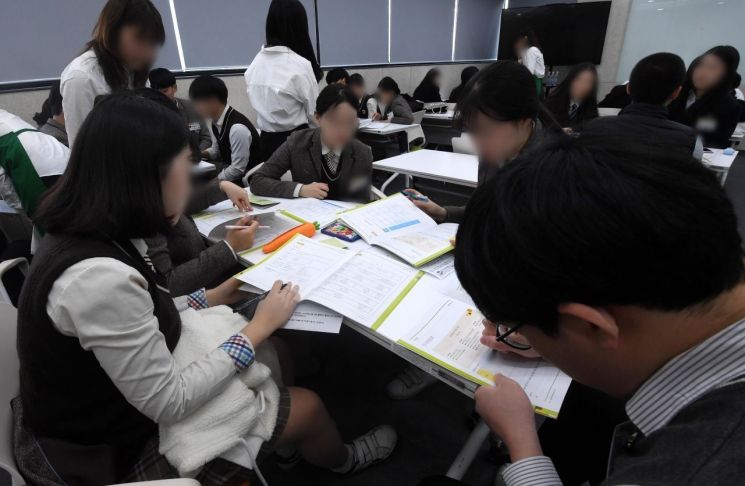
 At a specialized high school job fair held in 2018 in Yongsan-gu, Seoul, students are learning job application tips such as how to write a resume. This photo is not related to the article content. Photo by Kim Hyun-min kimhyun81@
[Asia Economy Reporters Minjae Kwak and Youngwon Kim] Seo Mo (17), a second-year student at a specialized high school in Jeonnam, is recently considering university admission instead of employment. This is because the number of jobs has decreased due to COVID-19, causing fear about finding employment. Among the 200 third-year graduates at this school this year, only 60 have found jobs. Changing career paths is not easy either. Specialized high schools have about half the number of basic subject hours (Korean, English, Math) compared to general high schools, which puts them at a disadvantage in university admissions. Seo’s mind is complicated, thinking that a decision must be made before becoming a third-year student.
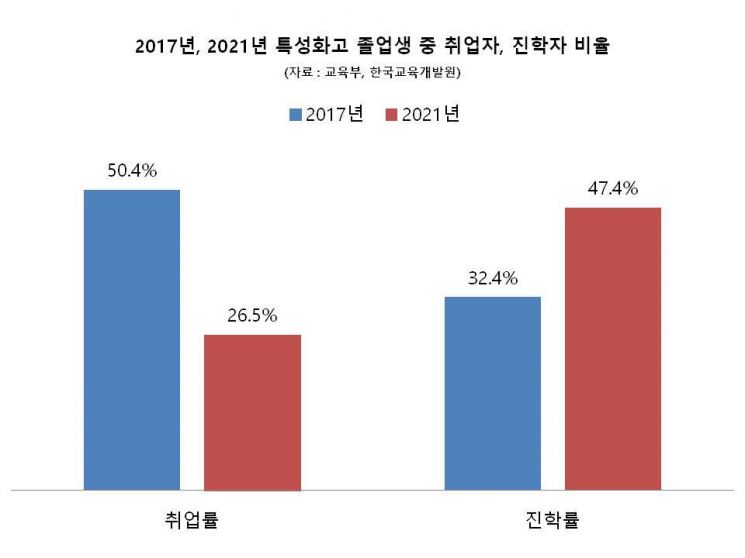
◆Employment ↓ University Admission ↑... Specialized High Schools Losing Their Way= Specialized high schools are losing their way. They were established to train personnel capable of employment without going to university through vocational education. Currently, there are 488 specialized high schools nationwide. However, as employment has become difficult due to COVID-19 and inadequate vocational education, more students are choosing university admission. This undermines the original purpose. According to data compiled from the Ministry of Education and the Korea Educational Development Institute, the employment rate among specialized high school graduates last year was 26.5%, about half of what it was five years ago (50.4%). During the same period, the university admission rate increased from 32.4% to 47.4%.
This change is influenced by the 'COVID-19 employment crisis.' As field training was conducted only through non-face-to-face classes, students found it difficult to acquire sufficient practical skills. Shin Mo (19), a graduate of a specialized high school in Incheon, said, "In the second year, field training was conducted online for a year. Practical training is easier to understand when done hands-on with explanations, but listening only to online classes made it hard to concentrate and understand." The service industry jobs, where these students mainly find employment, have also decreased. Kim Daeyu, deputy director of the Korea Education Research Institute, said, "Due to COVID-19, both training opportunities and service industry jobs have decreased, leading students to consider university admission instead of employment."
Another problem is the lack of employment support for specialized high schools compared to Meister high schools. The training environment is relatively poor, and there are differences in equipment support. Shin said, "When I attended a specialized high school, we had to use equipment that was decades old," expressing regret, "I heard that friends who graduated from Meister high schools receive quality education funded by large companies and study with the latest equipment." Last year, the employment rate of Meister high school graduates was about 2.4 times higher than that of specialized high school graduates.
◆Forced University Entrance Exam Also a 'Difficult Path'= Students who suddenly change their career paths due to employment difficulties experience confusion in university entrance exams. Most specialized high schools share the common feature that few freshmen hope to enter university, but the number of students aiming for university increases by the third year. Choi Seohyun, chairperson of the National Specialized High School Labor Union, explained, "Originally, by the second semester, most third-year students would have succeeded in employment, leaving classrooms empty, which was natural. Now, many students hurriedly submit university applications out of fear of becoming unemployed until the day before the application deadline."
From the university’s perspective, they inevitably prefer general high school students who study basic subjects until the third year in comprehensive student record screening. Kim Mo (18), a graduate of a specialized high school in Gyeonggi Province, said, "Specialized high schools have fewer hours for basic subjects due to major subjects and practical training, so when calculating grades, the scores are about 1 to 2 points lower than the original grades. Also, specialized high school students can only apply to departments related to their major, making career changes difficult."
◆Preserving the Purpose of Specialized High Schools... "The Essence is Jobs"= There are calls for expanding high school graduate jobs, such as a 'high school graduate quota system,' to operate specialized high schools according to their founding purpose. Choi Seohyun, chairperson of the Specialized High School Labor Union, said, "To enable people to earn money and live without going to university, quality jobs for high school graduates must be guaranteed. High school graduate jobs should be increased from public institutions and public enterprises to large corporations." The Ministry of Education recognizes that students face difficulties in both employment and university admission due to COVID-19 and is working to prepare various policy measures. A Ministry of Education official said, "We will strengthen guidance and education at the ministry level so that specialized high school teachers can provide better entrance exam counseling, and we plan to expand high school graduate jobs from public institutions to private companies."
© The Asia Business Daily(www.asiae.co.kr). All rights reserved.

![User Who Sold Erroneously Deposited Bitcoins to Repay Debt and Fund Entertainment... What Did the Supreme Court Decide in 2021? [Legal Issue Check]](https://cwcontent.asiae.co.kr/asiaresize/183/2026020910431234020_1770601391.png)















