Worried About Immediate Principal Repayment if Business Closes
Additional Loans Difficult, So Register Home as Business Location
Maintaining Business Number Enables Government Support
Bank Sector: "No Way to Know, Risk of Default May Increase"
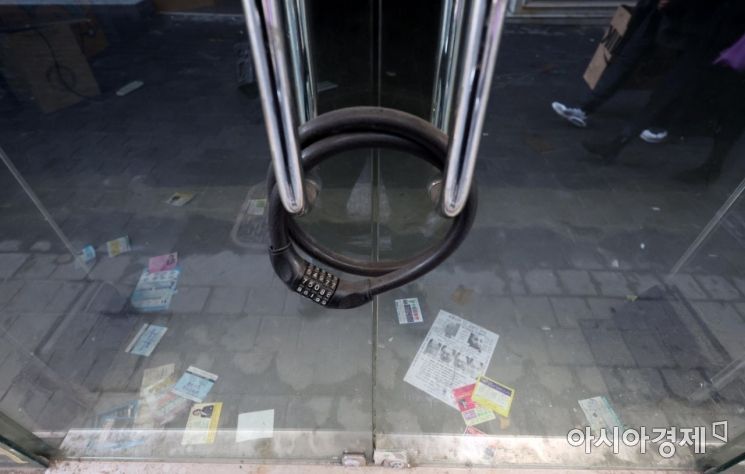 Earlier this year, the shops on Myeongdong Street in Seoul were firmly closed due to business closures, and the interiors were empty. Photo by Hyunmin Kim kimhyun81@
Kim Sang-cheon (35, pseudonym), who runs a restaurant in Seocho-gu, Seoul, borrowed 30 million won last August through a business loan product from a commercial bank. Later, due to the worsening economy, he planned to close his business in mid-January but postponed the decision after hearing that the principal would be collected. Instead, he changed his business type to 'telecommunication sales,' registered his home as the business location, and disguised himself as an online shopping mall operator. Although he became a ghost small business owner with zero VAT and zero income, Kim lamented that the principal and interest burden was too heavy to obtain new loans, saying "I had no choice."
Recently, among self-employed individuals, it has become a trend to change the business type and register the home as the business location after closure. This is to prevent loan collection when business suspension is inevitable. There are criticisms that financial support policies were grossly insufficient for the survival of small business owners, and concerns have been raised that financial institutions are finding it difficult to manage loan risks.
On the 6th, dozens of posts asking "Do I have to repay the loan in full upon business closure?" were posted within the past month on a self-employed community used by over one million people. Most posts disclosed the financial products and amounts they used and asked how to handle the situation. The more frequent the history of principal and interest delinquency and the shorter the loan maturity, the more they seemed worried about repayment pressure.
One user, who revealed they run a business in the metropolitan area, posted, "I have about 17 million won in personal business loans, but I might have to repay it all at once due to business closure," and asked, "It's difficult to borrow more money from my main bank; what should I do?" In response, advice appeared saying, "Register your residence as the business location and maintain your business registration number," adding, "Banks usually do not verify the actual business operation, so there is little worry about being caught."
"If you close your business, you can't receive government support... I have no choice"
Typically, business and small business loans must be repaid immediately to the bank upon business closure. A financial industry official explained, "These loans were not granted based on the store itself," and added, "If the business owner status disappears due to closure, the collection process begins." The Korea Credit Guarantee Fund announced that until March this year, loans guaranteed by them would not require immediate repayment, but even this requires institutional review.
Until now, self-employed individuals have been using general loans or secondary financial institution loans to roll over principal and interest when asked for lump-sum repayment upon closure. However, many self-employed people say that additional loans have become difficult and interest burdens have increased, making it challenging. Also, government and financial authority support, which is only available during business operation, stops, and since loss compensation policies and debt relief plans promised by presidential candidates may be delayed, a "let's hold on" mentality seems to be at work.
Within the banking sector, concerns are also emerging about the deterioration of loan assets extended to small business owners and the self-employed. A commercial bank official said, "We ask by phone whether there is an intention to resume business upon closure," but admitted, "If they change the business type and continue operations to avoid repayment, honestly, financial institutions have no way of knowing."
© The Asia Business Daily(www.asiae.co.kr). All rights reserved.

![User Who Sold Erroneously Deposited Bitcoins to Repay Debt and Fund Entertainment... What Did the Supreme Court Decide in 2021? [Legal Issue Check]](https://cwcontent.asiae.co.kr/asiaresize/183/2026020910431234020_1770601391.png)














