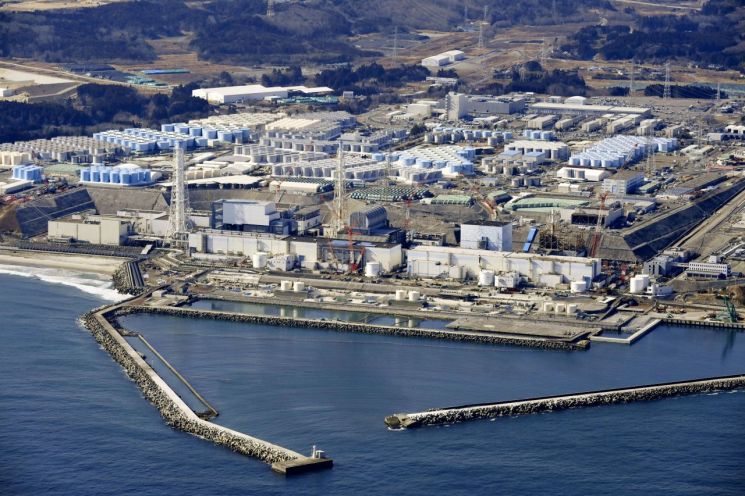
[Asia Economy Reporter Kwon Jae-hee] Tokyo Electric Power Company (TEPCO), which announced plans to discharge Fukushima contaminated water by constructing an undersea tunnel, is reported to have determined that there is no problem with the ground strength at the planned tunnel construction site.
According to the Yomiuri Shimbun on the 4th, TEPCO, the operator of Japan's Fukushima Daiichi Nuclear Power Plant, conducted a 'boring' survey using a trial excavation method in the sea in front of the No. 1 plant, the planned tunnel construction site, from the 14th to the 24th of last month.
The areas surveyed by TEPCO were three points at 400m, 700m, and 1km, where holes were drilled from a floating work platform into the seabed to check ground strength and collect samples.
TEPCO stated, "We confirmed the strength level necessary for tunnel construction," and added, "We will conduct a detailed analysis of the collected geological samples and review the detailed design and construction methods of the tunnel."
Accordingly, the possibility has increased that the tunnel construction work for discharging contaminated water, targeted for next spring, will proceed as planned despite opposition from local residents and neighboring countries such as Korea.
At Units 1 to 4 of the Fukushima Daiichi Nuclear Power Plant, which experienced an accident due to cooling system failure during the Great East Japan Earthquake in March 2011, contaminated water containing high concentrations of radioactive materials is being generated as rainwater, groundwater, and cooling water come into contact with the reactors.
The total amount of contaminated water generated so far is known to be close to 1.3 million tons.
The Japanese government decided last April to discharge the purified contaminated water treated by the Advanced Liquid Processing System (ALPS) into the ocean (Pacific Ocean) starting next spring, citing the need for workspace to accelerate the decommissioning of the accident-affected nuclear plant.
However, even though the contaminated water is purified, current technology cannot completely remove the radioactive substance tritium, causing significant opposition from local residents who rely on fisheries as well as neighboring countries such as Korea and China.
In response, the Japanese government and TEPCO argue that there is no problem if the tritium-containing contaminated water is diluted with water.
TEPCO plans to reduce the tritium contamination concentration to less than 1,500 becquerels (Bq) per liter, about one-seventh of the World Health Organization (WHO) drinking water standard, and discharge it through the undersea tunnel.
This tunnel is planned to be constructed starting near Units 5 and 6, located slightly north of the site of the explosion accident at Units 1 to 4, with the outlet placed about 1 km offshore where no fishing rights are established.
TEPCO applied to the Nuclear Regulation Authority, the supervisory body, on the 21st of last month, requesting approval for the plan to discharge contaminated water through the tunnel.
The tunnel construction is expected to begin as soon as approval is granted by the Nuclear Regulation Authority.
© The Asia Business Daily(www.asiae.co.kr). All rights reserved.