Implementation of the Alternative Education Institution Registration System 'Alternative Education Institution Act' on the 13th
School buildings and land must be owned or leased
Operation committee can review parent expenses and meals
Encouraging unlicensed educational institutions to register as alternative education institutions
[Asia Economy Reporter Han Jinju] The Ministry of Education has refined the requirements for school sites, school buildings, and teacher qualifications related to the registration of alternative education institutions as it prepares to implement the 'Alternative Education Institution Registration System,' which incorporates unlicensed educational institutions, previously outside regulatory oversight, into the formal system.
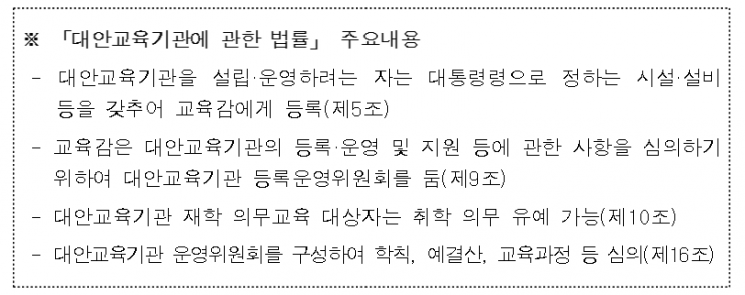
On the 4th, the Ministry of Education reviewed and approved the enforcement ordinance for the Alternative Education Institutions Act at the Cabinet meeting. The ordinance specifies detailed standards for facility and equipment registration and the registration process for alternative education institutions under the Alternative Education Institutions Act, which will take effect on the 13th. The enforcement ordinance applies from the date the law is enforced.
To register as an alternative education institution, the school must secure a school building area standard according to the number of students per course, as well as appropriate school buildings, school sites, and teaching materials suitable for instruction and learning. The school building and school site must be either directly owned or leased.
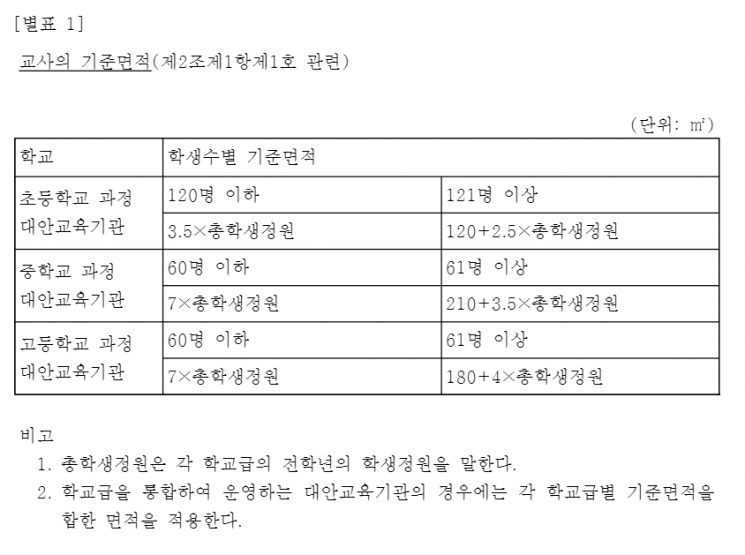
The required school building area varies by school level. For elementary-level alternative education institutions with 120 or fewer students, multiply the total student capacity by 3.5; if 121 or more, multiply the total student capacity by 2.5 and then add 120. For example, 120 students require 420㎡, and 121 students require 422.5㎡.
For middle school-level alternative education institutions with 60 or fewer students, multiply the total student capacity by 7; if 61 or more, multiply the total student capacity by 3.5 and then add 210. For high school-level alternative education institutions, the standard area is the same as middle school for 60 or fewer students; if 61 or more, multiply the student capacity by 4 and then add 180.
However, considering educational diversity, the superintendent of education may relax the school building area standards within a range that does not interfere with education, after deliberation by the Alternative Education Institution Registration and Operation Committee. If the superintendent, after committee review, deems the decision inappropriate, registration will not be possible.
The Alternative Education Institution Registration and Operation Committee consists of the superintendent of education, public officials from related local governments, and persons appointed by the superintendent. The term is two years, with one possible renewal.
To register as an alternative education institution, documents must be attached detailing the establishment date, student capacity, facility and equipment status, and ownership status. Additionally, information on purpose and name, location, educational goals, school regulations, expense and maintenance methods, curriculum operation plan, and staff deployment plan must be included.
Once registered, the metropolitan or provincial superintendent of education manages the student roster submitted by the institution, which includes students' names, dates of birth, addresses, and guardians' names, addresses, and contact information.
An official from the Ministry of Education stated, "The manual related to the enforcement ordinance is in its final stages, and we plan to encourage most unlicensed educational facilities to register through regional briefings, training, and consulting."
The enforcement ordinance also stipulates the composition and operation of the Alternative Education Institution Operation Committee. The committee consists of 5 to 12 members, including the chairperson, with parent representatives and teacher representatives. It can deliberate on matters such as parent expenses, educational activities during vacations, meal services, school regulations, budget and settlement, curriculum operation methods, tuition, and admission fees.
The teacher qualification requirements for alternative education institutions have also been clarified. Eligible individuals include those who have obtained an associate degree or higher in the relevant educational field and have at least two years of practical experience in that field, or those with four or more years of practical experience in the relevant field. Additionally, persons recognized by the head of the alternative education institution after review by the operation committee or those meeting qualification conditions prescribed and announced by the superintendent of education are also eligible.
Deputy Prime Minister and Minister of Education Yoo Eun-hye emphasized, "With the enforcement ordinance, unlicensed educational facilities, which have had unstable legal status, can be registered as alternative education institutions, ensuring student safety and educational quality while diversifying educational opportunities. We will work closely with metropolitan and provincial offices of education to ensure the Alternative Education Institution Registration System is firmly established in the educational field."
© The Asia Business Daily(www.asiae.co.kr). All rights reserved.


















