[Asia Economy Reporter Kiho Sung] The bill to introduce the labor director system, which allows worker representatives to participate in the boards of public institutions, is highly likely to be passed by bipartisan agreement in the National Assembly early next year. With presidential candidates from both ruling and opposition parties expressing support for the introduction of the labor director system ahead of this year's presidential election, momentum is rapidly building. The financial sector is closely monitoring the progress of the related bill. Discussions on introducing the union-recommended director system, a preliminary stage of the labor director system, are already underway mainly at state-run banks, and if the bill passes and is introduced to private companies, the financial sector is expected to be the first target.
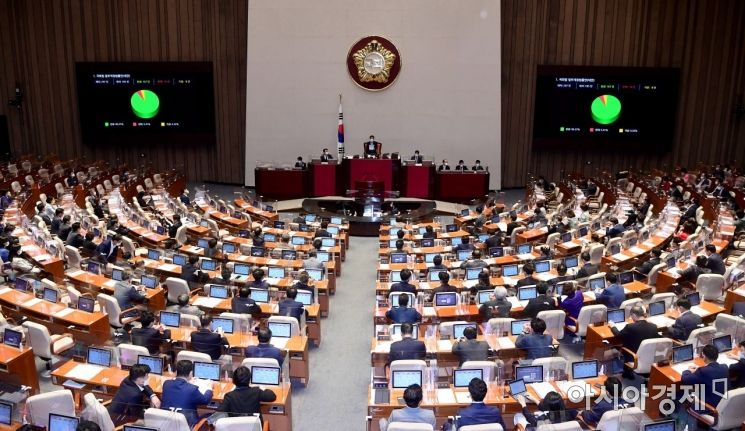
According to political circles on the 2nd, the National Assembly's Planning and Finance Committee held a subcommittee meeting on the afternoon of the 31st of last month to begin discussions on the Amendment to the Act on the Management of Public Institutions (Public Institution Management Act), which includes provisions requiring that among the standing directors of public institutions, those recommended by labor unions be included. The subcommittee is a system where a committee composed of an equal number of ruling and opposition members deliberates on bills with political disagreements for up to 90 days.
The Public Institution Management Act discussions are accelerating as candidates from both ruling and opposition parties have expressed support ahead of this year's presidential election. Lee Jae-myung, a member of the Democratic Party of Korea, promised to process the labor director system during his visit to the Korean Confederation of Trade Unions last November. The People Power Party, which had previously opposed the system, saw a turnaround when presidential candidate Yoon Seok-youl visited the Korean Confederation of Trade Unions in December and expressed support for introducing the labor director system in the public sector. At that time, it was reported that Yoon explained to the Korean Confederation of Trade Unions that the People Power Party had also decided to positively accept the introduction of the labor director system in the public sector at the party level.
If this bill passes, labor directors will be appointed in quasi-governmental institutions such as the Korea Asset Management Corporation, the Deposit Insurance Corporation, the Korea Housing Finance Corporation, the Korea Credit Guarantee Fund, and the Korea Inclusive Finance Agency. Additionally, discussions on the union-recommended director system are underway mainly at state-run banks. The Export-Import Bank of Korea, IBK Industrial Bank of Korea, and KDB Industrial Bank are among the targets, and demands for introducing the union-recommended director system may also increase at the Korea Development Bank.
If labor directors or union-recommended directors appear in financial public enterprises and state-run banks, the system could spread to private financial companies. The KB Financial Group labor union has been advocating for the union-recommended director system annually since 2017. Furthermore, Woori Financial Group, which recently succeeded in privatization, may also push for the introduction of this system as its employee stock ownership association is the largest shareholder.
The management side is unable to hide its concerns, as labor-management conflicts could extend to the board of directors. A financial sector official said, "There are certainly advantages to the labor director system and the union-recommended director system," but added, "However, since it could hinder swift decision-making, careful discussion is essential."
The business community is also anxiously awaiting developments. There are concerns that if the labor director system is introduced in the public sector, pressure to introduce it in private companies will increase. Sohn Kyung-shik, chairman of the Korea Employers Federation, cited the full application of the Labor Standards Act to workplaces with fewer than five employees, currently under discussion in political circles, along with the introduction of the labor director system in the public sector, as risk factors for the corporate environment in 2022 in his New Year's address.
He urged, "The new year urgently requires policies to enhance national competitiveness and revive economic dynamism," and added, "I sincerely hope that presidential candidates will focus on preparing policy pledges to create an environment where ‘free economic activities and entrepreneurial spirit are respected.’"
© The Asia Business Daily(www.asiae.co.kr). All rights reserved.

















