KOSPI Closed at 2977.65 the Previous Day
Plunged from 1st to 18th Last Year
Lowest After China and Brazil
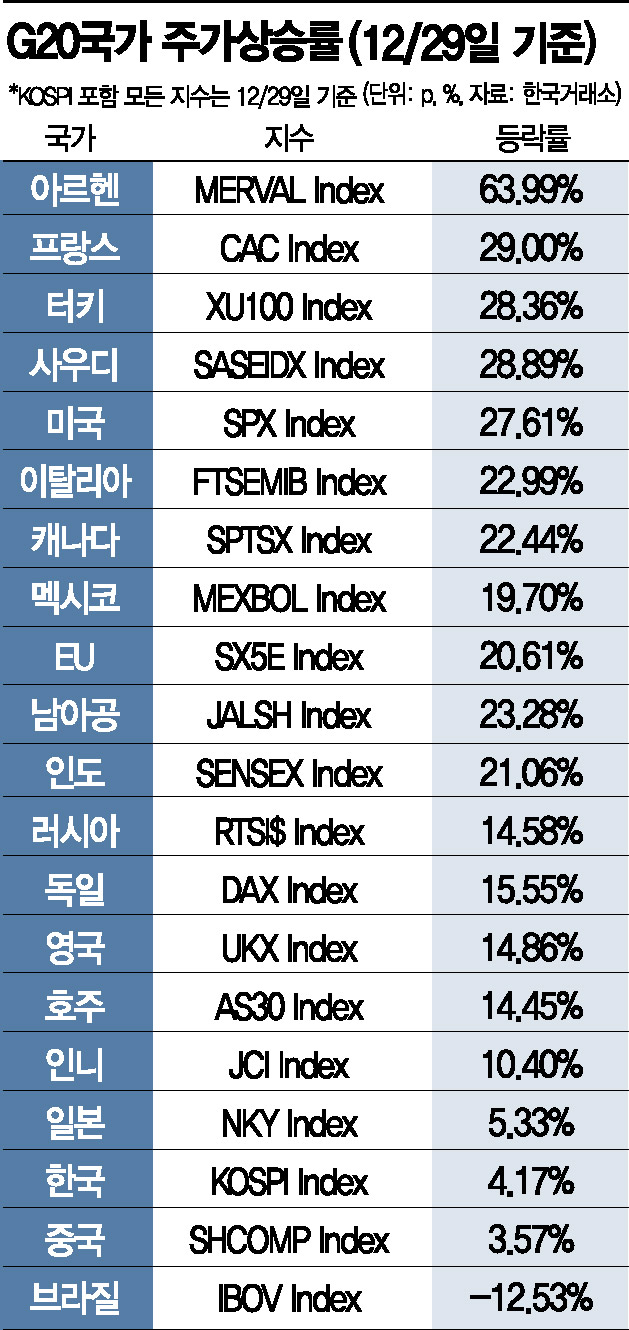
[Asia Economy Reporter Song Hwajeong] The KOSPI ended the year without recovering the 3000-point mark. Among the Group of Twenty (G20) countries, its stock return ranking fell from first place last year to near the bottom.
According to the Korea Exchange on the 31st, the KOSPI closed at 2977.65 the previous day, finishing the year without regaining the 3000 level.
It rose 3.63% compared to the end of last year, continuing an upward trend for three consecutive years, but this was far below last year's 30.75% increase. This sluggish performance was clearly evident when compared to global stock markets. The KOSPI, which recorded the highest return among G20 countries last year, dropped sharply to 18th place this year. As of the 29th, the KOSPI's increase rate was 4.17%, ranking 18th among G20 countries. Only China, which rose 3.57%, and Brazil, which fell 12.53%, lagged behind South Korea, placing it near the bottom.
Argentina showed the highest increase rate at 63.99%, and the United States rose 27.61%, ranking 5th. Japan increased by 5.33%, ranking 17th. Emerging market stock indices were generally sluggish, but the KOSPI recorded a higher return than the Morgan Stanley Capital International (MSCI) Asia index, which fell by 7.4%. In December, led by the semiconductor sector, it rebounded and ranked 6th among G20 countries.
An official from the Korea Exchange analyzed, "Due to the expansion of vaccine distribution and the resumption of global economic activities, the market showed an upward trend until the first half of the year. However, since July, concerns over a slowdown in the semiconductor industry, persistent inflation, the implementation of tapering (asset purchase reduction), and the emergence of COVID-19 variants led to a correction phase," adding, "In December, the market rebounded mainly due to semiconductor stocks."
The KOSPI market capitalization closed at 2,203 trillion won, an 11.3% increase from 1,980 trillion won at the end of last year.
Individual investors net purchased a record 66 trillion won this year, while foreigners and institutions sold 26 trillion won and 39 trillion won respectively, marking two consecutive years of net selling. Although individuals made the largest net purchases ever this year, their share of trading slightly decreased compared to the previous year. The proportion of individual investors in buying transactions fell from 66.55% last year to 63.8% this year, and their share in selling transactions dropped from 64.98% to 62.08%. The average daily trading value increased by 26.2%, from 12.2 trillion won last year to 15.4 trillion won this year. The average daily trading value per month remained above 15 trillion won in the first half of the year but declined in the second half due to sluggish stock market conditions.
The KOSDAQ closed at 1033.98, up 6.8% compared to the end of the previous year. Its market capitalization closed at 446.3 trillion won, a 15.7% increase.
© The Asia Business Daily(www.asiae.co.kr). All rights reserved.

















