The semiconductor market is experiencing a boom due to accelerated digital transformation caused by COVID-19. Semiconductors are broadly divided into memory and non-memory types. Memory semiconductors store data, while non-memory semiconductors, also called system semiconductors, perform information processing functions such as computation and control. Among these, system semiconductors are gaining attention due to the acceleration of the 4th industrial revolution fields such as artificial intelligence (AI), autonomous driving, and the Internet of Things (IoT). According to the Export-Import Bank of Korea, the system semiconductor market is growing at an average annual rate of 7.6% and is expected to reach $338.9 billion by 2025. However, Korea's global market share in system semiconductors remains modest at 3.2% as of 2019, unlike its world-leading position in memory semiconductors. Nevertheless, there are companies achieving results in this area. Asia Economy analyzes the business status and growth potential of domestic system semiconductor companies ‘Above Semiconductor’ and ‘Pixelplus.’
[Asia Economy Reporter Jang Hyowon] Above Semiconductor, which designs microcontroller unit (MCU) system semiconductors, is gaining attention. The utilization of MCUs is increasing as the 4th industrial revolution advances with AI, IoT, and other technologies. Above Semiconductor is strengthening its foundation by investing in semiconductor intellectual property (IP) development companies while also expanding its scope by acquiring back-end process companies.
Increased MCU Demand Due to AI and IoT Development
Above Semiconductor is a fabless company that designs and produces system semiconductors such as MCUs. MCUs are semiconductor chips that act as the brain of home appliances and electrical products and are essential components applied to at least one in every electrical and electronic device.
Above Semiconductor’s main revenue comes from the home appliance MCU sector. CEO Choi Won, who previously worked in the MCU division of Geumseong (LG) Semiconductor, focused on the home appliance MCU design market from the company’s inception. As of the end of the third quarter last year, the home appliance sector accounted for 51% of sales. This was followed by mobile solutions (19%), remote controls (11%), and power solutions (9%).
Major customers include domestic home appliance companies such as Samsung Electronics, LG Electronics, Winia, and Winix, as well as Chinese companies Xiaomi and Lenovo, and firms from Japan, Europe, and the United States. Domestic sales account for 58.9% of total revenue, while exports make up 41.1%.
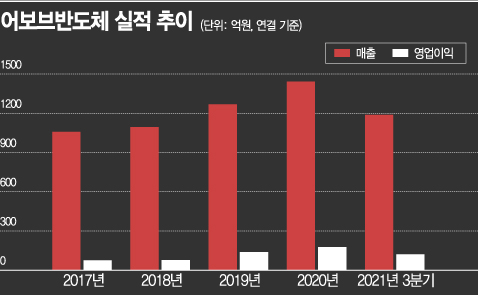
Above Semiconductor’s sales have been on the rise. Consolidated sales recorded 103.2 billion KRW in 2016 and increased to 144.2 billion KRW in 2020. In the third quarter of last year, cumulative sales reached 118.8 billion KRW, a 12.6% increase compared to the same period the previous year. The rise in demand for MCU products in IoT-based white goods, kitchen appliances, and smart home appliances is believed to have contributed to the sales growth.
However, operating profit and net profit decreased by 26.9% and 37.2%, respectively, because the cost of goods sold increased more than the sales growth. During the same period, the cost of goods sold rose by 24.3%. To reduce costs, Above Semiconductor is working to secure in-house production lines for probe testing and final testing.
Looking ahead, Above Semiconductor is considered a company with high growth potential as the system semiconductor market expands with the development of AI, IoT, and electric vehicles. Recently, it entered the automotive market by launching a rapid charging MCU for vehicles. Currently, Above Semiconductor is developing technologies such as wireless charging system-on-chip (SoC), lightweight AI SoC, and SoCs for proximity and ultrasonic sensors to strengthen its competitiveness in AI semiconductor products.
Yang Kibo, a specialist at Korea Enterprise Data, analyzed, "The smartification of the entire industry and the government’s efforts to create a win-win ecosystem for fabless and foundry companies will promote market growth. Above Semiconductor has secured competitiveness by developing AI semiconductor-related SoCs and automotive power semiconductor products."
Securing Growth Engines Through M&A
Above Semiconductor is also active in investing in promising companies and mergers and acquisitions (M&A). As of the end of the third quarter last year, Above Semiconductor had invested in nine companies including Finechips, Davinchips, Autosilicon, Gwanak Analog Technology, and Skychips. These companies develop IP for semiconductor manufacturing and collaborate with Above Semiconductor.
Recently, Above Semiconductor acquired Winpack, a KOSDAQ-listed company. In December last year, Above Semiconductor purchased 6,153,849 shares (14.34%) of Winpack from the existing largest shareholder TLI and two others at 3,900 KRW per share, totaling 24 billion KRW. Along with this, it conducted a paid-in capital increase worth 15 billion KRW, investing a total of 39 billion KRW to secure a 25.99% stake in Winpack. Above Semiconductor held approximately 50.4 billion KRW in cash assets as of the end of the third quarter last year, allowing the acquisition to proceed smoothly.
Winpack is a back-end process specialist company that simultaneously conducts semiconductor packaging and testing. While the companies Above Semiconductor previously invested in were IP developers related to its core business, Winpack represents a new business area. Through Winpack, Above Semiconductor can outsource semiconductor back-end processes, which is expected to create synergy.
Going forward, Above Semiconductor’s challenges include improving Winpack’s performance and diversifying its client base. Winpack’s sales to SK Hynix account for 58%, making its performance heavily dependent on SK Hynix’s orders. Additionally, as of the end of the third quarter last year, Winpack recorded an operating loss of 6.5 billion KRW, turning to a deficit compared to the same period the previous year.
© The Asia Business Daily(www.asiae.co.kr). All rights reserved.

















