Partial Slot Return by Integrated Airlines, Redistribution of Traffic Rights
Concerns Over Strengthening Foreign Airlines' Operational Competitiveness in Allocation Process
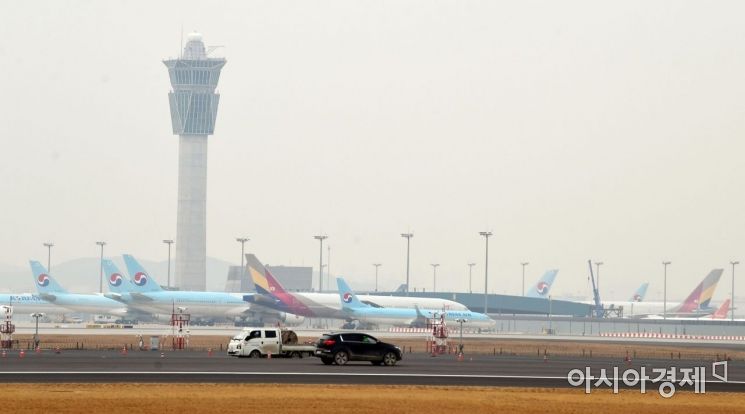 As Korean Air moves forward with the acquisition of Asiana Airlines, on the 17th, Korean Air and Asiana Airlines passenger planes are parked behind the construction site of the 4th runway at Incheon International Airport. Photo by Mun Ho-nam munonam@
[Asia Economy Reporter Dongwoo Lee] The Fair Trade Commission (FTC) has tentatively concluded to approve the merger of Korean Air and Asiana Airlines on the condition that they return some slots (the number of aircraft takeoffs and landings possible per hour) and redistribute traffic rights, accelerating the integration process.
However, the FTC specified that even with traffic rights adjustments, redistribution is only possible to domestic airlines under relevant laws. There are concerns that if financially weaker domestic low-cost carriers (LCCs) fail to receive traffic rights, they may effectively lose competitiveness against foreign airlines.
On the 29th, the FTC announced this decision as a provisional condition for the merger of Korean Air and Asiana Airlines and stated that a plenary meeting will be held in January next year to begin deliberations.
It is judged that competition restrictions will occur on some routes, including 10 monopoly routes with a 100% market share upon the merger, such as 'Incheon-LA', 'Incheon-New York', 'Incheon-Zhangjiajie', and 'Busan-Nagoya'.
Concerns Over Foreign Airlines Strengthening Competitiveness on Routes with Returned Traffic Rights
The FTC approved the merger but proposed that the two companies return some of the slots they hold at Korean airports. Although the exact number of slots to be returned was not specified that day, it was mentioned that it would be at a level that prevents competition restrictions or resolves parts where market share increases.
For 'air routes without liberalization' where operation is only possible with traffic rights (operating rights allocated by the government to airlines), the FTC also mentioned returning and redistributing the traffic rights of the two companies. These non-liberalized routes include many European routes such as Incheon-London, Chinese routes, some Southeast Asian routes, and some Japanese routes.
The FTC emphasized that the redistribution of traffic rights on non-liberalized routes is only possible to domestic airlines and not foreign airlines, but it appears that foreign airlines still have a significant chance of gaining indirect benefits in this process.
For example, even if the integrated airline returns traffic rights on certain European non-liberalized routes, there may be cases where domestic LCCs cannot receive them due to difficult management conditions. This is because domestic LCCs’ financial capacity, such as increasing new aircraft, has already bottomed out.
The FTC has set a policy that if structural measures (traffic rights adjustments) are ineffective, only behavioral measures such as fare increase restrictions, supply reduction prohibitions, and service reduction prohibitions will be imposed on the integrated airline as an exception. This means the integrated airline can temporarily continue operations at the current level while maintaining traffic rights.
The problem is that in this process, foreign airlines can indirectly enhance competitiveness by strengthening domestic operations using traffic rights from Europe to Incheon Airport acquired in their home countries. New entries occur equally based on reciprocal relations between the two countries.
Additionally, for 'liberalized routes' such as trans-Pacific routes, if slot returns occur, there is also a concern that traffic rights may directly transfer to foreign airlines. Regarding slots at foreign airports, the Ministry of Land, Infrastructure and Transport plans to decide on transfers after consultation, considering factors such as whether the airport is congested and the slot holdings of new entrant airlines. However, it is also analyzed that there is little justification to restrict foreign airlines if they request allocation.
© The Asia Business Daily(www.asiae.co.kr). All rights reserved.

















