Construction Industry with Widely Varying Prices by Company... Focus on 'Intuitive Standardization'
CEO Yoon So-yeon, Former Broadcast PD... Started Business While Running an Interior Blog
Opened Pop-up Store at Gangnam Shinsegae Department Store... Sales 6 Times Company Target
Seeking Series C Investment... "Will Increase Construction Managers by More Than 5 Times"
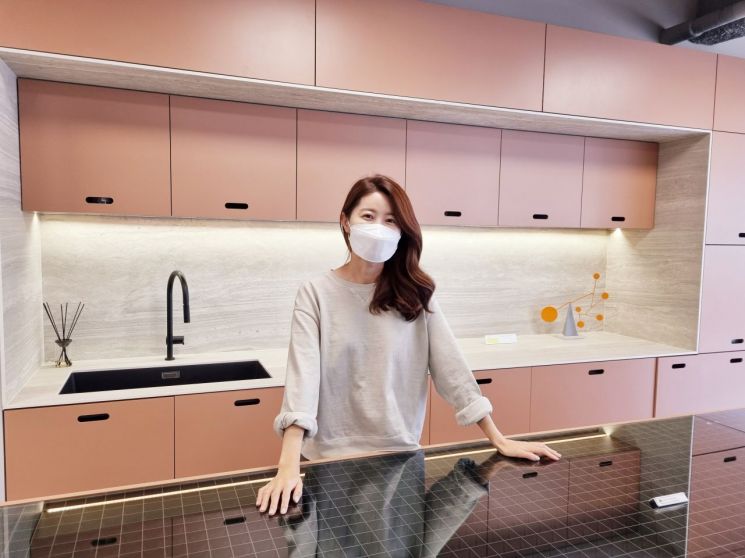
[Asia Economy Reporter Junhyung Lee] The interior construction industry is considered a typical ‘lemon market’ (a market with many low-quality products due to information asymmetry). There are about 48,000 interior construction businesses in South Korea, with prices and quality varying widely among companies. Therefore, consumers often say, “Interior construction costs whatever you ask.” The lack of price transparency stems from information imbalance between sellers and buyers regarding materials, labor costs, and more.
The interior startup Apartmentary focused on the construction market, which had many ‘blind contracts.’ The company was founded based on the insight that interior construction prices were not standardized. Co-founder and CEO So-yeon Yoon personally experienced these inconveniences while remodeling after purchasing her home in 2013. Yoon, a former TV producer, started running an interior blog and began seeking solutions to these issues. Venture capital firm SoftBank Ventures highly valued Yoon’s insight and proposed business expansion in 2015.
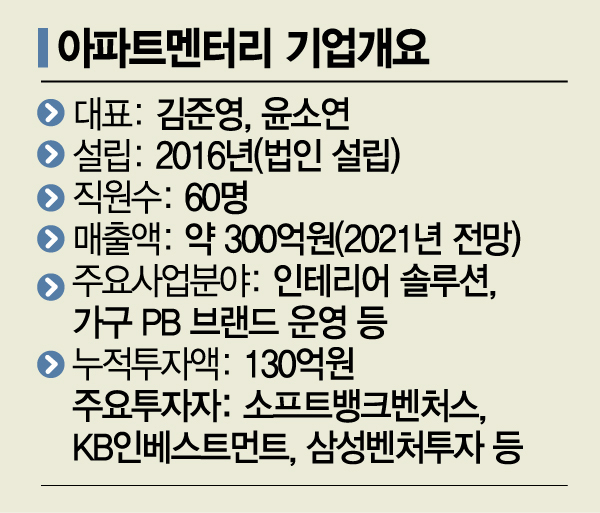
Standardization of Interior Prices and Quality
From its inception, the company focused on standardizing prices and quality. Its proprietary interior standardization model, the ‘Price Tag System,’ is a prime example. This solution offers interior construction at the same price based on the size of the residence. To achieve this, construction methods and materials were modularized and segmented to build a construction lineup priced between 10 million and 20 million KRW. In 2018, the company launched ‘Five,’ a modular interior service that includes only essential construction processes. This service covers five major areas with high customer demand: wallpapering, flooring, film, lighting, and tiles. CEO Yoon explained, “Customers choose brands like Hanssem because they want to experience standardized services. There is no competitor in the interior industry that offers remodeling services as thoroughly systematized as ours.”
Thanks to intuitive standardization, the company quickly rose as an industry ‘super rookie.’ The cumulative number of construction projects increased from 10 in its founding year, 2016, to 300 in 2020. Revenue has grown at an average annual rate of 250% since 2016. Riding on word of mouth, the company recorded 15 billion KRW in sales in the first half of last year, 1.5 times the total sales of the previous year (about 10 billion KRW). In November last year, sales reached 3 billion KRW, more than doubling compared to the same period the previous year. The company expects this year’s sales to reach around 60 billion KRW, roughly twice last year’s (about 30 billion KRW).
The market outlook is also bright. The interior industry is considered one of the sectors that benefited from the COVID-19 pandemic. With more time spent at home due to remote work, interest in home decoration has naturally increased. According to the Korea Construction Industry Research Institute and others, the domestic interior and remodeling market grew approximately 44.6%, from 41.5 trillion KRW in 2020 to 60 trillion KRW last year.
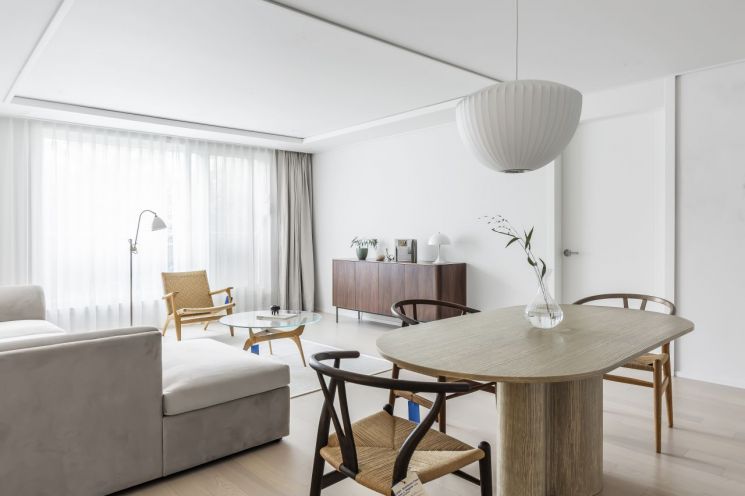 An apartment in Segok Prugio, Gangnam-gu, Seoul, where Apartmentary was in charge of the interior construction.
 [Photo by Apartmentary]
‘Love Call’ from Shinsegae Department Store
This is why Shinsegae Department Store extended a ‘love call.’ From August to October last year, Apartmentary opened a pop-up store on the 9th floor of Shinsegae Department Store’s Gangnam branch, known as the ‘luxury district.’ This was the first case of an interior brand entering Shinsegae Department Store Gangnam. The company explained that the store attracted the attention of the MZ generation (Millennials + Generation Z), who are highly interested in interior design. In fact, the pop-up store achieved sales six times the company’s target within just one month of opening. CEO Yoon said, “Before entering, Shinsegae hinted that the 9th floor had the highest sales. Sales in September last year, right after opening, exceeded 1.5 times that amount.”
The company is also proactive in adopting new technologies. In October last year, it launched the Apartmentary application (app), which allows real-time monitoring of apartment construction sites. It is also exploring collaboration with virtual reality (VR) and augmented reality (AR) companies to apply related technologies to the app. This is to provide services such as showing the apartment’s appearance after construction through VR and AR technologies.
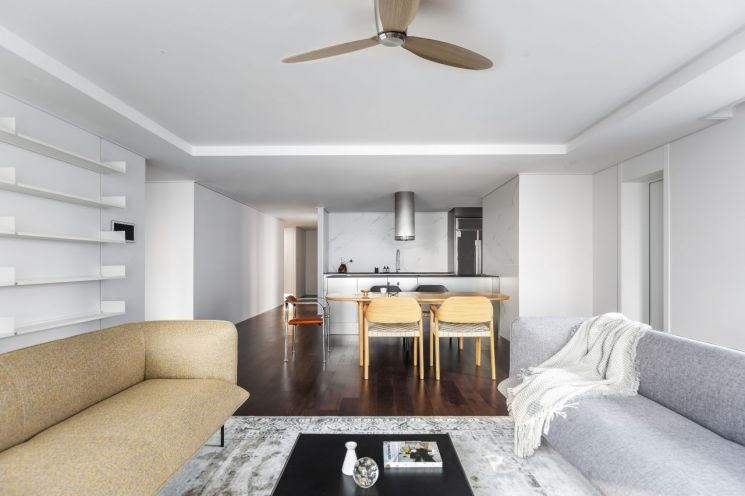 An apartment in Helio City, Songpa-gu, Seoul, where Apartmentary was in charge of interior construction.
 [Photo by Apartmentary]
The company is accelerating the establishment of offline stores as well. Next month, it will open its first offline store at ‘Mapo Raemian Prugio’ in Mapo-gu, Seoul. Starting here, it plans to open nine additional offline stores. The strategy focuses on targeting areas with many potential customers based on analysis of existing data.
Recently, the company has been working on raising Series C investment worth 20 to 30 billion KRW. Previously, in 2019, it secured 10 billion KRW in Series B funding from SoftBank Ventures, Samsung Venture Investment, KB Investment, and Illoom under the Persys Group. The company is preparing for aggressive expansion, including increasing the number of construction managers by about five times.
© The Asia Business Daily(www.asiae.co.kr). All rights reserved.
![Clutching a Stolen Dior Bag, Saying "I Hate Being Poor but Real"... The Grotesque Con of a "Human Knockoff" [Slate]](https://cwcontent.asiae.co.kr/asiaresize/183/2026021902243444107_1771435474.jpg)


















