Received University-Specific Self-Optimal Scale Plans and Set Regional Retention Rates
Universities with Low Retention Rates and Non-Compliance with Recommendations Will Have Funding Suspended from the Third Year
Support Funds to Be Provided to Universities Excelling in Optimal Scaling Implementation
[Asia Economy Reporter Han Jinju] The Ministry of Education will recommend universities with low enrollment maintenance rates to reduce their quotas starting in 2023. If universities do not comply with the recommendation, funding support will be suspended. Instead, incentives will be provided to universities that proactively implement the measures.
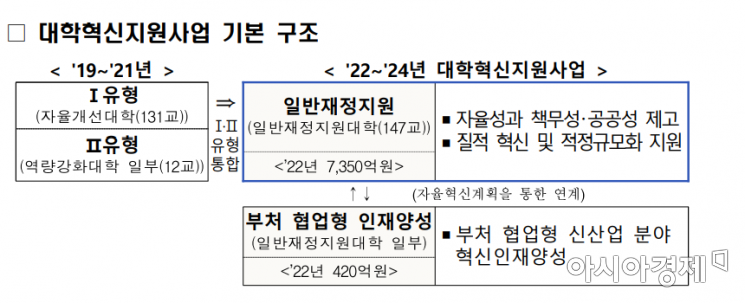
On the 29th, the Ministry of Education announced a draft of the basic plan for the 2022-2024 University and Junior College Innovation Support Project. The core of this basic plan is to evaluate autonomous innovation achievements such as appropriate scaling, provide incentives such as funding to excellent universities, recommend appropriate scaling ratios to universities with low enrollment maintenance rates, and suspend funding support if recommendations are not followed.
Through the 2022-2024 Innovation Support Project, the Ministry of Education will provide 795 billion KRW to 153 general universities and 402 billion KRW to 104 junior colleges selected through the 2021 University Basic Competency Diagnosis. This includes 233 universities selected as general financial support universities and an additional 13 universities.
Earlier this year, universities failed to recruit about 40,000 freshmen, and large-scale under-enrollment is inevitable until 2024. Accordingly, the Ministry of Education has required universities to independently establish appropriate scaling plans, including quota reductions, to induce voluntary quota adjustments and reductions.
Appropriate scaling plans must be submitted by May next year... Recommendations for the bottom 30-50% of universities
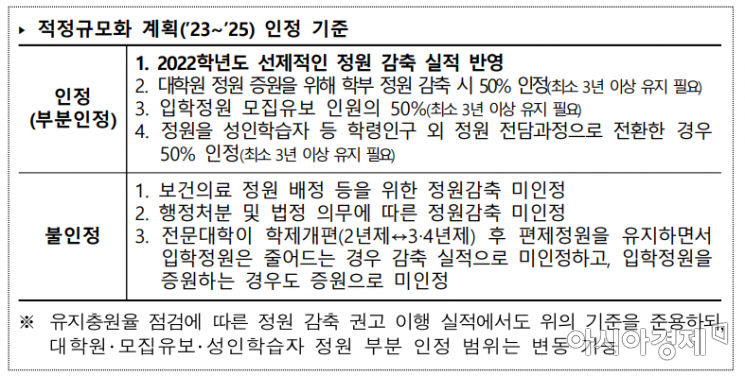
Universities must establish autonomous innovation plans and appropriate scaling plans for total quotas inside and outside the enrollment quota by May next year. Based on this, regional standard enrollment rates will be set considering the current enrollment rates.
Choi Eun-ok, Director of the Higher Education Policy Office, said, "Once an overall plan on how much universities will reduce is established, we will check the maintenance enrollment rates of current and new students and recommend quota reductions to the bottom 30-50% of universities by region. We expect many universities in each region to participate in adjusting quotas during the period of rapid decline in the school-age population."
The Ministry of Education will check the regional maintenance enrollment rates of 147 general financial support universities in two phases in 2022 and 2023. The maintenance enrollment rate is calculated by adding 0.6 times the average new student enrollment rate of the inspection year and the previous year, and 0.4 times the average current student enrollment rate of the inspection year and the previous year.
Based on the inspection results, universities in the bottom 30-50% of maintenance enrollment rates within each region will be recommended consulting and appropriate scaling. Consulting will be recommended in the first year, and appropriate scaling in the second year. If the recommendation is not followed, funding support will be suspended from the third year. When announced last May, the quota adjustment recommendation was scheduled for the second half of 2022, but considering the timing of discussions within universities, the implementation of funding suspension was postponed.
Regarding this, Director Choi explained, "The first maintenance enrollment rate check will be around October 2022, and universities will need to discuss internally and promote academic structure reform and appropriate scaling based on the results, but the time is too tight. We decided that suspending funding support in the final year after consulting and recommending would avoid excessive difficulties."
Incentives will be given if quotas are reduced by the amount of under-enrollment this year
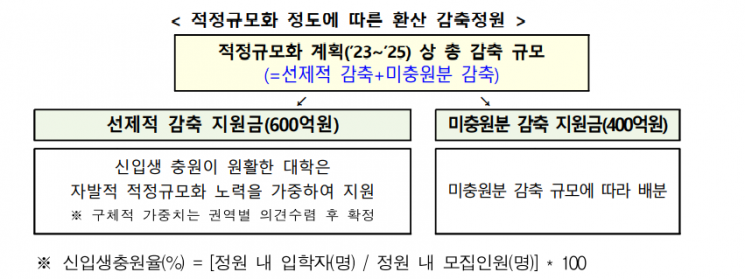
Carrots for appropriate scaling were also presented. Among general financial support universities, those that establish appropriate scaling plans covering at least 90% of this year's under-enrollment (within quota) will receive a total of 100 billion KRW to ensure no difficulties in academic restructuring or operations. Teacher training universities and Korea National University of Education are excluded.
Universities exceeding the 2021 under-enrollment scale will receive up to 6 billion KRW per university as proactive reduction support funds, totaling 60 billion KRW regardless of region, and 40 billion KRW will be provided to universities that reduce within the scale. Specific weighting will be finalized after collecting opinions.
Funding will be reduced according to the extent of exceeding the standard if universities exceeding the 118% selection criteria outside the quota fail to meet the teacher securing rate.
The Ministry of Education plans to allocate appropriate scaling support funds based on the appropriate scaling plans included in each university's autonomous innovation plan and will provide guidance on the regional maintenance enrollment rate inspection criteria in the first half of the year. After collecting opinions on the draft basic plan for the University and Junior College Innovation Support Project, the Ministry plans to finalize the basic plan by the end of January next year.
© The Asia Business Daily(www.asiae.co.kr). All rights reserved.



















