Over the Past Decade, More Than 130 Cases of Infant Abandonment and Murder Annually
Most Are Single Mothers Facing Economic and Social Hardships
Adoption Requires 'Birth Registration'... Reluctance Due to Identity Exposure Concerns
"Unconditional Enforcement of Birth Registration Should Be Avoided"
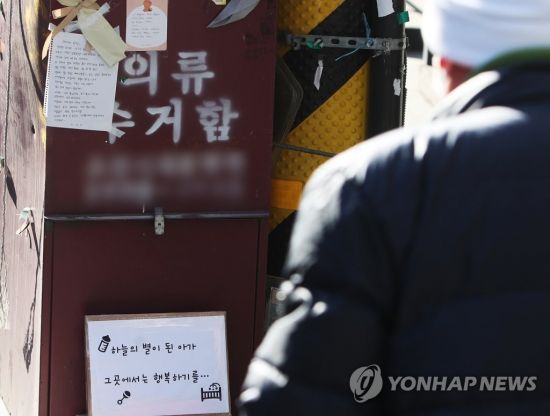 On the morning of the 27th, memorial messages and items were placed at a clothing collection box in Osan-si, Gyeonggi-do, where an infant was found dead on the 19th. / Photo by Yonhap News
[Asia Economy Reporter Lim Ju-hyung] A shocking incident occurred in Osan, Gyeonggi Province, where a biological mother abandoned her newborn baby in a clothing collection box, resulting in the baby's death. It is known that the biological mother committed this act to hide the fact that she was pregnant without her husband's knowledge. The tragedy of 'infant abandonment,' where parents cannot cope with their children due to economic and social reasons, continues unabated. Some call for alternatives such as a 'protected birth system' to safeguard both the child and the mother in order to break this vicious cycle.
◆More than 130 cases of infant abandonment and murder annually... an unending tragedy
The Osan Police Station in Gyeonggi announced on the 26th that they had arrested Ms. A, a woman in her 20s and the biological mother of the newborn. Ms. A is suspected of abandoning her newborn son in a clothing collection box in Gwoldong, Osan City, at around 5:20 p.m. on the 18th and fleeing the scene.
The baby was found by a man at around 11:30 p.m. on the 19th, a day after being abandoned by the biological mother. At that time, the baby was deceased with the umbilical cord still attached and wrapped in a towel.
The police analyzed CCTV footage near the clothing collection box and apprehended Ms. A at her home. Upon arrest, Ms. A told the police, "I was pregnant and gave birth without my husband's knowledge. I abandoned the baby in the clothing collection box to hide this."
The police are conducting a detailed investigation into the exact cause and time of the baby's death and whether the baby was alive at the time of abandonment.
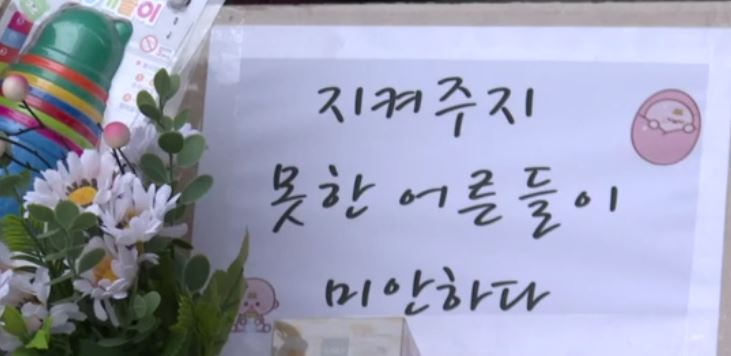 A memorial note attached to a clothing collection box in Osan, Gyeonggi, where an infant abandonment incident occurred. / Photo by Yonhap News TV capture
After the incident became known, a wave of mourning spread throughout the local community. Notes and placards with messages such as "Adults are sorry" and "May you be happy in heaven" were placed at the clothing collection box where the baby was found to commemorate the infant.
The tragedy of 'infant abandonment,' where mothers themselves abandon their newborns, is not a recent phenomenon. In August, a baby abandoned in a food waste bin in Cheongju, Chungbuk Province, was miraculously saved after being discovered by a passerby.
The baby, who was urgently transported to a hospital at the time, had severe wounds on the neck and back, necrotic skin, and symptoms of sepsis, putting the infant in critical condition. However, after about 50 days of treatment, the baby recovered and was transferred to a care facility to proceed with adoption and other procedures.
Meanwhile, in January of last year, Mr. B was arrested in Buk-gu, Gwangju Metropolitan City, on suspicion of abandoning an infant. Mr. B gave birth to a daughter alone in the factory restroom where he worked and abandoned the baby in a nearby garden before fleeing. At the time, Mr. B told the police, "I was not confident I could raise the child well."
According to data compiled by the National Police Agency, from 2010 to 2019, there were 1,271 reported cases of infant abandonment and 110 cases of infant murder, totaling 1,381 cases over ten years. This amounts to more than 130 cases of infant abandonment and murder annually.
◆Babies abandoned due to economic and social difficulties... current adoption system also problematic
Why do biological mothers give up on their children or even resort to killing them? The Jusarang Community Foundation, which operates the 'Crisis Infant Emergency Protection Center' (Baby Box), diagnoses that most cases arise from social prejudice and economic hardship.
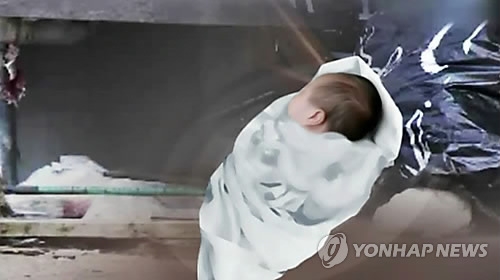 Biological mothers facing social and economic difficulties were found to primarily choose infant abandonment crimes. / Photo by Yonhap News
The Jusarang Community is responsible for establishing and operating the 'Baby Box,' a facility that temporarily shelters infants at risk of abandonment. Analyzing cases of biological mothers who sought help at the Baby Box, the foundation explained that these mothers faced issues such as unwanted pregnancies due to sexual assault or extramarital relationships, experiencing prejudice and isolation from family and society after childbirth, economic difficulties in raising the child, challenges with adoption, and social and economic hardships related to giving birth to disabled children.
They emphasized, "Most infant abandonment cases are carried out by single parents. Most users of the Baby Box are unmarried mothers or single-parent families who experience isolation as they have to handle pregnancy, childbirth, and child-rearing alone. These problems are difficult for women to manage on their own."
It is also known that the current law makes it difficult for unmarried mothers and female heads of single-parent families to choose adoption for their children, indirectly contributing to the increase in infant abandonment.
According to Article 11 of the current Adoption Special Act, prospective adoptive parents must obtain approval from the family court with supporting documents such as the child's birth registration. Birth registration must be completed by the biological parents within one month after the child's birth. Adoption agencies may exclude personal information of biological parents if they do not consent, but for mothers who are extremely sensitive about exposing their identity, this alone is a significant burden.
Regarding this, the Jusarang Community stated that 43% of the letters they received from women who abandoned babies at the Baby Box cited birth registration as the reason.
◆"We must protect families with a protected birth system, not just a birth registration system"
Given these circumstances, some civic groups are calling for the introduction of a 'protected birth system.' This system supports anonymous childbirth for mothers with unwanted pregnancies, assisted by the government. Some advanced European countries, including Germany, introduced the protected birth system in 2014 as a measure to prevent infant abandonment.
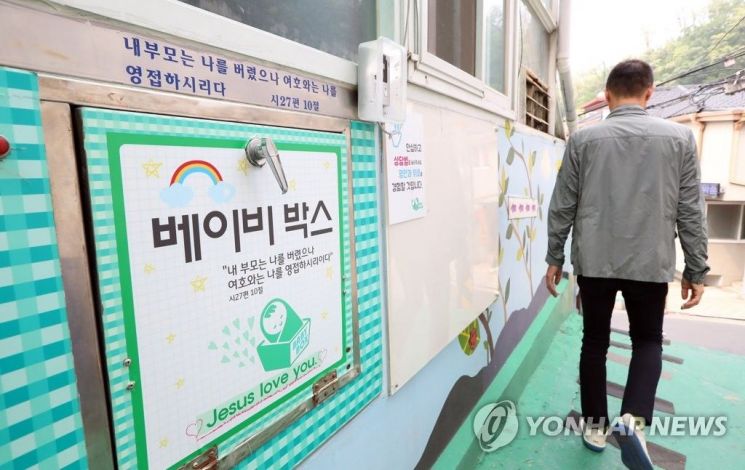 The baby box installed by the Jusarang Community Foundation in Gwanak-gu, Seoul. It is a facility that temporarily cares for infants at risk of abandonment. / Photo by Yonhap News
Several civic groups, including the National Adoption Family Solidarity and the Korea Orphan Love Association, held a press conference on December 8 last year in front of the National Assembly in Yeongdeungpo-gu, Seoul, stating, "Our society's current laws and systems have enforced an unconditional 'birth registration system,' which has led to countless children being abandoned or dying."
They continued, "Children who survived safely lost their parents and had to go to facilities because their births were not registered on time. Protective measures for new families have become a 'lottery' granted to only a few. The protected birth system is the only alternative that can save children's lives and uphold the principle of family protection in this harsh reality."
The government is also considering introducing the protected birth system as part of policies to eradicate infant abandonment. In April, the Ministry of Gender Equality and Family held a meeting at the Government Seoul Office to explore inclusive family policies, discussing with various civic groups and experts ways to prevent the disclosure of biological mothers' personal information in children's birth registration documents.
At the time, Vice Minister Kim Kyung-sun said, "Although family structures are diversifying, current laws and systems are not responding to these changes, so improvement is urgent. We will actively work on system improvements to support diverse families without blind spots in policies."
© The Asia Business Daily(www.asiae.co.kr). All rights reserved.
![Clutching a Stolen Dior Bag, Saying "I Hate Being Poor but Real"... The Grotesque Con of a "Human Knockoff" [Slate]](https://cwcontent.asiae.co.kr/asiaresize/183/2026021902243444107_1771435474.jpg)


















