Hanwha Holds Completion Ceremony for Uzbekistan GTL Plant Worth KRW 3.1 Trillion
Uzbek President Attends in Person...Government Shows Strong Interest in GTL Plant
GTL Plant Processes Natural Gas to Produce High-Value Petroleum Products Like Diesel and Naphtha
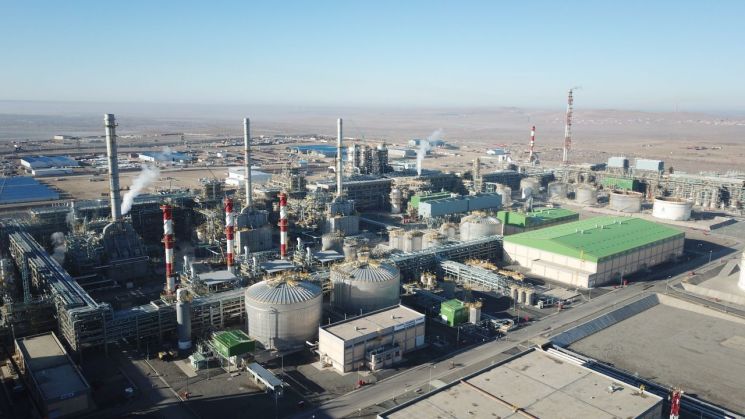
Hyundai Engineering has completed a GTL (Gas-to-Liquid) plant in Uzbekistan worth a total of 2.62 billion USD (approximately 3.1 trillion KRW).
On the 25th, Hyundai Engineering announced on the 29th that it held a completion ceremony for the 'Uzbekistan GTL Plant' attended by Uzbek government senior officials including President Shavkat Mirziyoyev, Prime Minister Abdulla Aripov, Minister of Energy Alisher Sultanov, and Hyundai Engineering CEO Kim Chang-hak.
GTL is a general term for technology that chemically converts natural gas into liquid petroleum products. It is a highly complex process that requires advanced technical capabilities because it transforms natural gas beyond simple refining into high value-added petroleum products used across various industries through chemical reactions.
The fuel produced through the GTL process is reborn as clean fuel with very low contents of air pollutants such as sulfur, aromatics (BTX), and heavy metals, unlike conventional crude oil refining products. Its carbon dioxide emissions are about half compared to coal and about 70% compared to petroleum.
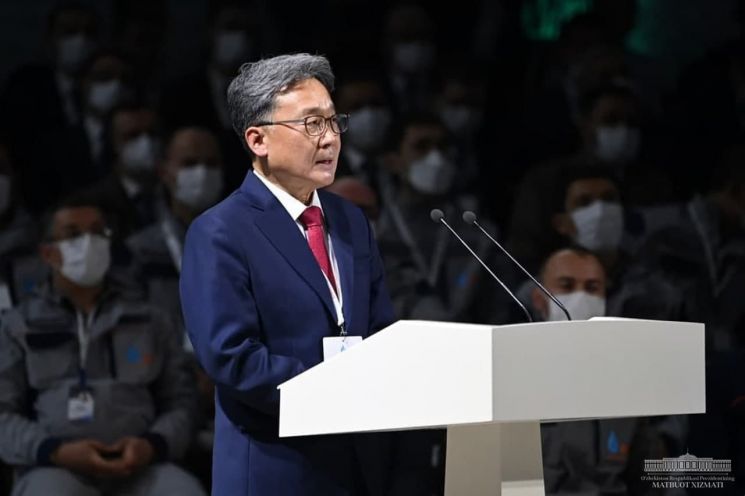 Kim Chang-hak, CEO of Hyundai Engineering, is delivering a congratulatory speech at the completion ceremony of the "Uzbekistan GTL Plant" held locally in Uzbekistan on the 25th.
The 'Uzbekistan GTL Plant' was ordered by Hyundai Engineering from an SPC (Special Purpose Company) involving Uzbekistan’s state-owned oil and gas companies. It is the sixth GTL plant built worldwide, with a total scale of 2.62 billion USD (approximately 3.1 trillion KRW). The large-scale petrochemical plant is located in Kashkadarya Province, about 400 km southwest of Tashkent, the capital of Uzbekistan, processing natural gas to produce high value-added petroleum products such as diesel, kerosene, and naphtha.
The Export-Import Bank of Korea and the Korea Trade Insurance Corporation provided financing worth 880 million USD, making this a representative case where Korean ECA capital and Hyundai Engineering’s plant technology and execution capabilities created synergy. Additionally, the procurement ratio of domestic equipment and materials reached 70%, significantly contributing to the entry of Korean small and medium-sized enterprises into Central Asia and improving foreign currency earnings.
A Hyundai Engineering official stated, "Based on this experience, we will accelerate securing orders for high value-added petroleum product production plants requiring advanced technologies such as GTL and olefin production facilities."
© The Asia Business Daily(www.asiae.co.kr). All rights reserved.
![Clutching a Stolen Dior Bag, Saying "I Hate Being Poor but Real"... The Grotesque Con of a "Human Knockoff" [Slate]](https://cwcontent.asiae.co.kr/asiaresize/183/2026021902243444107_1771435474.jpg)

















