Announcement of Civil Defense Training Operation Plan, Differentiated Operation by Year and Subject
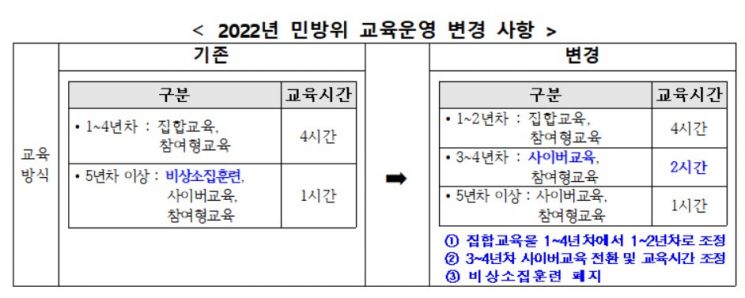
[Asia Economy Reporter Lim Cheol-young] Starting next year, group training for civil defense members with three or more years of service will be converted to cyber training, and emergency assembly drills for members with five or more years of service will be abolished.
On the 28th, the Ministry of the Interior and Safety announced the "2022 Civil Defense Training Operation Plan," which includes these changes to enable efficient civil defense training in response to the COVID-19 situation and changes in the digital era environment. Civil defense training has been conducted every March for civil defense members (men aged 20 to 40) to protect the lives and property of citizens, and currently, 3.5 million people are registered as civil defense members.
The main changes in next year's civil defense training operation plan include changes in training methods by years of service, differentiation of training subjects, expansion of training notifications, and establishment of a training management system.
First, the training method will change according to years of service. Training for members in their 1st and 2nd years will continue as group training (4 hours) as before, while training for members in their 3rd and 4th years will be converted to cyber training (2 hours). Additionally, the emergency assembly drills conducted for members with five or more years of service will be abolished and replaced with cyber training (1 hour).
However, participatory training related to safety prevention and disaster preparedness will continue as before, and the training method will be flexibly adjusted depending on the spread of COVID-19 and other factors.
Furthermore, moving away from a uniform curriculum, training will be divided into mandatory and elective subjects according to years of service, and customized training considering regional characteristics will be implemented.
The notification method for training will also be expanded. In addition to the existing direct delivery, registered mail, and electronic document methods, notification by regular mail will be allowed through amendments to the Civil Defense Basic Act. The Ministry plans to coordinate with local governments to link this with the Ministry of the Interior and Safety’s National Secretary notification service.
Finally, to improve the quality of training content due to the expansion of cyber training, a training management system will be established. A cyber training quality certification review committee will be formed, and through regular inspections, substantial training content will be provided to members.
The Ministry of the Interior and Safety expects that by supplementing the problems of the previously formal group training and emergency assembly drills, the convenience of civil defense members will increase and the training effectiveness will be further enhanced.
Lee Seung-woo, Director of the Disaster and Safety Management Headquarters, said, “We have restructured the existing operation methods to promote efficient civil defense training that responds to changes in the new era,” and added, “We will continue to improve civil defense training operations to strengthen civil defense capabilities.”
© The Asia Business Daily(www.asiae.co.kr). All rights reserved.

















