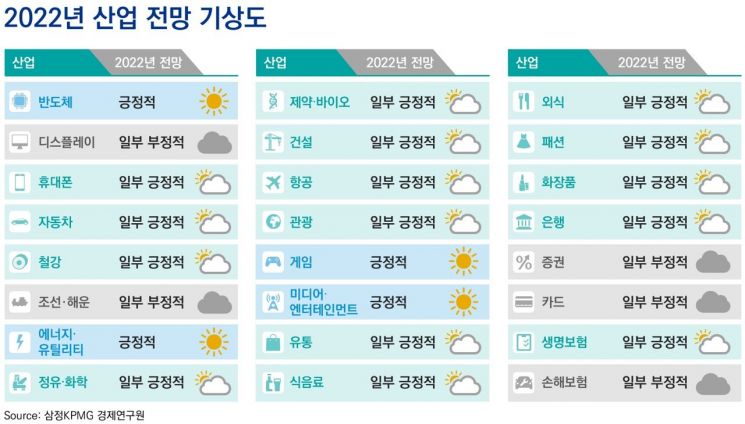
[Asia Economy Reporter Park Jihwan] As the economic recovery and improvement in consumer sentiment are expected to continue next year, the semiconductor, energy & utilities, gaming, and media & entertainment industries have been identified as sectors with anticipated growth.
Samjong KPMG presented forecasts and response strategies for 24 major domestic industries, including semiconductors, displays, mobile phones, automobiles, gaming, and banking, in its ‘2022 Domestic Major Industry Outlook Report’ released on the 27th. Despite ongoing concerns such as the possibility of sustained inflation, interest rate hikes, and exchange rates, the domestic economic growth rate is expected to continue a moderate recovery at 3.0% to 3.3% in 2022.
The semiconductor industry is predicted to see some relief in the system semiconductor shortage due to expanded foundry production capacity, while memory semiconductors are expected to show single-digit growth, down from the double-digit growth rate this year, due to increased supply and price declines. The report emphasized that strategic cooperation between the government and companies is essential to advance the upstream and downstream supply chains, localize semiconductor materials and components, and strengthen semiconductor self-sufficiency.
The outlook for the energy & utilities industry is also positive. Following the climate agreement at the 26th United Nations Climate Change Conference of the Parties (COP26), the demand for renewable energy is expected to clearly maintain its upward trend, while demand for coal and gas is projected to stagnate. The report suggested the need to establish hedge strategies against oil and energy price risks and prepare for greenflation during the carbon neutrality transition.
The domestic gaming market is also expected to continue growing next year. As the business use of the metaverse and NFTs (non-fungible tokens) becomes more active, competition within the gaming industry is anticipated to intensify. The report highlighted the need to prepare for securing a lead in the metaverse and NFTs while preserving the fundamental enjoyment of games. Regulatory aspects must also be considered, as NFT-based games are currently prohibited domestically.
Alongside the global success of Korean content, the media & entertainment industry is expected to maintain a favorable business environment next year. Domestic webtoon platforms, led by Kakao and Naver, are pursuing global business expansion. In the music industry, commerce is expected to be integrated into fandom platforms to expand revenue streams. The report urged domestic OTT companies to target the global market by considering various means such as direct investment, M&A, and strategic alliances to secure differentiated content.
Fifteen industries, including mobile phones, automobiles, steel, refining & chemicals, pharmaceuticals & bio, construction, aviation, tourism, distribution, food & beverage, dining out, fashion, cosmetics, banking, and life insurance, are expected to show some positive prospects.
Smartphone shipments are expected to grow compared to 2021, with foldable phones expanding their share in the premium market. The global automobile market is forecasted to experience limited growth due to steady pent-up demand and the gradual normalization of production. The pharmaceutical & bio sector is expected to continue aggressive investments to discover new growth engines based on accumulated cash and assets.
In particular, with rising vaccination rates and expectations for economic recovery, consumer sentiment, which had been sluggish, is expected to improve, leading to a gradual recovery in both online and offline retail sectors. The report emphasized the need to respond to competition for market dominance by establishing customer lock-in strategies and stressed the importance of developing an ‘OMO (Online Merge with Offline)’ strategy to provide differentiated customer experiences by combining online experiences with offline advantages.
The outlook for the display, shipbuilding & shipping, securities, credit card, and non-life insurance industries is viewed as ‘somewhat negative.’ The display market is expected to enter a downward cycle again due to the base effect as coexistence with COVID-19 becomes the norm next year. The shipbuilding industry is expected to show an overall lull due to a decline in global orders, while the shipping industry is predicted to see a general decrease in major cargo volumes due to factors such as resolving logistics disruptions, restrictions on China’s crude steel production, and the spread of Omicron.
Securities, which recorded the best performance this year, are expected to see profitability decline due to a slowdown in stock trading. The credit card industry is forecasted to face a deteriorating business environment due to strengthened household loan regulations, reduced merchant fees, and increased funding costs. Non-life insurance is expected to experience a decline in insurance business profitability due to rising loss ratios and intensified competition.
Samjong KPMG Economic Research Institute emphasized, “In 2022, all industries are expected to be affected by factors such as instability in global supply chains and raw material prices, and companies with risk management capabilities to handle domestic and international variables will stand out in growth.” It added, “Domestic companies need to concretize response strategies to the changing industrial environment caused by COVID-19, digitalization, and the rise of ESG, and proactively secure a growth foundation through mid- to long-term planning.”
© The Asia Business Daily(www.asiae.co.kr). All rights reserved.

















