Lee Jun-seok Resigns...
Shin Ji-ye Effect...
Unfairness Controversy...
Increase in Undecided 20s Males (Idaenam), Ahn Cheol-soo's Spillover Effect
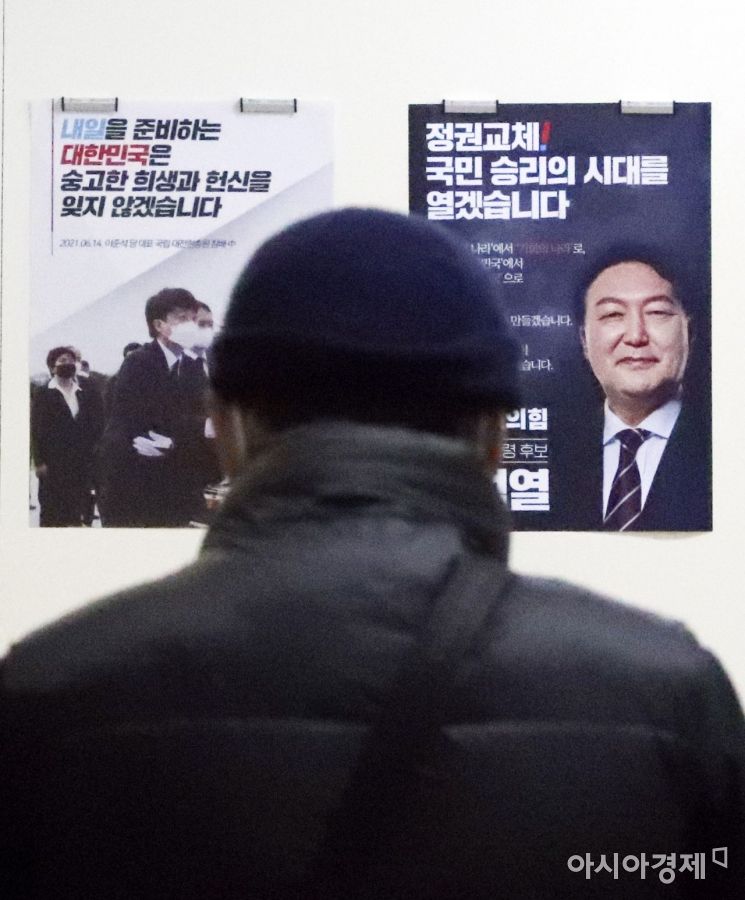
[Asia Economy Reporter Oh Ju-yeon] It has been revealed that people in their 20s, considered the casting vote for next year's presidential election, are significantly withdrawing their support for Yoon Seok-yeol, the presidential candidate of the People Power Party. This appears to be the result of a series of negative factors sensitive to the youth, including the resignation of party leader Lee Jun-seok, controversies surrounding Lee Soo-jung and Shin Ji-ye, and unfairness allegations involving Yoon’s spouse, Kim Geon-hee. The decline in support is particularly noticeable among males in their 20s, so-called "Idaenam."
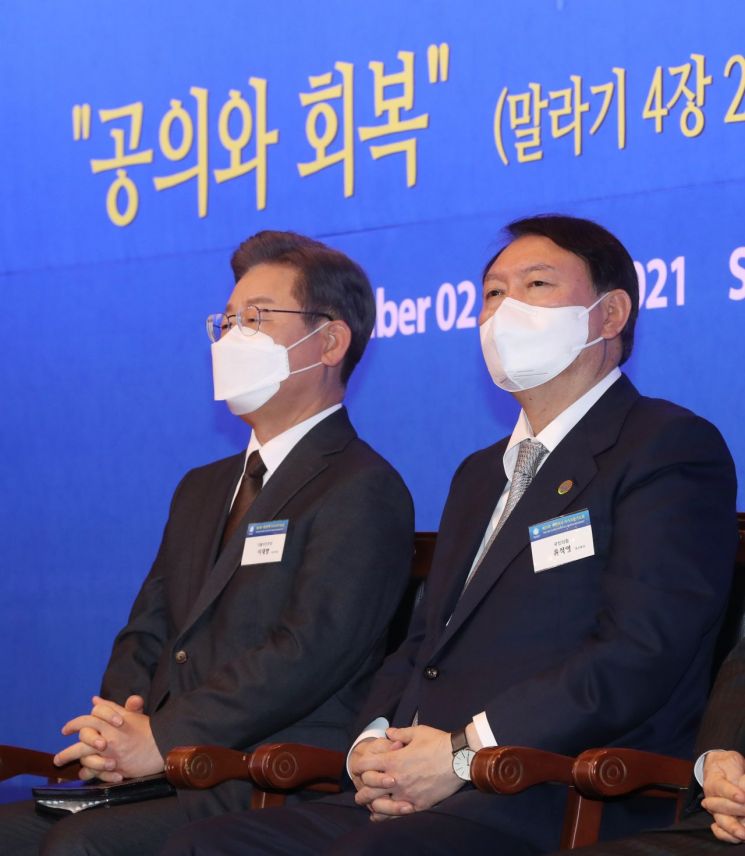
Two polls released on the 27th reflected this trend. In the Realmeter survey, Yoon’s support rate among people in their 20s dropped by 4.2 percentage points from the previous survey by the same organization (announced on the 19th), falling to 34.6%. Among males in their 20s, Yoon’s support rate fell sharply by 7.4 percentage points from 46.4% to 39.0% during the same period (commissioned by OhmyNews, conducted from the 19th to 24th, with 3,090 respondents aged 18 and older, margin of error ±1.8% at 95% confidence level). As people in their 20s turned away from Yoon, the beneficiary of this reflected advantage was Ahn Cheol-soo, the candidate of the People’s Party. Ahn’s support rate among people in their 20s rose by 3.2 percentage points from 8.4% to 11.6%. Lee Jae-myung, the candidate of the Democratic Party, also saw a 2.1 percentage point increase from 28.2% to 30.3%. The undecided voters slightly increased from 12.7% to 13.3%.
At one point, Yoon’s support among Idaenam exceeded 50%. Right after the People Power Party primary on the 8th of last month, 52.1% of Idaenam supported Yoon. Since then, it maintained a slight decline with 46.6% (December 10) and 46.4% (December 19), but this time it sharply dropped to the 30% range.
Yoon’s conflict with party leader Lee, a symbol of Idaenam support, and his decision to recruit figures like Lee Soo-jung and Shin Ji-ye, whom Lee opposed, may have influenced this. Additionally, allegations of false credentials involving Yoon’s spouse damaged his ‘fairness’ image.
Another poll released on the same day showed similar implications. According to a survey conducted by the Korean Society Opinion Institute (KSOI) commissioned by TBS (targeting 1,000 respondents aged 18 and older from the 24th to 25th, margin of error ±3.1% at 95% confidence level), Yoon’s support rate among people in their 20s was 25.2%, a 12.5 percentage point decrease from 37.7% in the same organization’s survey on the 19th. This is the largest drop among all age groups.
Support rates among people in their 30s and 50s also fell, but the decline among people in their 20s was four times greater. In this survey as well, the reflected advantage went to Ahn. Ahn’s support rate among people in their 20s tripled from 5.1% to 16.4%.
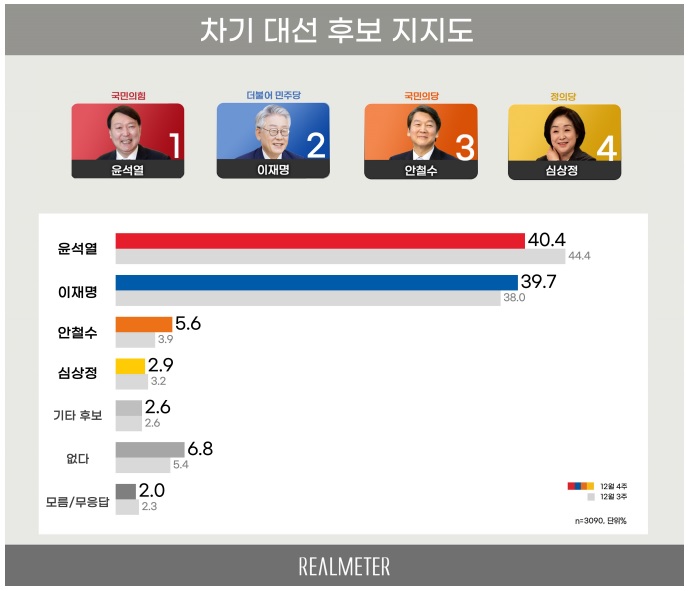
Meanwhile, in both polls released on the day, the difference in support rates between the two candidates showed a very close race within the margin of error. In the Realmeter survey, Yoon’s support rate dropped by 4.0 percentage points from the previous week to 40.4%, while Lee’s rose by 1.7 percentage points to 39.7%, narrowing the gap from 6.4 percentage points to 0.7 percentage points.
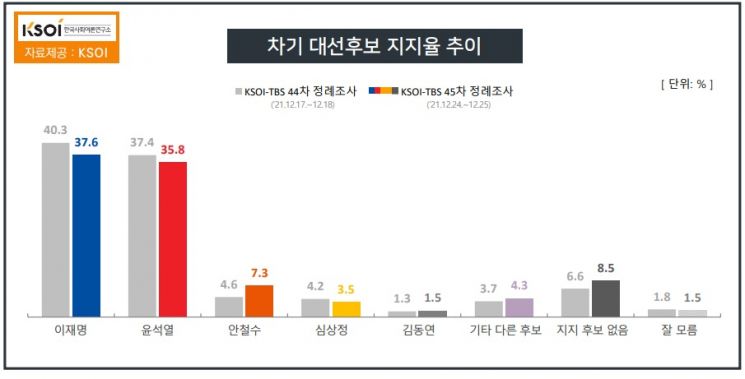
In the KSOI survey, Yoon (35.8%) and Lee (37.6%) showed a difference of 1.8 percentage points, which is within the margin of error. For detailed information regarding the polls, please refer to the Central Election Poll Deliberation Commission website.
© The Asia Business Daily(www.asiae.co.kr). All rights reserved.



















