Common People's Funding Stream Expected to Temporarily Open Early Next Year
Preferential Interest Rates Restored, Suspended Loan Products Sales and Limits Normalized
[Asia Economy Reporter Park Sun-mi]Mr. Lee Jin-young (42, pseudonym), who requested a loan review from a foreign bank at the end of October to prepare funds for a jeonse eviction in January next year, recently applied for a loan again at his main bank. He heard that the credit limit and interest rate would be more flexible than last month. He said, “At that time, since it was possible that the main bank would not approve the loan, I urgently applied to wherever it was possible. Recently, it seems that the loan threshold has lowered a bit, so I reapplied at my main bank because they said the transaction was possible.”
Due to government regulations on household loans, the financial lifeline for ordinary people, which had been blocked, is expected to temporarily open early next year. This is because banks will restore the preferential interest rates they had reduced and resume the sale of loan products and normalize limits that had been suspended, following the reset of the total household loan limit for the new year.
However, since the total household loan target for the financial sector next year is lower than this year and the second stage of the Debt Service Ratio (DSR) will be implemented, the outlook is that the loan cliff phenomenon for actual demand borrowers will not improve significantly.
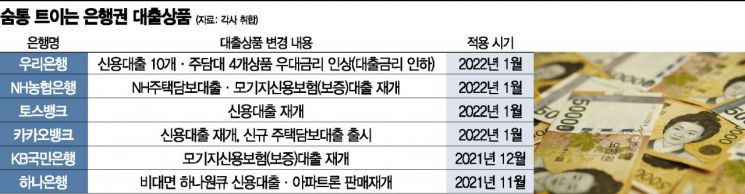
According to the banking sector on the 27th, Woori Bank will raise preferential interest rates by up to 0.6 percentage points on 10 types of unsecured loans and 4 types of mortgage loans starting from the 3rd of next month. Raising preferential interest rates has the effect of lowering loan interest rates. The maximum preferential rate for the representative unsecured loan product, the Employee Loan (including non-face-to-face), will increase up to 0.9%. The maximum discount rate for subsidiary transactions will also be restored from no discount to 0.4 percentage points for the Woori WON mortgage loan. This is a partial restoration of preferential interest rates that had been reduced as part of managing the total household loan volume.
KB Kookmin Bank will lift all temporary loan restrictions previously applied, such as mortgage credit insurance (guarantee) loans, earlier this month. Only the part that allows loan applications within the increased amount when renewing jeonse loans remains. Although it is not yet confirmed whether preferential interest rates will be adjusted, the bank is keeping open the possibility of changing interest rate operation standards early next year considering business conditions.
NH Nonghyup Bank will fully resume mortgage loans, which had been suspended since August, in January next year. The credit loan limit, which had been lowered to 20 million KRW, will be restored to 100 million KRW starting next month. They are also reviewing expanding preferential interest rates.
Internet-only banks such as KakaoBank and Toss Bank will also simultaneously resume new loans next month. In particular, KakaoBank is preparing to launch a new non-face-to-face mortgage loan early next year.
The severely dried-up bank loans began to normalize last month when Hana Bank resumed sales of non-face-to-face products such as Hana OneQ unsecured loans and Hana OneQ apartment loans. Following this, Kookmin Bank and SC First Bank also joined in resuming loans. Although the household loan growth rate in the second half of the year approached the financial authorities’ recommended range (annual 5-6%), they tightened loans simultaneously, but with the total limit reset early next year, loan capacity has become available.
There are concerns that a first-come, first-served loan phenomenon may reoccur among actual demand borrowers who urgently need money. Since the financial authorities plan to manage next year’s household debt growth rate at 4-5%, lower than this year, and banks are shifting household loan management from annual to monthly and quarterly management, once the limit is reached, the loan threshold could rise at any time.
Some expect that although the loan threshold may temporarily lower early in the year, the strengthened DSR regulations will prevent the usual year-end surge in loans. A bank official said, “Loan conditions will improve compared to the second half of this year, but with the implementation of DSR stage 2 next month, a DSR of 40% will apply to borrowers whose total loan amount exceeds 200 million KRW, so loans will be focused on actual demand borrowers.”
© The Asia Business Daily(www.asiae.co.kr). All rights reserved.

















