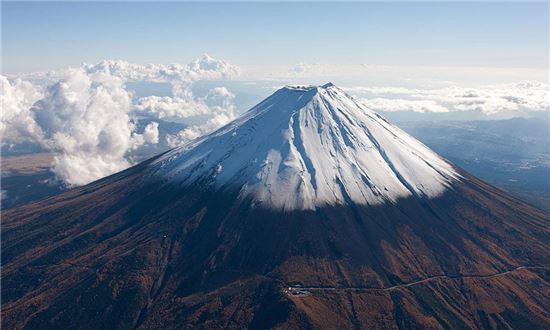
 Mount Fuji, Japan.
 Photo by Wikipedia
[Asia Economy Reporter Seoyoung Kwon] Amid a series of earthquakes occurring in the central region of the Japanese archipelago, experts are raising concerns about the possibility of an eruption of Mount Fuji.
On the 25th, the Japanese current affairs weekly Shukan Gendai reported that earthquakes occurred at three-hour intervals earlier this month in Yamanashi Prefecture and Wakayama Prefecture, along with small-scale earthquakes in Kagoshima Prefecture, drawing attention to a possible connection with magma activity beneath Mount Fuji.
In Japan, on the morning of the 3rd, a magnitude 4.8 earthquake struck eastern Fujigoko in Yamanashi Prefecture at 6:37 a.m., followed by a magnitude 5.4 earthquake at 9:28 a.m. in Kiisuito, Wakayama Prefecture. This led to the spread of information related to a potential eruption of Mount Fuji on Japanese social networking services (SNS), amplifying public anxiety.
Currently, Japanese authorities maintain the position that "the epicenters of the earthquakes are locations where earthquakes have repeatedly occurred in the past and do not appear to be directly related to Mount Fuji's activity." However, Shukan Gendai quoted Hideki Shimamura, a volcanology expert and special professor at Musashino Gakuin University, stating that "signs of abnormal activity have begun to appear at Mount Fuji."
Professor Shimamura argued, "If the earthquake that occurred on the morning of the 3rd in eastern Yamanashi Prefecture was caused by magma movement beneath Mount Fuji, it could indicate that a volcanic eruption is approaching." He also warned, "Even a mere 0.5mm accumulation of volcanic ash in the Tokyo metropolitan area could halt train operations, causing severe traffic congestion." Other experts have similarly stated, "(Mount Fuji) will inevitably erupt someday," and "once it erupts, it will lead to a large-scale explosion."
In the event of an eruption, if volcanic ash spreads eastward carried by the prevailing westerly winds, Tokyo is expected to experience direct damage approximately two hours after the eruption. In fact, during the Hoei eruption of Mount Fuji on December 16, 1707, volcanic ash began to settle in Tokyo two hours after the eruption and accumulated to a thickness of about 2cm over roughly two weeks.
Meanwhile, Takamasa Wada, a disaster risk management advisor, stated, "Mount Fuji is the best-monitored volcano, so precursors can be detected before an eruption," but warned, "the actual strength of the eruption can only be determined after it occurs." He added, "Waiting for official announcements is foolish. The only way to survive is to evacuate immediately."
© The Asia Business Daily(www.asiae.co.kr). All rights reserved.
















