Joint Op-Ed by French and Italian Leaders in Leading Daily: "Advocate for Easing Fiscal Rules"
Hardliners in Germany Step Down After Merkel, Prompting France and Italy to Move Toward Easing Fiscal Rules
Investment Slump and Fiscal Spending Vicious Cycle... Calls for Introducing the 'Golden Rule'
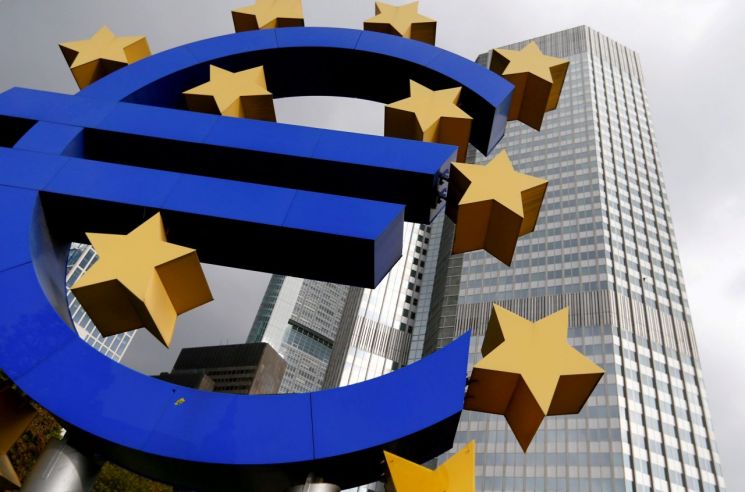
[Asia Economy Reporter Park Byung-hee] French President Emmanuel Macron and Italian Prime Minister Mario Draghi jointly advocated for the revision of the European Union (EU) fiscal rules in a joint op-ed published on the 23rd (local time) in leading economic daily newspapers.
The 'Stability and Growth Pact,' known as the EU fiscal rules, sets the framework to limit the government budget deficit ratio of EU member states to 3% of their Gross Domestic Product (GDP) and the debt ratio to within 60% of GDP. It was introduced to prevent certain member states from reckless fiscal management that could devalue the euro, and countries violating the fiscal rules face penalties such as fines.
President Macron and Prime Minister Draghi argued that the fiscal rules suppress government spending, becoming an obstacle to expanding investment and economic growth.
The two leaders stated, "The fiscal rules should be revised in a way that is favorable to investment," and "The limits on budget deficits and debt ratios should be raised to expand investment." They also emphasized, "Fines imposed on countries violating the fiscal rules should be reduced," and "Prioritizing public expenditure will substantially contribute to sustainable debt and the future of the EU in the long term."
They explained, "Our strategy is to curb ongoing fiscal spending through reasonable structural reforms." This is interpreted as a call to break the vicious cycle where fiscal spending limits lead to sluggish investment and slowed growth, plunging the economy into crisis and forcing governments to reconsider expanding fiscal spending again.
Following the 2008 global financial crisis and the 2012 Eurozone (19 countries using the euro) debt crisis, demands for easing the EU fiscal rules have been continuously raised, mainly by France and Italy. However, fiscally sound countries such as Germany, the Netherlands, and Austria repeatedly dismissed these demands from Southern European countries. In particular, former German Chancellor Angela Merkel emphasized strict application of the fiscal rules, frequently clashing with Southern European countries. As soon as Chancellor Merkel stepped down, France and Italy have been pushing hard for revisions to the fiscal rules. At the end of last month, France and Italy signed a mutual friendship treaty, signaling their intention to amplify their voices during Germany's regime change period.
The Italian government even unveiled a 2022?2024 budget plan in October that seemed to disregard the EU fiscal rules altogether. The Italian government set three-year budget deficit targets at 5.9%, 3.9%, and 3.3%, respectively.
The EU decided last year not to apply the fiscal rules until 2023 following the COVID-19 pandemic. The Italian government stirred controversy by setting budget deficit ratios exceeding the fiscal rule standards even in 2024, when exceptions are no longer recognized. This can be seen as a clear indication of Italy's determination to enforce the easing of the fiscal rules.
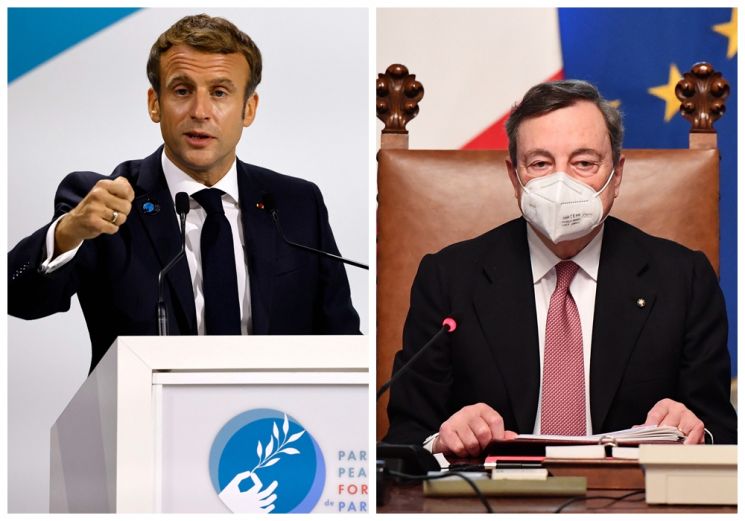 French President Emmanuel Macron (left) and Italian Prime Minister Mario Draghi
 [Photo by AFP Yonhap News]
The newly formed German coalition government emphasizes the principles of the fiscal rules while leaving room for expanding investment. This is because a massive investment is needed in the green sector as the economic system must transition from fossil fuel-based to environmentally friendly energy.
Christian Lindner, Germany's Finance Minister and former leader of the Free Democratic Party, said in his first meeting last week with French Finance Minister Bruno Le Maire, "We need to combine more investment required for the stability of the Eurozone currency and the transition to a climate-friendly economy," adding, "It is difficult but possible."
The new German government stated in its coalition agreement, "The fiscal rules have shown flexibility," and "Based on this, we hope to ensure growth, debt sustainability, and sustainable, environmentally friendly investment."
Regarding green investment, there are voices calling for the introduction of the so-called 'golden rule.' This rule would exclude green investment items from the application of the EU fiscal rules. It is known that most EU member states agree on introducing the golden rule. However, Dutch Acting Finance Minister Aukje de Vries expressed a negative stance, saying, "The golden rule does not have a definite effect on increasing public investment and is too complicated." Regarding the introduction of the golden rule, it seems necessary first to clarify the criteria for green investment. Recently, issues of disguised environmentalism, so-called greenwashing, have emerged, where investments that are not truly green are emphasized as green investments.
Valdis Dombrovskis, EU Executive Vice-President, recently stated in an interview that he would consider introducing a green golden rule. However, he emphasized that the EU's priority should be reducing overall public debt. The EU began discussions in October on whether to revise the fiscal rules to be applied after 2024.
Discussions surrounding the revision of the EU fiscal rules are expected to intensify in the first half of next year when France holds the rotating presidency of the EU.
© The Asia Business Daily(www.asiae.co.kr). All rights reserved.


















