Korea Consumer Agency, Online Survey Results of 1,000 Participants
[Asia Economy Reporter Lim Chun-han] Starting from the 25th, the policy for separate disposal of transparent (colorless) PET bottles will be implemented even in detached houses. A survey revealed that removing labels is the most inconvenient part when separating transparent (colorless) PET bottles for disposal.
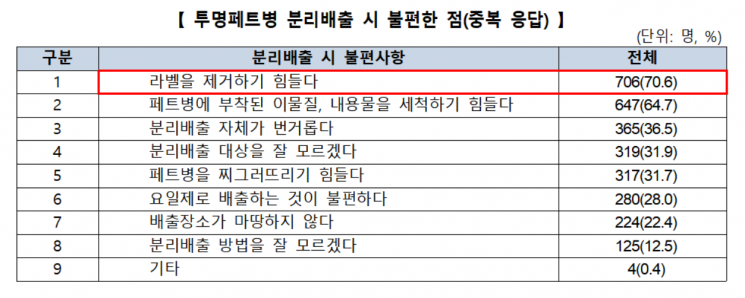
On the 23rd, the Korea Consumer Agency conducted an online survey from September 29 to 30 targeting 1,000 consumers who had experience separating transparent PET bottles within the last six months. According to the results, 70.6% cited 'label removal' as the most inconvenient aspect of separate disposal (multiple responses allowed). This was followed by 'washing foreign substances or contents' (64.7%), 'the separate disposal process itself is cumbersome' (36.5%), 'uncertainty about the applicable items' (31.9%), and 'crushing the PET bottles' (31.7%).
When labels on transparent PET bottles do not separate well and are not completely removed, 42.7% responded that they dispose of the bottles in the plastic collection bin with the labels still attached, indicating that a significant number of transparent PET bottles are discarded without label removal. Regarding how removed labels are disposed of, 44.0% mistakenly disposed of them in the transparent PET bottle collection bins or plastic collection bins. Additionally, transparent plastic ice cups and transparent PET packs were incorrectly disposed of in the transparent PET bottle collection bins at rates of 32.1% and 31.7%, respectively. Labels should be disposed of in vinyl collection bins, while transparent plastic ice cups and transparent PET bottles should be disposed of in plastic collection bins.
Regarding whether information about separate disposal of transparent PET bottles is provided at the local recycling collection points, 44.5% answered that no information was provided. Notably, among residents of apartment complexes, 79.6% said that related information was provided, whereas only 31.4% of residents in detached houses and similar dwellings reported receiving such information. Furthermore, 64.3% said that auxiliary tools are necessary at disposal sites, and among them, 54.1% identified a 'label removal stick' as the most needed tool.
Separately from this survey, the Consumer Agency also introduced results from an experiment conducted on October 20 with 30 men and women in their 20s. The experiment tested the ease of label removal on 20 types of transparent PET bottled beverages using shrink labels with perforation lines (a non-adhesive label method where the label is shrunk onto the PET bottle using high heat).
When evaluating whether the perforation lines helped with label removal, the ease of removal scored relatively low at 2.82 out of 5 points. All tested beverages had perforated labels and were classified as 'average recycling' grade, but 12 of them scored below 3 points for ease of removal, indicating that the perforation lines did not significantly aid label removal. The experiment confirmed that the longer the vertical length of the holes along the perforation line, the easier the label removal.
Based on the survey results, the Consumer Agency recommended that related businesses improve container structures and perforation lines to facilitate easier label removal and expand the release of no-label products. They also stated that they have consulted with relevant government departments about reflecting whether perforation lines aid label removal in the recycling grade assessment, and that related regulatory revisions are currently underway.
© The Asia Business Daily(www.asiae.co.kr). All rights reserved.

















