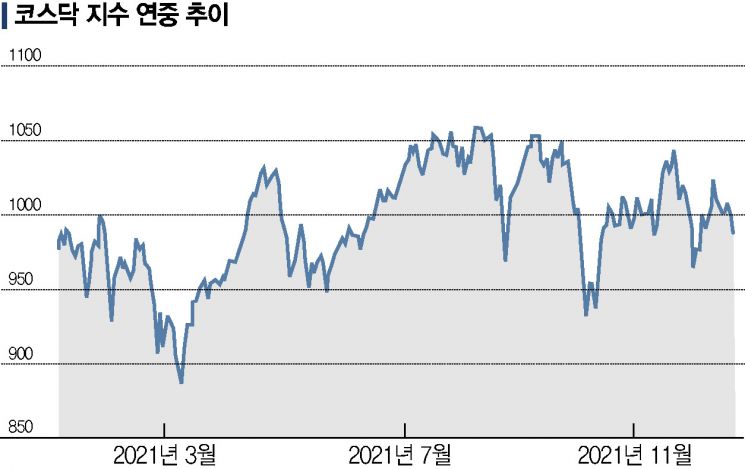
January KOSPI Breaks 3000, KOSDAQ Surpasses 1000
KOSPI Hits Historic High of 3300 in July
Retreats to 2980 Amid Inflation and Tapering Concerns
Year-End Santa Rally Missing Due to Omicron Setback
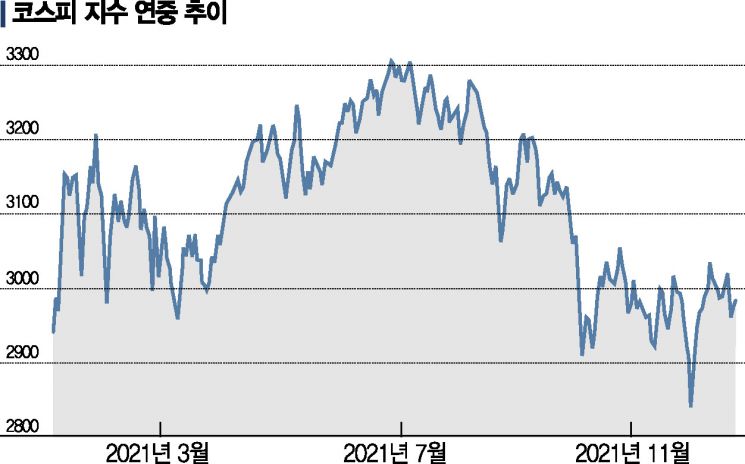
[Asia Economy Reporter Ji Yeon-jin] On the first trading day of the Year of the Ox (January 4), the KOSPI surged by 70.98 points (2.47%), quickly surpassing 2900. The stock market, which had been built up by liquidity triggered by COVID-19 last year, combined with the "January effect" (a rising market due to early-year optimism), reached the dream milestone of 3000 in just 25 days, and then soared to 3300 in April, marking a historic high. The KOSDAQ also surpassed 1000 from January, fully opening the era of "Samcheonpi and Cheonsudak" in the domestic stock market this year.
According to the Korea Exchange on the 23rd, as of the previous day, the KOSPI's return this year was 3.86%, and the KOSDAQ's was 3.27%. Compared to last year’s gains of 30.75% for the KOSPI and 44.68% for the KOSDAQ, this amounts to essentially standing still.
The domestic stock market, which showed a strong start to the year, gradually lost momentum. Inflation and concerns over U.S. monetary tightening suppressed the domestic stock market throughout the year. Since late last year, as COVID-19 vaccinations expanded and the economy reopened, prices of crude oil and other raw materials surged sharply, causing inflation to spike. In response, countries around the world prepared to withdraw the liquidity they had injected to cope with the COVID crisis, which dragged down the valuations of listed companies in the domestic stock market one after another.
In particular, in August, the COVID-19 Delta variant struck the stock market hard, pushing the KOSPI down to the 3000 level. Samsung Electronics and SK Hynix, ranked first and second in domestic market capitalization, were pressured from the second half of the year by concerns over a semiconductor industry "peak-out" (decline after economic peak), and in October, the KOSPI even fell below the 3000 mark. Furthermore, as oil and raw material prices surged, inflationary pressures increased, and when the U.S. began full-scale "tapering" (asset purchase reduction) last month, investor sentiment sharply froze.
The KOSPI dropped to a yearly low of 2839.01 on the 30th of last month. This was a return to the level of the last trading day of last year (2873.47). Although foreign buying has flowed in this month, attempting a rebound, the adverse impact of the COVID-19 Omicron variant has made a "Santa rally" difficult to expect. Individual investors, aiming to avoid year-end capital gains tax, have continued selling, leading to fierce battles around the "Samcheonpi" level daily. The KOSDAQ has also been fluctuating around the 1000 mark.
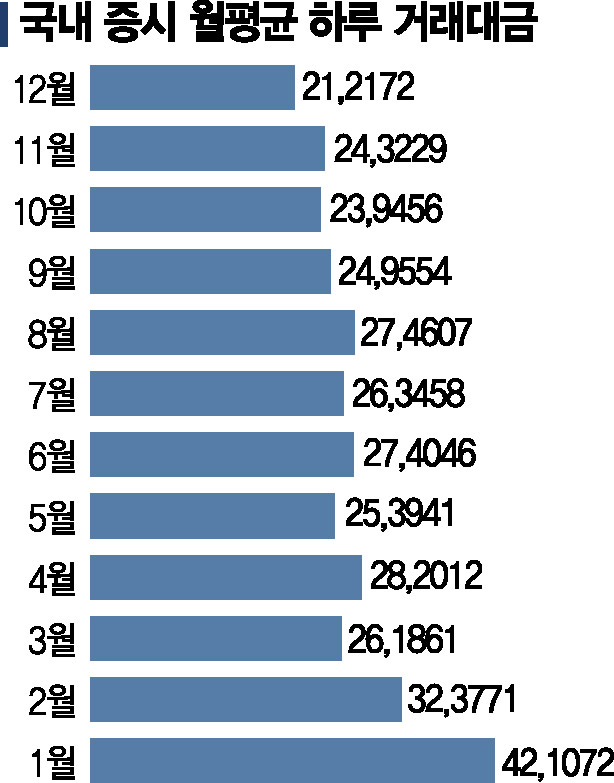
This year, as the stock market showed a "high start, low finish" pattern, investor sentiment has become increasingly subdued. The total daily average trading value in the domestic stock market has halved from 42 trillion won in January to 21 trillion won this month. Investors trapped at the market peak in April have turned to a wait-and-see stance amid the dull sideways market.
However, individual investors, known as Donghak Ants, have played a crucial role as the backbone of the stock market throughout the year. They have net purchased stocks worth 79.6048 trillion won up to the previous day this year, supporting the Samcheonpi and Cheonsudak levels. The net purchase volume by individual investors exceeds last year's 63.924 trillion won, when the stock investment boom began. This year, institutions have net sold 45.9397 trillion won, and foreigners have net sold 26.717 trillion won.
Lee Kyung-min, a researcher at Daishin Securities, explained, "Supply chain bottlenecks have prolonged, inflationary burdens have increased, accelerating the normalization of U.S. monetary policy, and manufacturing recovery has slowed, causing Asian stock markets, including the domestic market, a representative emerging market, to underperform."
© The Asia Business Daily(www.asiae.co.kr). All rights reserved.



















