No Protection Law for Bona Fide Third Parties Who Bought Without Knowing About Illegal Resale
Ministry of Land, Infrastructure and Transport: "Relief Possible Through Authoritative Interpretation"
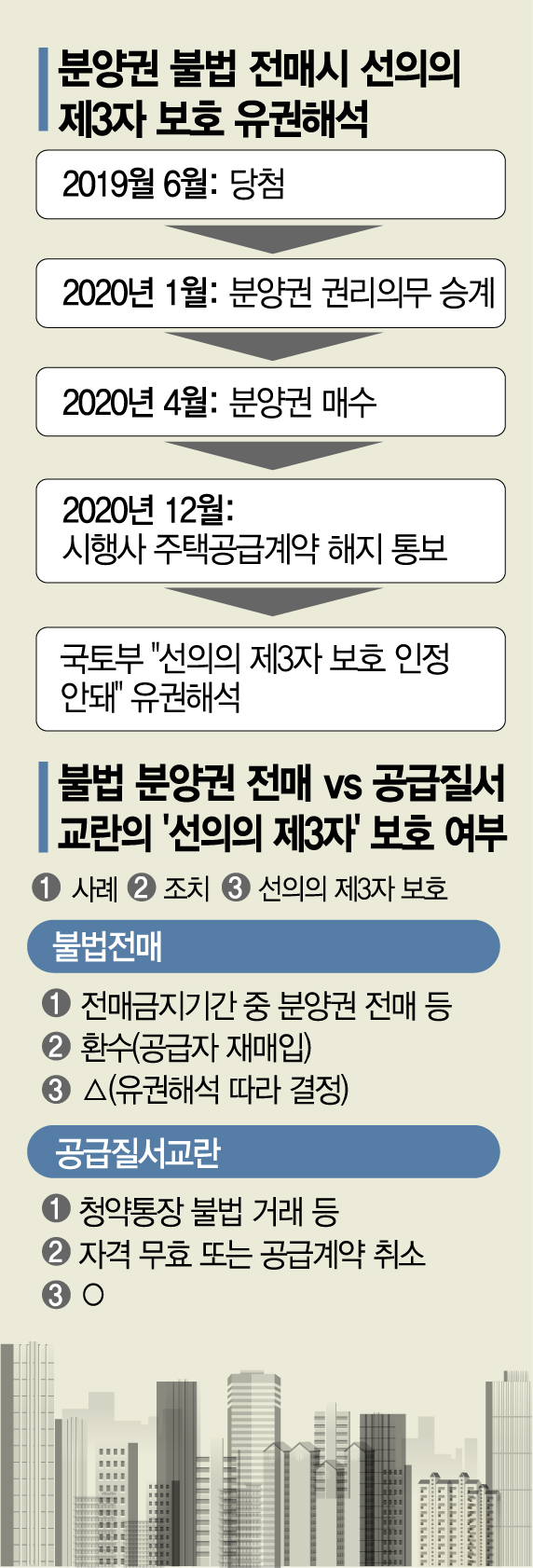
[Asia Economy Reporter Kim Min-young] #C purchased the pre-sale rights for E Apartment in Incheon from B in April last year. On paper, B had legally acquired the pre-sale rights from the original winner A after the six-month resale restriction period had passed. However, in December of the same year, the apartment developer notified C that the housing supply contract would be canceled, citing that A had illegally resold the rights to B within the resale restriction period. C is preparing a civil lawsuit against the developer and a damages lawsuit against the Ministry of Land, Infrastructure and Transport, arguing, "It is unacceptable that a bona fide buyer should have their pre-sale contract canceled due to illegal resale between A and B."
There is controversy over the Ministry of Land, Infrastructure and Transport’s authoritative interpretation, with residents who unknowingly acquired pre-sale rights through illegal resale and later received contract cancellation notices criticizing it as bureaucratic administration that fails to protect bona fide third parties. While those who received contract cancellation notices argue for a mechanism to protect bona fide third parties who legally acquired pre-sale rights during subsequent resale processes, the Ministry maintains that due to the diverse nature of illegal resale cases, relief is sufficiently possible through authoritative interpretation rather than separate protection regulations.
According to the current Housing Act as of the 22nd, those who disrupt supply order through illegal transactions of subscription savings accounts face disqualification or contract cancellation, whereas illegal resale of pre-sale rights during the resale restriction period results in the supply itself being valid but the contract being subject to cancellation or recovery measures.
The issue is that while legislative measures to protect bona fide third parties have been enacted for fraudulent subscription transactions, there are no separate specific regulations or enforcement guidelines for illegal resale. Earlier this year, the Housing Act was amended after multiple victims emerged in Busan’s Haeundae-gu Marine City Xi, where resale buyers unknowingly traded pre-sale rights from original winners who had committed illegal subscriptions and faced eviction threats.
A Ministry of Land, Infrastructure and Transport official stated, "In cases of fraudulent subscription, the illegal act clearly involves party A between A and B. However, in illegal resale, both the seller (winner) and buyer are involved in the illegal act, so we assess the possibility of bona fide purchase between B and C to determine relief."
In response, C insists on their innocence. The pre-sale contract records show that the rights and obligations were transferred from the original winner A to B after the six-month resale restriction period, and C legally purchased the pre-sale rights after this period.
C argues, "If there was an illegal transaction between B and C within the resale restriction period, the name should have been directly changed from A to C after the period ended. The rights and obligations transfer record in the pre-sale contract clearly confirms that C is a bona fide buyer."
Legal experts point out that in cases of illegal resale, the recovery measures stipulated in the Housing Act should only be applied to the buyer who committed the illegal resale, not to bona fide third parties who legally acquired the pre-sale rights during subsequent resale processes.
Moon Sung-jun, a lawyer at Hanyu Law Office, said, "Fraudulent subscription pre-sale rights inevitably get transferred through illegal resale, and bona fide buyers of such fraudulent subscription pre-sale rights are recognized as victims and protected. However, bona fide victims who legally purchase pre-sale rights after illegal resale and after the resale restriction period are not protected at all. This reflects a misinterpretation of the Housing Act by the Ministry of Land, Infrastructure and Transport," adding, "Due to bureaucratic administration that fails to understand the reality of multiple successive transfers of pre-sale rights, bona fide victims are increasing."
Some argue that while protection for bona fide third parties is explicitly stipulated for fraudulent subscription, which is defined as a market disruption act, the absence of specific regulations for illegal resale of pre-sale rights, which carries a lower penalty, raises issues of fairness.
The Ministry of Land, Infrastructure and Transport counters that although there are no specific relief regulations for illegal resale, it distinguishes bona fide third parties through administrative guidance and takes relief measures accordingly. A Ministry official said, "After reviewing various circumstances such as monetary transactions, if it is recognized as bona fide damage, we try to provide relief as much as possible," adding, "Due to the complexity and diversity of illegal resale cases, it is difficult to establish separate regulations, so relief procedures are conducted through authoritative interpretation."
© The Asia Business Daily(www.asiae.co.kr). All rights reserved.
![Clutching a Stolen Dior Bag, Saying "I Hate Being Poor but Real"... The Grotesque Con of a "Human Knockoff" [Slate]](https://cwcontent.asiae.co.kr/asiaresize/183/2026021902243444107_1771435474.jpg)











