Distorted Phenomena Undermining Financial Literacy Become More Evident
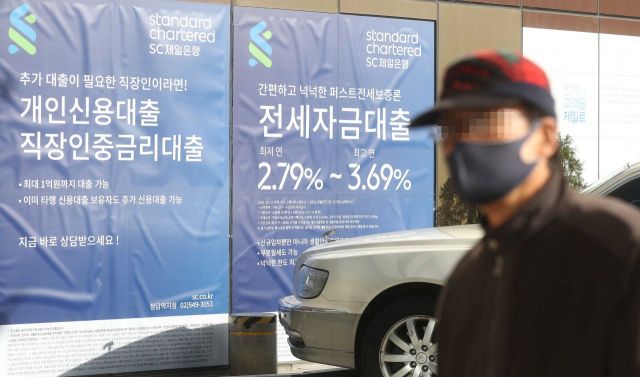 The era of near-zero interest rates that began after the COVID-19 crisis has come to an end after 1 year and 8 months. On the 25th, the Monetary Policy Board of the Bank of Korea held a meeting to decide on monetary policy direction and raised the base interest rate by 0.25 percentage points from 0.75% to 1%. The photo shows a loan-related notice posted on the exterior wall of a bank in downtown Seoul on the same day. Photo by Moon Honam munonam@
[Asia Economy Reporter Kim Jin-ho] Jung Woo-cheol (42, pseudonym), who works at a large corporation, was shocked when he tried to get a loan ahead of several family events next year. His main bank, an internet-only bank, rejected his loan application citing his high credit rating. Other banks also set loan amounts far below his requested limit, citing his top-tier credit rating. Jung said, "I have carefully managed my credit score to avoid delinquencies, but having a high rating has become a disadvantage, which I don't understand," and added, "Why should someone with a top-tier rating and the ability to repay be discriminated against compared to middle- or low-credit borrowers?"
As financial authorities have announced plans for stringent household debt management next year, dissatisfaction among high-credit borrowers is reaching a peak. While the total loan volume for high-credit borrowers with credit scores exceeding 900 is being further tightened, loans for middle- and low-credit borrowers are expected to be loosened under the pretext of relief measures for genuine borrowers, raising concerns about continued reverse discrimination. Some argue that this goes against common sense in the financial market and that the direction of regulation is inappropriate even from a soundness perspective.
According to the financial sector on the 21st, major banks have proposed a household loan growth target of 4.5 to 5.0% for next year to financial authorities. This is up to 1 percentage point lower than this year.
The ruling party and government recently agreed to ensure that loans for middle- and low-credit borrowers can proceed smoothly without interruption. Accordingly, banks plan to focus on loans to middle- and low-credit borrowers as their main business next year.
However, high-credit borrowers are expected to face a loan freeze again next year. With the lowered household loan growth target and the expansion of loans to middle- and low-credit borrowers, loans to high-credit borrowers must be restricted first. Most banks have already significantly reduced or suspended loans such as overdraft accounts for high-credit borrowers. Next year, even jeonse (key money deposit) loans, which were excluded from this year's total volume management, will be included, making it clear that the loan threshold for high-credit borrowers will rise further.
The market fears that the ‘distortion phenomenon,’ where financial common sense is collapsing, will become more pronounced. In one self-employed community, a method of deliberately lowering credit scores to receive government-supported loans is spreading like a trend. Especially recently, as a balloon effect of total volume regulation, high-credit borrowers with grades 1 to 2 who were pushed out of banks are knocking on the doors of secondary financial institutions, creating an unusual phenomenon. A financial sector official pointed out, "Telling lenders not to lend to those who are capable but only to those in difficulty cannot be explained by basic financial logic," adding, "From the financial companies' perspective, there is a significant risk of an increase in non-performing loans."
© The Asia Business Daily(www.asiae.co.kr). All rights reserved.

















