KIST Research Team
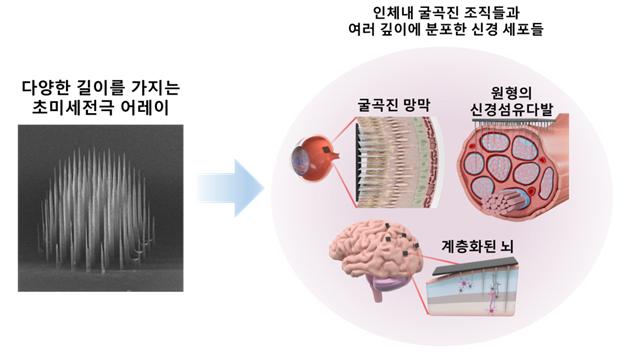 Microneedles, which are bundles of ultrafine electrodes of various lengths arranged together. They can closely approach only the target cells among nerve cells located at different depths in curved tissues such as nerve fiber bundles, the retina, and the brain, enabling effective reading of neural signals.
[Asia Economy Reporter Kim Bong-su] A microneedle (microneedle·ultrafine neural electrode bundle) made of neural electrode bundles of different lengths has been developed to approach neural cells existing at various depths within human tissue, record signals, and selectively stimulate them.
The National Research Foundation announced on the 21st that the research team led by Dr. Im Mae-soon and Dr. Lee Byung-chul at the Korea Institute of Science and Technology (KIST) developed a simpler semiconductor process capable of fabricating microneedles densely arranged with microelectrodes of various lengths.
To reach into the gaps of bathroom floor tiles, it is advantageous to use a cleaning brush with bristles of different lengths densely arranged. The same applies to the human body. To simultaneously record signals from neural cells distributed across multiple layers within complexly curved three-dimensional tissues such as the brain and retina, while selectively stimulating neural cells at desired locations, microneedles composed of electrodes of varying lengths are necessary.
Previously, this required a complicated and repetitive process of individually fabricating and assembling neural electrodes of different lengths.
The research team developed a method to fabricate bundles of neural electrodes of various lengths at once using a photomask design containing the desired length arrangement information, eliminating the hassle of separately producing electrodes of different lengths. The electrodes were designed with sharp tips (electrode tip cross-sectional width: ~145nm) and a high aspect ratio (25:1) to precisely position them in the target neural layer while minimizing tissue damage during insertion. This principle is similar to how sharp and thin thumbtacks and nails penetrate walls more smoothly. The microneedles actually fabricated could be inserted into mouse brains with about 100 times less force compared to previous studies. This force is comparable to that required for caterpillar spines to pierce mouse skin. By densely arranging up to 625 microelectrodes per unit area, the device can read a large volume of neural signals, making it useful for elucidating the functional connectivity of complex neural networks.
The research team plans to optimize the process, evaluate the biocompatibility and electrical characteristics of the device, and expects that high-density neural signal analysis using this technology will provide clues to understanding the efficient operating principles of the brain.
Student researcher Noh Hyun-hee, who participated in the study, explained, "We are also preparing electronic medicine experiments that implant the device into the eyes of blind animals and electrically stimulate the retina to realize artificial vision."
The research results were published online on the 9th in the international journal in the field of materials science and nanotechnology, Nano-Micro Letters.
© The Asia Business Daily(www.asiae.co.kr). All rights reserved.












