2022 Economic Policy Direction Briefing
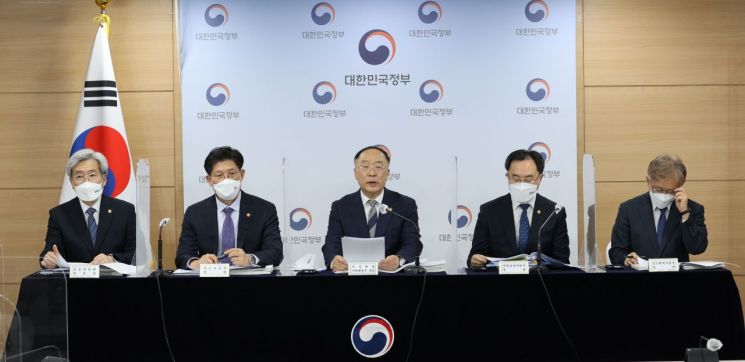 Deputy Prime Minister and Minister of Economy and Finance Hong Nam-ki announces the 2022 Economic Policy Direction at the 2022 Supplementary Budget Joint Briefing of Related Ministries held at the Government Seoul Office briefing room on the afternoon of the 20th. From the left, Ko Seung-beom, Chairman of the Financial Services Commission; Noh Hyung-wook, Minister of Land, Infrastructure and Transport; Deputy Prime Minister Hong; Moon Seung-wook, Minister of Trade, Industry and Energy; Kwon Chil-seung, Minister of SMEs and Startups. (Image source=Yonhap News)
[Sejong=Asia Economy Reporter Moon Chaeseok] Hong Nam-ki, Deputy Prime Minister for Economy and Minister of Economy and Finance, stated on the 20th, "Although a new government will be inaugurated due to next year's presidential election, our economic team will do our utmost without any hesitation to achieve our goals until the very end." The briefing was attended by Deputy Prime Minister Hong, Minister of Land, Infrastructure and Transport Noh Hyung-wook, Minister of Trade, Industry and Energy Moon Seung-wook, Financial Services Commission Chairman Ko Seung-beom, and Minister of SMEs and Startups Kwon Chil-seung.
At the '2022 Economic Policy Direction' briefing held at the Government Complex Seoul on the same day, Deputy Prime Minister Hong said, "This is a crucial time for efforts to overcome the crisis and leap toward normalization." He emphasized, "Next year is the first year of returning to normal life and the period to actively pursue the post-COVID-19 agenda. It is a very meaningful and important year in terms of economic management spanning both the current and next governments." He added, "I look forward to self-employed small business owners standing up again, our economy achieving full normalization, and vigorously advancing toward a leading economy in the post-COVID era."
He explained that the spread of the new COVID-19 variant Omicron, global supply chain disruptions, and concerns about global inflation are risk factors for our economy. He said, "The temporary pause in the phased recovery of daily life, which was difficult to start, was inevitable but a very painful decision," adding, "Since quarantine is essentially an economic vaccine, we will prioritize thorough quarantine control and implement economic policies accordingly."
Below is a Q&A session.
- The entities managing state affairs in the first and second halves of next year are different, but why was the early execution target for the first half set at 63%?
▲ Deputy Prime Minister Hong: The early execution target for the first half of next year's budget was set at 63%. It was 63% this year as well, and 62% last year. I want to make it clear that this was not set specifically considering political schedules such as the inauguration of the new government next year. Considering various factors, including the recent increase in uncertainty at the beginning of the year due to the spread of the Omicron variant, it was necessary to prioritize boosting the economy in the first half, so the target was set at 63%, the same as this year.
- The government mentioned platform fees as part of addressing structural price stability challenges. This seems to imply an intention to intervene in the fees small business owners pay to delivery apps and other platforms. What direction do you envision?
▲ Deputy Prime Minister Hong: Due to the limited competition characteristics of the online platform market, the voices of consumers and small business owners are not sufficiently considered in fee settings. The government intends to respond by enhancing the market's monitoring and competition functions. There are two directions. First, in cooperation with consumer organizations, we plan to provide online information on the status of delivery fees and price differences by delivery platform. Second, we will promptly proceed with the enactment of the Online Platform Fairness Act, which is currently pending in the National Assembly, to institutionalize platform fee surveys and information disclosure included in the law.
- There is mention of supplying some of the 3rd New Town and 2·4 Plan housing units as public owner-occupied housing to enable 'homeownership' with low initial costs. Could you explain in detail?
▲ Minister Noh: There are three types of public owner-occupied housing. The first is the 'equity accumulation type,' where initially about 10-20% of the house price is paid, and equity is accumulated gradually like a savings plan to eventually acquire ownership. The second is the land lease type, which separates land and building ownership, transferring ownership only of the building. The third is the profit-sharing type, where a small initial cost is paid, and when selling the house later, the Korean Land and Housing Corporation (LH) or other public institutions buy it and share the profits. Currently, our real estate market is divided between sales and rentals, but this provides a new form to expand choices. Through this economic policy direction, we intend to announce a detailed schedule. To promote this project, it is necessary to review the specific characteristics of each project district individually. We expect to announce the overall plan by June next year after changing district designation plans or consulting with local governments. Actual sales will proceed sequentially.
© The Asia Business Daily(www.asiae.co.kr). All rights reserved.

















