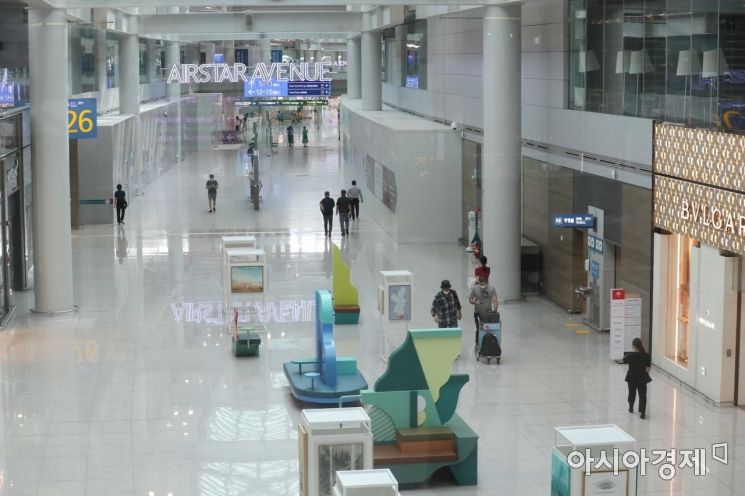
 On the 29th, the duty-free shop at Terminal 1 of Incheon International Airport is quiet due to the impact of COVID-19. Photo by Moon Honam munonam@
[Asia Economy Reporter Yuri Kim] Next year, the duty-free purchase limit will be abolished for the first time in 43 years. This is a plan to support the duty-free industry and shift travelers' overseas spending to domestic consumption in order to gradually normalize the international tourism industry base. As COVID-19 quarantine levels improve and travel demand increases, the demand for duty-free shopping is also expected to expand, so the purchase limit will be lifted accordingly.
The government announced the 2022 economic policy direction containing this information on the 20th. The domestic duty-free purchase limit was introduced in 1979. It gradually increased from $500 (about 596,000 KRW) at that time to $1,000 in 1985, $2,000 in 1995, $3,000 in 2006, and $5,000 (about 5.96 million KRW) in 2019.
A government official said, "The duty-free purchase limit was established in 1979 to curb consumption of overseas products, but considering Korea's current foreign exchange reserves and economic scale, the original purpose of suppressing excessive consumption and preventing foreign currency outflow has become less relevant." He added, "We expect to improve the problem where consumers had to purchase high-priced products overseas due to the low purchase limit and to revitalize the duty-free industry by shifting overseas consumption to domestic consumption." However, the overseas traveler duty-free limit of $600 is expected to remain unchanged. The duty-free limit is the per-person limit on duty-free goods purchased at duty-free shops and overseas upon entry. It has been maintained at $600 for seven years since it was raised from $400 in 2014.
The duty-free industry welcomed the news of the abolition of the domestic purchase limit. The industry has long argued that the purchase limit was too low compared to the purchasing power of the public. They have also requested that the regulation be promptly eased to help the recovery of the duty-free industry, which was hit hard by COVID-19. A duty-free industry official said, "The industry has been severely contracted for two years as the COVID-19 situation repeatedly worsened after hopes of improvement," adding, "With the abolition of the domestic purchase limit, we can now have some expectations for improvement in business conditions."
However, there was some disappointment that the duty-free limit remains at the current level. Another duty-free industry official said, "It is encouraging that the purchase limit was raised to expand the range of products available at duty-free shops," but added, "If the actual duty-free limit is also increased, it would greatly help stimulate consumption and support the struggling duty-free industry."
Meanwhile, to support the aviation and duty-free industries until international tourism resumes, the government will extend the operation period of non-landing sightseeing flights by six months from the end of this year to the end of June next year. Seat restrictions will also be lifted, aligning with regular routes.
© The Asia Business Daily(www.asiae.co.kr). All rights reserved.
![Clutching a Stolen Dior Bag, Saying "I Hate Being Poor but Real"... The Grotesque Con of a "Human Knockoff" [Slate]](https://cwcontent.asiae.co.kr/asiaresize/183/2026021902243444107_1771435474.jpg)











