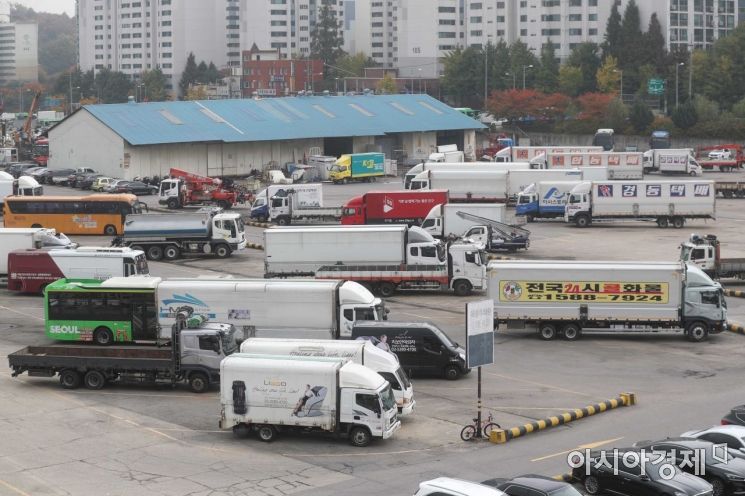
 On the 4th of last month, when the shortage of diesel exhaust fluid worsened, a truck was stopped at the Western Truck Terminal in Yangcheon-gu, Seoul. Photo by Moon Honam munonam@
[Asia Economy Reporter Choi Dae-yeol] It is forecasted that global supply chains, climate change response, and digital trade will remain key issues in the global trade market next year.
The Korea Chamber of Commerce and Industry and the Ministry of Trade, Industry and Energy held a forum on the 20th focusing on next year's trade issues and import regulations outlook. Lawyer Lee Seong-beom of the law firm Hwawoo stated, "Countries such as the US, EU, and Japan have introduced or are promoting economic security-related laws to protect their domestic industries' global value chains. These laws will impact global value chains, and our companies must prepare accordingly."
Supply chain issues that have persisted since last year, such as medical equipment supply problems triggered by COVID-19, production and supply disruptions of automotive semiconductors, and difficulties caused by a decrease in logistics providers, have continued throughout the year. Mainly negative aspects have been highlighted. In this context, these phenomena may become more pronounced under the pretext of protecting domestic industries and workers. A clear example is the Biden administration's domestic nurturing policies for the semiconductor and battery ecosystems.
Regarding climate change issues, Lawyer Lee said, "Several countries, including the EU and Korea, have introduced carbon emissions trading systems and grant free allowances to industries with high carbon intensity, but the US recently judged this as a subsidy. There needs to be an international agreement that policies introduced to achieve carbon emission targets should not be considered subsidies."
He added, "It is encouraging that Korea is actively involved in establishing digital trade norms, as seen in the recent Korea-Singapore Digital Partnership Agreement (DPA). It is necessary to identify corporate difficulties and actively reflect them in trade norms, and before expanding digital trade, efforts should be made to create a market-friendly domestic digital ecosystem."
There were also remarks emphasizing the need to prepare for US trade pressures. Simon Lester, President of World Trade Law, said, "The Biden administration is hesitant to withdraw the aggressive trade policies pursued by the Trump administration because it does not want the political risks associated with stopping Trump-era measures." He continued, "The labor-centered trade policy emphasized by the Biden administration actually began under the Trump administration. As union influence grows and regulations on forced labor strengthen, participation in free trade may decline. Therefore, the Biden administration may impose new commitments and obligations on countries like Korea."
The rising wave of import regulations targeting Korea is another area requiring preparation. Kim Doo-sik, lead lawyer at the law firm Sejong, said, "Last year, global import regulation measures such as anti-dumping and countervailing duties reached their highest level in the past decade, and Korea became the second most targeted country after China. Import regulations, especially among emerging Asian countries, may become more active as trade imbalances arise."
He added, "Regarding changes in the trade environment, companies prioritizing efficiency and governments prioritizing security may have differing positions. When establishing new trade orders among countries, such as the Indo-Pacific Economic Framework, all stakeholders should participate to thoroughly assess impacts and prepare countermeasures."
Woo Tae-hee, Vice Chairman of the Korea Chamber of Commerce and Industry, said, "While the global economic recovery is slowing due to the emergence of COVID-19 variants, movements toward supply chain restructuring and new protectionism such as carbon border taxes are accelerating and becoming more sophisticated. As industrial issues like supply chain restructuring, net zero, and import regulations, as well as geopolitical issues such as US-China relations, become more prominent, it is necessary to strengthen the foundation for intergovernmental cooperation to respond to trade issues."
© The Asia Business Daily(www.asiae.co.kr). All rights reserved.
![Clutching a Stolen Dior Bag, Saying "I Hate Being Poor but Real"... The Grotesque Con of a "Human Knockoff" [Slate]](https://cwcontent.asiae.co.kr/asiaresize/183/2026021902243444107_1771435474.jpg)
















