Government Blocks Increase to Control Prices... KEPCO Debt Swells to 142 Trillion Won This Year
"Additional Burden of 40,000 Won Per Citizen Annually... Neglecting Duty by Shifting Burden to Next Administration"
Urgent Need to Adjust Electricity Rates to OECD's Lowest Level Reality
[Sejong=Asia Economy Reporter Kwon Haeyoung] The government’s rationale for deciding to freeze electricity rates in the first quarter of next year is price control. It aims to keep public utility rates, which affect the lives of the people, unchanged due to concerns about inflation. However, the prevailing analysis is that the underlying reason is a political decision made out of concern for rising prices ahead of the presidential election in March next year. Despite the sharp rise in fuel costs that began earlier this year, Korea Electric Power Corporation (KEPCO), a public enterprise, has not raised electricity rates by a single won for a year, prioritizing political logic, thereby bearing all the losses. With the government’s nuclear phase-out policy causing energy costs to surge and the additional burden of passing on the electricity bill bomb, KEPCO’s deficits and debts are likely to balloon like a snowball. Since the debt of public enterprises ultimately falls on the people, the burden that the next government and future generations will bear will increase even more.
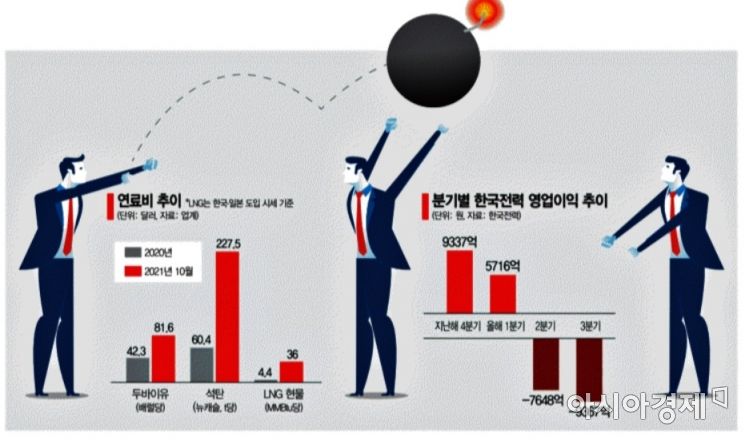
◆Fuel costs soar... KEPCO’s deficit expands=According to industry sources on the 20th, fuel costs such as crude oil, coal, and liquefied natural gas (LNG) are soaring. The price of Dubai crude oil rose 93% in less than a year, from $42.3 per barrel in 2020 to $81.6 from January to October this year. Coal, based on Newcastle coal, surged 277% from $60.4 per ton to $227.5, and spot LNG prices based on the JKM benchmark for Korea and Japan jumped 718% from $4.4 per MMBtu to $36 during the same period.
KEPCO’s fuel cost burden is also increasing. According to KEPCO, the average fuel cost over the three months from September to November rose 61.6% compared to the average fuel cost over the previous year. The wholesale price (SMP) at which KEPCO purchases electricity from power producers to sell to consumers such as households and businesses also tripled, rising from 49.8 won per kWh in November last year to 148.67 won per kWh on December 1 this year.
However, KEPCO was unable to raise electricity rates charged to consumers by even 1 won this year. The government raised electricity rates by 3 won per kWh in the fourth quarter for the first time since the introduction of the fuel cost linkage system, but this only restored the 3 won per kWh cut made in the first quarter. The Ministry of Trade, Industry and Energy insists that the rise in fuel costs should be reflected in electricity rates, but the Ministry of Economy and Finance, which oversees economic policy, has suppressed public price increases due to inflation concerns.
The freeze on electricity rates has rapidly worsened KEPCO’s financial burden. KEPCO’s operating profit on a consolidated basis was 933.7 billion won in the fourth quarter of last year but shrank to 571.6 billion won in the first quarter this year, and recorded losses of 764.8 billion won and 936.7 billion won in the second and third quarters, respectively. In less than a year, it turned from a 1 trillion won surplus to a 1 trillion won deficit. Internally, KEPCO estimates its operating loss this year to be 3.8492 trillion won, and the loss excluding the performance of its power generation subsidiaries to be 4.3845 trillion won.
◆Breach of trust controversy over electricity rate freeze likely to grow=The government is suppressing electricity rate hikes for price stability, but criticism is raised that this is merely a 'short-sighted' policy that worsens KEPCO’s financial situation and ultimately increases the burden on the people. KEPCO’s debt is expected to exceed 142 trillion won this year, with annual interest costs reaching 2 trillion won. The interest cost alone amounts to 5.7 billion won per day. Former KEPCO CEO Kim Jonggap pointed out, “Due to accumulated deficits, KEPCO has borrowed 70 trillion won, resulting in a debt burden of 1.4 million won per citizen, and paid 2 trillion won in interest last year, imposing an additional annual burden of 40,000 won per citizen. If electricity rates are controlled, it must be clearly stated that citizens will later bear a greater burden including principal and interest on the loans.”
Above all, critics argue that the government’s failure to raise electricity rates sufficiently to cover the rapid increase in costs caused by the Moon Jae-in administration’s nuclear phase-out, expansion of renewable energy investments, and imposition of climate and environmental costs amounts to dereliction of duty.
There are also many claims that freezing electricity rates constitutes a breach of trust that harms KEPCO’s shareholders’ interests. KEPCO is a public enterprise with the government holding 51.1% of shares (Korea Development Bank 32.9%, government 18.2%), but it is also a listed company with private investors holding shares. Minor shareholders of KEPCO have announced plans for a class-action lawsuit over the electricity rate freeze, and the government cannot be free from breach of trust controversy.
Some argue that the unrealistically low electricity rates need to be normalized. Korea’s electricity rates for the residential sector are $102.4 per MWh, the second lowest among 36 OECD countries (based on 2019 market exchange rates). For the industrial sector, the rate is 94.8 won, ranking 12th lowest among OECD countries.
An industry official said, “With the government accelerating carbon neutrality, related investments and costs will increase, and as electrification speeds up, KEPCO’s burden will grow further. Electricity rates should be normalized to improve KEPCO’s financial structure and encourage consumers to use electricity rationally.”
© The Asia Business Daily(www.asiae.co.kr). All rights reserved.
![Clutching a Stolen Dior Bag, Saying "I Hate Being Poor but Real"... The Grotesque Con of a "Human Knockoff" [Slate]](https://cwcontent.asiae.co.kr/asiaresize/183/2026021902243444107_1771435474.jpg)
















