Korea Institute of Radiological & Medical Sciences
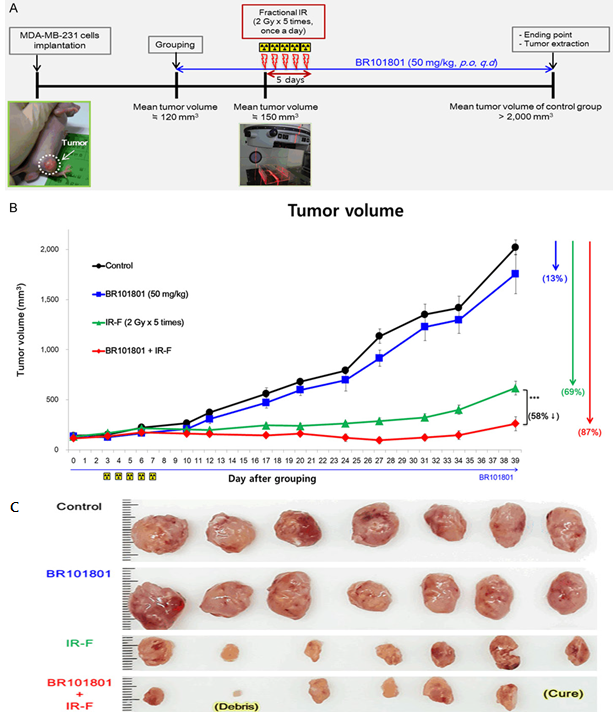 Graph verifying the combined efficacy of the blood cancer treatment drug (BR101801) with radiation using a xenograft animal model.
[Asia Economy Reporter Kim Bong-su] It has been revealed that a blood cancer treatment drug can be used as an adjuvant to enhance the effect of radiation therapy when treating various other cancers.
The Korea Institute of Radiological & Medical Sciences announced on the 20th that Dr. Jeong Yeon-gyeong's research team confirmed that the blood cancer treatment drug (BR101801), which simultaneously inhibits the major growth and regulatory factors of cancer cells, PI3K and DNA-PK, has a radiosensitizing effect in various solid tumors. A radiosensitizer refers to an adjuvant drug that reduces resistance and side effects while enhancing the effectiveness of radiation therapy in cancer patients.
BR101801 is currently undergoing a Phase 1 clinical trial by Boryung Pharmaceutical Co., Ltd. for its anticancer effects on non-Hodgkin lymphoma, a type of blood cancer. This study was conducted with support from a private consignment project to investigate not only the anticancer effects of BR101801 on blood cancer but also its radiation therapy effects on solid tumors.
The research team focused on the fact that PI3K and DNA-PK, major growth and regulatory factors of cancer cells, cause resistance during radiation therapy, and that the blood cancer treatment drug BR101801 simultaneously inhibits PI3K and DNA-PK. They confirmed the therapeutic effect when combining BR101801 with radiation therapy in solid tumors and demonstrated the potential of BR101801 as a radiosensitizer. Specifically, in cell experiments with various solid tumors such as colorectal cancer, lung cancer, and breast cancer, BR101801 alone showed no inhibitory effect on cancer cell proliferation, but when combined with radiation, it showed a cancer cell proliferation inhibition rate of over 50 to 70%.
In animal experiments with implanted cancer cells, BR101801 alone showed almost no tumor suppression effect, but when combined with radiation, it exhibited about 85% tumor suppression, and in 2 out of 7 experimental animals, tumors completely disappeared.
The results of this study were published online on the 15th of last month in the international academic journal American Journal of Cancer Research.
Dr. Jeong said, “By elucidating new core mechanisms that produce a synergistic effect in cancer treatment when combining BR101801 with radiation exposure in solid tumors, we will accelerate the establishment of a groundbreaking turning point in domestic radiation therapy.”
© The Asia Business Daily(www.asiae.co.kr). All rights reserved.
![Clutching a Stolen Dior Bag, Saying "I Hate Being Poor but Real"... The Grotesque Con of a "Human Knockoff" [Slate]](https://cwcontent.asiae.co.kr/asiaresize/183/2026021902243444107_1771435474.jpg)
















