Professor Yonggeun Park's Research Team at KAIST
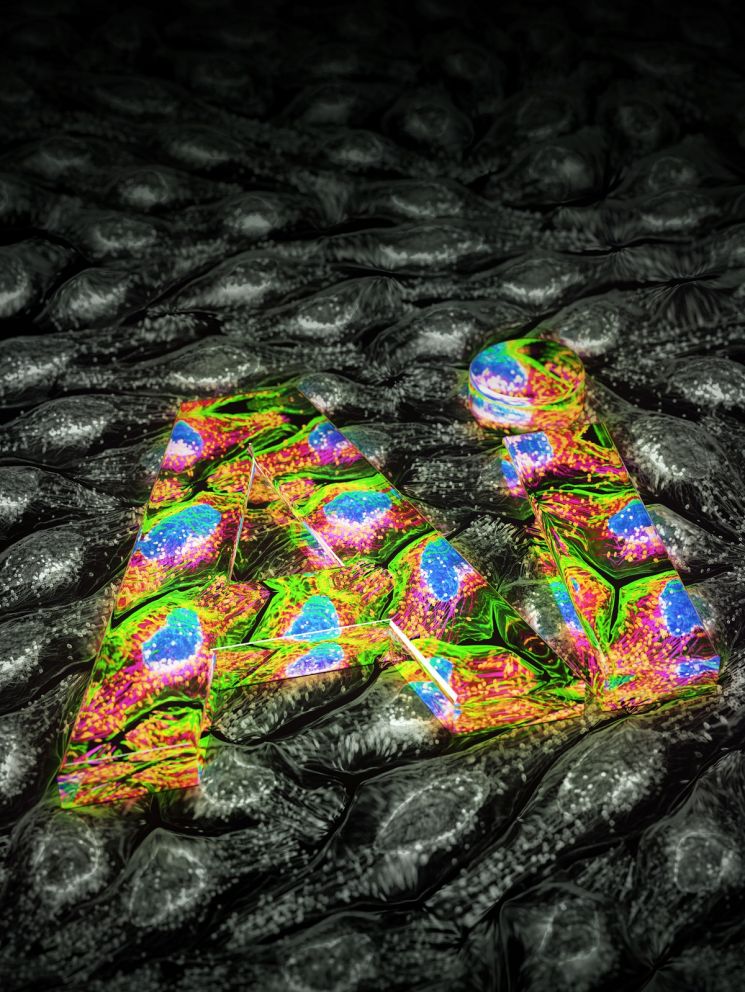
[Asia Economy Reporter Kim Bong-su] An artificial intelligence (AI) microscope that can view molecular information of cells without fluorescent staining has been developed.
The Korea Advanced Institute of Science and Technology (KAIST) announced on the 20th that a research team led by Professor Park Yong-geun of the Department of Applied Physics published a paper on this AI microscope technology in the international journal Nature Cell Biology on the 7th.
Professor Park's research team began research in early 2012 to introduce artificial intelligence into the field of holographic microscopy to solve specificity issues, culminating in this achievement.
Optical microscopes have been one of the most important technologies used in biology and medicine from hundreds of years ago to the present, evolving into various forms based on image formation principles. In recent decades, with the remarkable advancement of molecular biology, it has become possible to label specific structures within cells using fluorescence, and thanks to this high biochemical specificity, fluorescence microscopy has become the most widely used optical microscopy technology today.
However, fluorescence microscopy places a burden on cells because the fluorescent labeling itself alters the cells. Due to issues with brightness, cytotoxicity, and stability, ultra-fast or long-term measurements are difficult. There is a fundamental limitation in simultaneously viewing various structures due to the limited number of colors available.
On the other hand, microscopy technology that uses the refractive index, a fundamental property determining the interaction between each substance and light, which requires no staining, has also steadily advanced. Traditional microscopes utilize light absorption and phase differences derived from the refractive index.
Recently, various holographic microscopy technologies that quantitatively measure the refractive index itself in three dimensions have been commercialized. These label-free microscopy technologies have several advantages compared to fluorescence microscopy, but they have the drawback of lower molecular specificity because the relationship between the refractive index and intracellular structures is unclear.
However, Professor Park's team, through continuous research since 2013, found that refractive index images of samples that are morphologically similar but biochemically different (such as various species of bacteria and different classifications of white blood cells) appear similar to the human eye, but interestingly, artificial intelligence can classify them with high accuracy. This result was consistently observed across a wide variety of biological samples, leading the research team to hypothesize that information with high biochemical specificity is hidden in the spatial distribution of the refractive index.
The research team proved this hypothesis by demonstrating in their paper that fluorescent microscopy images can be directly predicted from holographic microscopy images. By using the quantitative relationship between the refractive index spatial distribution found by AI and major intracellular structures, decoding of the refractive index spatial distribution became possible, and surprisingly, this relationship was confirmed to be conserved regardless of cell type.
The resulting "AI microscope" combines the advantages of holographic and fluorescence microscopes. In other words, it can obtain specific fluorescence microscopy images without fluorescent labeling. Therefore, it enables simultaneous three-dimensional viewing of numerous types of structures in cells in their natural state, allows ultra-fast measurements at the millisecond (ms) level, and long-term measurements over tens of days. Furthermore, since it can be immediately applied to new types of cells not included in existing data, it is expected to be applicable to various biological and medical research fields.
© The Asia Business Daily(www.asiae.co.kr). All rights reserved.

















