This Year’s Voluntary Retirement Scale at 2,092+
Approaching 5,000 Including Foreign Firms
Voluntary Retirement Age ↓ Compensation Level ↑
Hiring and Store Numbers Decline Amid Downsizing
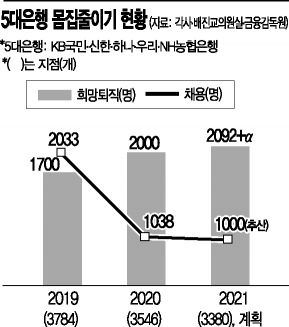
[Asia Economy Reporter Song Seung-seop] The number of voluntary retirees at major commercial banks this year is expected to be twice the number of new hires. This is due to a reduction in open recruitment and an increase in the number of voluntary retirement targets. Branch offices are also rapidly disappearing. While this is seen as an inevitable survival strategy, concerns about side effects coexist.
According to the financial sector on the 20th, the number of voluntary retirees at KB Kookmin, Shinhan, Hana, Woori, and NH Nonghyup Banks this year has reached 2,092. The number has been steadily increasing from the 1,700 range in 2019 to the 2,000 range last year. About 800 people left KB Kookmin Bank in January, and 350 people packed up in two rounds at Shinhan Bank. At NH Nonghyup Bank, a total of 452 people announced their intention to leave the company from the 19th to the 23rd of last month.
The number of voluntary retirees is expected to be even higher. Hana Bank had 22 people leave in the first half of the year and plans to accept voluntary retirement applications as early as the end of this month or in January. Woori Bank, which saw 468 people leave, is accepting voluntary retirement applications from today until the 28th according to labor-management agreement. Combining SC First Bank and Korea Citibank, which have 496 and about 2,300 voluntary retirement applicants respectively, the total is expected to exceed 5,000, marking an all-time high.
It is widely expected that voluntary retirements will continue to increase for the time being. Banks are competitively lowering the eligible age for voluntary retirement. Woori Bank lowered the voluntary retirement age from 54 to 46 last year and further lowered it to 41 this year. Compensation levels are also increasing. Citibank and SC First Bank announced that they will pay up to 600 to 700 million KRW per person as voluntary retirement benefits.
Decreasing Staff, Disappearing Branches
On the other hand, the number of new hires is steadily decreasing. According to Bae Jin-kyo of the Justice Party, the number of open recruitment hires at the five major banks is estimated to be about 1,000 this year. This has continuously decreased from 2,033 in 2019 and 1,038 last year. Most recruitment has been limited to digital and IT sectors. Most existing banker personnel were selected through occasional hiring. Hana Bank and Woori Bank did not conduct new graduate recruitment this year.
Downsizing is likely to accelerate in conjunction with branch closures. As face-to-face service spaces disappear, the demand for teller staff is shrinking faster. According to the Financial Supervisory Service, the number of domestic bank branches decreased from 7,281 in 2015 to 6,326 by the first half of this year, a reduction of about 1,000. Another 143 branches are planned to close in the second half. Large commercial bank branches led the decline, dropping from 4,314 to 3,380.
While some view this as an unavoidable survival strategy, there are also warnings about side effects. Researcher Lee Gu-hyung of the National Assembly Legislative Research Office said, “Branch closures are seen as one of the survival strategies banks must choose amid the expansion of financial digitalization,” but warned, “If financial exclusion is neglected, some users may be excluded from financial services, leading to social problems.”
© The Asia Business Daily(www.asiae.co.kr). All rights reserved.
![Clutching a Stolen Dior Bag, Saying "I Hate Being Poor but Real"... The Grotesque Con of a "Human Knockoff" [Slate]](https://cwcontent.asiae.co.kr/asiaresize/183/2026021902243444107_1771435474.jpg)















