KCCI SGI to Release Report on the 20th
Record High Export Performance This Year... Growing External Uncertainties Next Year
[Asia Economy Reporter Hwang Yoon-joo] This year, South Korea's trade surpassed 1 trillion dollars, marking an all-time high performance. However, concerns have been raised that export conditions may contract from next year onwards due to the semiconductor cycle transition and the slowdown in emerging market growth.
The Korea Chamber of Commerce and Industry's Sustainable Growth Initiative (SGI) stated in its report "Characteristics and Future Tasks of Domestic Exports" on the 20th, "This year, exports led domestic economic growth, but from next year, increasing risk factors threatening exports could become obstacles to economic recovery," adding, "To keep exports at the center of economic recovery next year, a response strategy through qualitative advancement of items and markets is necessary."
Top 3 Export Risks: ① Semiconductor Cycle Transition ② Financial Market Instability after US Tapering ③ Emerging Market Growth Slowdown
SGI identified three major risks threatening exports next year: ① semiconductor cycle transition, ② financial market instability following US tapering, and ③ slowdown in emerging market growth.
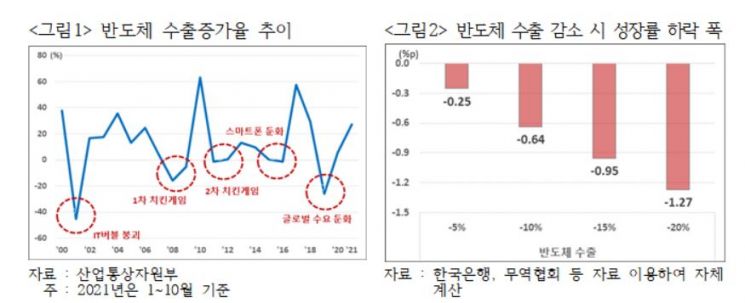
First, the possibility of a semiconductor business cycle transition was mentioned. In the past, during periods such as the IT bubble burst (2001) and the first and second chicken games (2008, 2011), semiconductor exports experienced a sharp decline of over 40%.
SGI said, "If the semiconductor market weakens next year, the domestic economy, which heavily depends on exports, will inevitably suffer adverse effects," and predicted, "If a semiconductor price shock materializes next year causing semiconductor exports to decrease by 10%, the economic growth rate is expected to drop by 0.64 percentage points."
The slowdown in emerging market growth following the US quantitative easing reduction is also a threat to exports. Recently, the US Federal Reserve (FED) announced a reduction in asset purchases starting at the end of November. The report explained, "After the global financial crisis, the tapering implemented by the US significantly contracted the economies of fiscally vulnerable countries such as Brazil and Indonesia," adding, "At that time, due to reduced import demand from emerging markets, South Korea's export share to emerging markets decreased from 54.7% in 2013 to 53.4% in 2015."
The report expressed particular concern about the slowdown in China's growth among emerging markets. It stated, "Recently, the IMF forecasted that China's economic growth rate, which peaked at 8.0% in 2021, will slow to 5.6% in 2022," and "South Korea's export dependence on China is very high at 25.3%, so if China's import demand decreases, domestic exports will suffer a direct impact."
According to SGI's analysis, if South Korea's exports to China decrease by 10%, the domestic economic growth rate is estimated to decline by 0.56 percentage points.
SGI's Export Expansion Measures: Diversification of Export Items, Fostering Eco-friendly and High Value-added New Industries, Diversification of Export Markets, Supply Chain Management
As countermeasures against export risks, SGI proposed ① diversification of export items, ② fostering eco-friendly and high value-added new industries, ③ diversification of export markets, and ④ supply chain management.
First, diversification of export items was emphasized. South Korea's export structure is highly dependent on the top 10 export items such as semiconductors, automobiles, and petroleum products, which account for 56.5%, making it vulnerable to risks in individual industries.
The report said, "It is necessary to strengthen domestic supply capacity for consumer goods such as bio, life sciences, beauty, and food, which have recently seen rapid export growth, and to enhance marketing using the Korean Wave and influencers."
It continued, "Energy transition policies should be utilized as opportunities to foster new industries, taking the lead in high value-added items such as eco-friendly vehicles and LNG ships," and added, "It is necessary to secure competitiveness in future car technologies with high added value and high import dependence such as automotive semiconductors, software, and lightweight materials, and to transform the industrial ecosystem including parts companies, maintenance systems, and workforce to be eco-friendly."
Along with diversification of export markets, supply chain management was also urged. The report stated, "After the COVID-19 crisis, vulnerabilities of the global supply chain to production stoppages, lockdowns, and export bans in specific regions were revealed," and "Support for stable construction of global supply chains through securing new import countries and inducing domestic relocation of production facilities by supporting smart factories and manufacturing robots for domestic companies that moved overseas for low wages is necessary."
© The Asia Business Daily(www.asiae.co.kr). All rights reserved.
![Clutching a Stolen Dior Bag, Saying "I Hate Being Poor but Real"... The Grotesque Con of a "Human Knockoff" [Slate]](https://cwcontent.asiae.co.kr/asiaresize/183/2026021902243444107_1771435474.jpg)
















