Differentiated Compensation for Medical Institution Losses Implemented
No Compensation for ICU Stays Over 20 Days
KMA: "Will Cause Confusion in Medical Field"
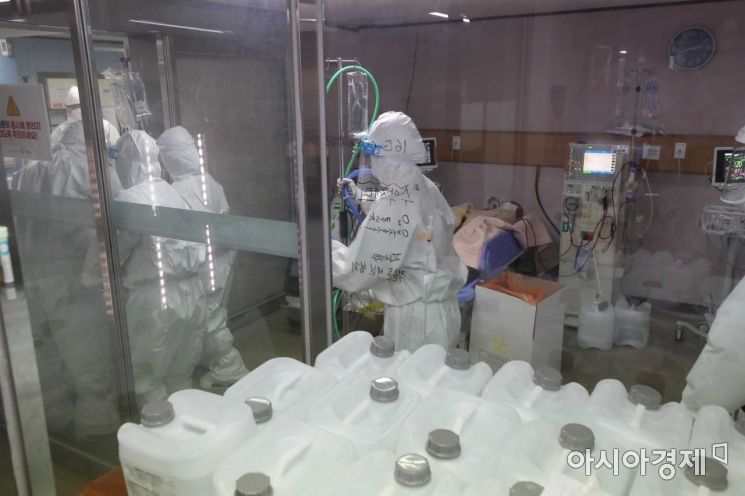 On the 16th, medical staff are caring for a patient in the intensive care unit of Pakae Hospital, a COVID-19 dedicated hospital in Pyeongtaek-si, Gyeonggi-do. Photo by Moon Honam munonam@
[Asia Economy Reporter Lee Chun-hee] As the shortage of COVID-19 intensive care unit (ICU) beds becomes increasingly severe, the government is continuously issuing measures to improve bed management efficiency. In addition to setting the isolation release period for COVID-19 critical patients to a maximum of 20 days, compensation for hospital losses will decrease inversely proportional to the length of stay when patients are admitted to severe beds for extended periods. The medical community has called for a review, criticizing the measures as ignoring the frontline situation.
On the 17th, the Central Disaster and Safety Countermeasures Headquarters of the Ministry of Health and Welfare announced that, following the deliberation and resolution of the Loss Compensation Deliberation Committee the previous day, differential compensation for medical institutions based on the length of stay of COVID-19 patients will be implemented starting that day. This will be applied temporarily until the shortage of severe patient beds is resolved.
This measure follows the recent announcement by health authorities that COVID-19 critical patients who have passed 20 days since symptom onset will be released from isolation. The authorities determined that after 20 days from symptom onset, patients no longer have infectiousness and thus should be released from isolation. If symptoms improve, immediate discharge from severe beds is possible, and if additional treatment is needed due to underlying conditions, patients will be transferred to general ICUs or other hospitals to continue treatment. They also announced that hospitalization costs incurred after the isolation period will be shifted to the patient's personal responsibility.
Furthermore, the government explained that the adjustment of incentives for COVID-19 severe beds provided to hospitals is a measure to ensure that beds are used by patients who truly need them. Previously, beds dedicated to critical patient treatment were compensated at 10 times the standard bed rate regardless of length of stay. During this process, some pointed out that certain medical institutions admitted patients to severe beds even when ICU treatment was not strictly necessary, considering the high loss compensation.
However, going forward, compensation will be increased in the early days of hospitalization and reduced in the later days based on length of stay. Compensation rates will increase up to 14 times for the first 5 days, remain at the current 10 times rate for days 6 to 10, but decrease to 6 times for days 11 to 19. No loss compensation will be provided if patients are released from isolation after 20 days.
Currently, COVID-19 critical patients stay in ICUs for an average of 10 to 12 days. Park Hyang, head of the Central Disaster and Safety Countermeasures Headquarters' quarantine team, explained during a COVID-19 briefing that "setting the isolation release period to 20 days after symptom onset is based on the understanding that typical patients have infectiousness for about 10 days, and critical patients for about 20 days," adding, "the average ICU length of stay ranges between 10 and 12 days."
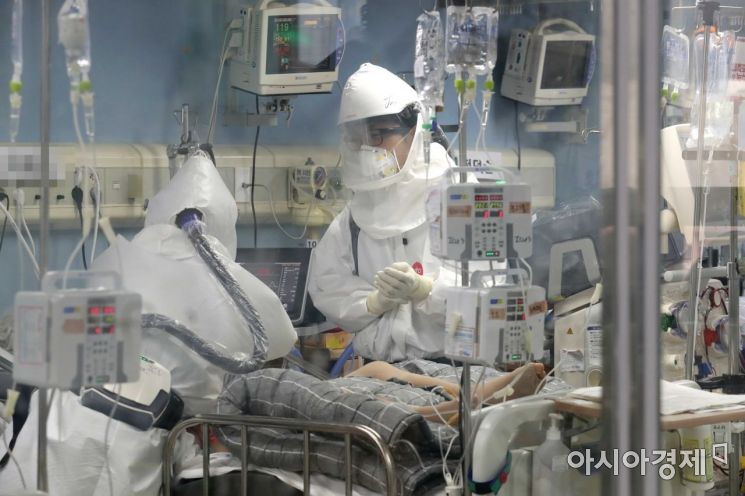 On the 16th, medical staff are caring for a patient in the intensive care unit of Pakae Hospital, a COVID-19 dedicated hospital in Pyeongtaek-si, Gyeonggi-do. Photo by Moon Honam munonam@
Meanwhile, the Korean Medical Association has requested an immediate review of the government's policy. The Association's COVID-19 Countermeasures Expert Committee expressed deep concern over the confusion the changed guidelines could cause in medical settings through their "Recommendation on the Government's Change of ICU Isolation Release Criteria," urging the government to promptly reconsider the ICU isolation release standards.
They pointed out that although the U.S. Centers for Disease Control and Prevention (CDC) and the European Centre for Disease Prevention and Control (ECDC) set the 20-day standard, the ICU medical environments in the U.S. and Europe differ significantly from Korea's. Unlike the mostly single-room ICUs in the U.S. and Europe, Korea's ICUs are mainly multi-bed rooms, raising concerns that if critical patients with residual infectiousness are present, it could lead to institutional cluster infections.
The Expert Committee warned that "under these guidelines, general ICU beds may be occupied by COVID-19 critical patients who have been released from isolation," which could "result in treatment restrictions for general critical patients." Currently, non-COVID-19 critical patients already wait several days for ICU beds, and in the future, ICU admission may become practically impossible, potentially delaying surgeries, emergency treatments, and general medical care.
Finally, the Expert Committee recommended "immediate withdrawal of the ICU isolation release criteria or pilot application only in ICUs where single-room isolation is possible," and insisted that "a thorough review and supplementation should be conducted through sufficient discussions with the medical community." They also urged reconsideration of the policy that hospitalization costs incurred after the COVID-19 isolation period be shifted to the patient's responsibility, stating, "Treatment and management of infectious diseases are the state's responsibility," and "It is appropriate for the state to also take responsibility for the treatment and management, including aftereffects, of COVID-19 patients."
Park Hyang also stated, "We are adjusting operational policies while listening to voices from the field." He added, "There is a possibility that patients released from isolation may still have infectiousness. Even if infectiousness decreases, psychological burdens remain, so various measures are being discussed." Currently, authorities are considering preparing separate rooms for these patients, taking into account the risk of transmission if isolated critical patients are moved to general multi-bed rooms.
© The Asia Business Daily(www.asiae.co.kr). All rights reserved.


















