Rural Housing Exclusion from Comprehensive Real Estate Tax Proposed
Clear Justification Amid Wealth Tax Cuts and Capital Gains Tax Suspension
Effects Include Addressing Local Extinction and Vacant House Issues
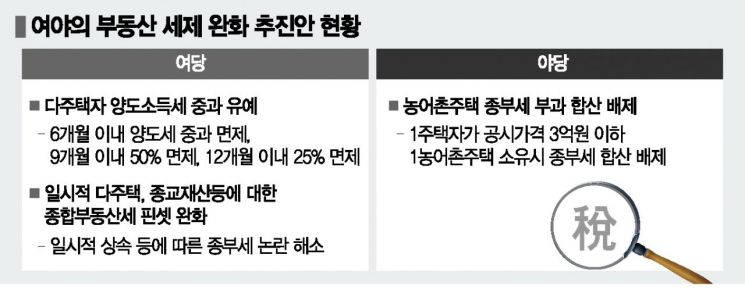
[Sejong=Asia Economy Reporters Kim Hyunjung, Oh Jooyeon] Ahead of the March presidential election next year, both ruling and opposition parties have simultaneously moved to ease real estate-related tax policies. The ruling party, which has consistently strengthened real estate holding and transaction taxes under the banner of a 'war on real estate,' is now accelerating the pace. The opposition party is also joining the movement toward 'reconciliation with real estate' by pushing for a revision of the Comprehensive Real Estate Tax Act to exclude rural housing from the comprehensive real estate tax base.
According to the National Assembly on the 17th, both parties share the internal consensus that the burden of comprehensive real estate tax on rural housing ownership should be reduced. Unlike the ruling party’s recent proposal to suspend the capital gains tax surcharge, which has been criticized as a 'tax cut for the wealthy,' the tax relief for rural housing has a clear justification in addressing local extinction and vacant house problems, making it easier to promote.
Furthermore, under the current Income Tax Act and Restriction of Special Taxation Act, capital gains tax exemptions are already provided for rural housing, allowing for an approach based on fairness. The relevant laws grant capital gains tax exemptions for towns and townships outside the metropolitan area, or for neighborhoods in cities with populations under 200,000, as well as border areas (such as Yeoncheon in Gyeonggi Province and Ongjin in Incheon). For example, even if a person who already owns a house in Seoul acquires a rural house in Yeoncheon, Gyeonggi Province, and later disposes of the existing Seoul house, the rural house is considered non-existent, and the person is regarded as a single-home owner, thus receiving capital gains tax exemption benefits. According to data on rural housing from the National Assembly Budget Office, as of 2019, the number of houses located in towns and townships reached 4.02 million households. Among them, detached houses accounted for 2.111 million households, apartment-type houses 1.848 million households, and houses within non-residential buildings 61,000 households.
Within the ruling party, Lee Jae-myung, the Democratic Party presidential candidate, recently mentioned that no one who owns a rural house occasionally used, even if they have two houses, should be unfairly subjected to the comprehensive real estate tax. Accordingly, it is highly likely that the upcoming Democratic Party caucus next week will address this issue along with the temporary suspension of the capital gains tax surcharge for multiple homeowners.
At a meeting held the previous day, Candidate Lee pointed out, "If you have two houses, you automatically become subject to the comprehensive real estate tax, but a rural house worth 5 million won that is occasionally used becomes a second house, and the comprehensive real estate tax is imposed on the Seoul apartment. Sometimes the amount imposed is more expensive than a rural shack. Is this reasonable?" He added, "This needs to be adjusted," opening the possibility that rural houses in agricultural and fishing areas may be excluded from the housing count in the comprehensive real estate tax calculation.
The Democratic Party is already preparing a revision bill to the Comprehensive Real Estate Tax Act reflecting this. A Democratic Party official said, "We are refining the revision bill" and "We are coordinating the timing of its submission."
A member of the Democratic Party’s election committee said, "This is one of the real estate tax reform plans that the candidate has always considered," but added, "However, the party atmosphere needs to be heard at the caucus." Since there are internal disagreements over the suspension of the capital gains tax surcharge, deliberation is also necessary regarding adjustments to the comprehensive real estate tax. He said, "Although internal opinions on the comprehensive real estate tax have not yet been finalized, if it is discussed at the next caucus, we will listen carefully."
The ruling party is also pushing to temporarily lower the capital gains tax surcharge rate, which was implemented at up to 75% in June, and to partially adjust the comprehensive real estate tax rate, which has increased due to temporary inheritances and other factors.
© The Asia Business Daily(www.asiae.co.kr). All rights reserved.
![Clutching a Stolen Dior Bag, Saying "I Hate Being Poor but Real"... The Grotesque Con of a "Human Knockoff" [Slate]](https://cwcontent.asiae.co.kr/asiaresize/183/2026021902243444107_1771435474.jpg)

















