Refusal of Private Hospitals Due to 'Corona' Label
"Severe Patients Need Ongoing Treatment
But No Beds Available, Forced Out"
Virus Remains, Can't Go to Nursing Hospitals
"Up to 20 Days Isolation After Symptoms
It Can Take 2 Months to Test Completely Negative"
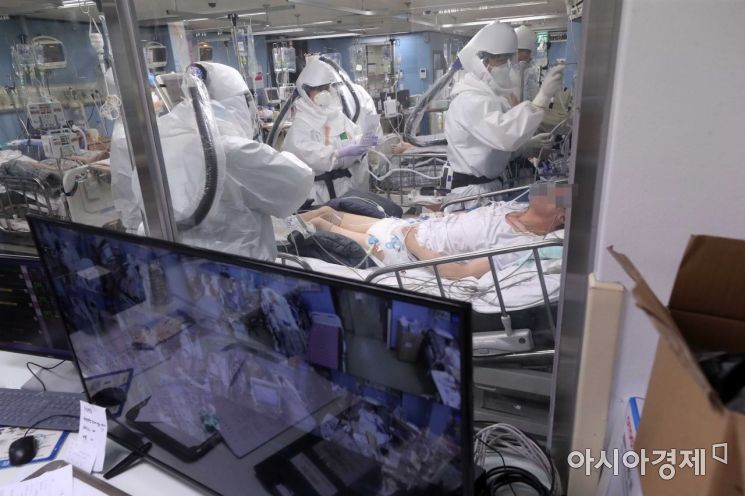 On the 16th, medical staff are caring for a patient in the intensive care unit of Pakae Hospital, a COVID-19 dedicated hospital in Pyeongtaek-si, Gyeonggi-do. Photo by Mun Ho-nam munonam@
[Asia Economy Reporters Seo So-jeong and Lee Chun-hee] "The COVID-19 symptoms have disappeared, so my mother should be discharged from the ICU, but there is nowhere for her to go."
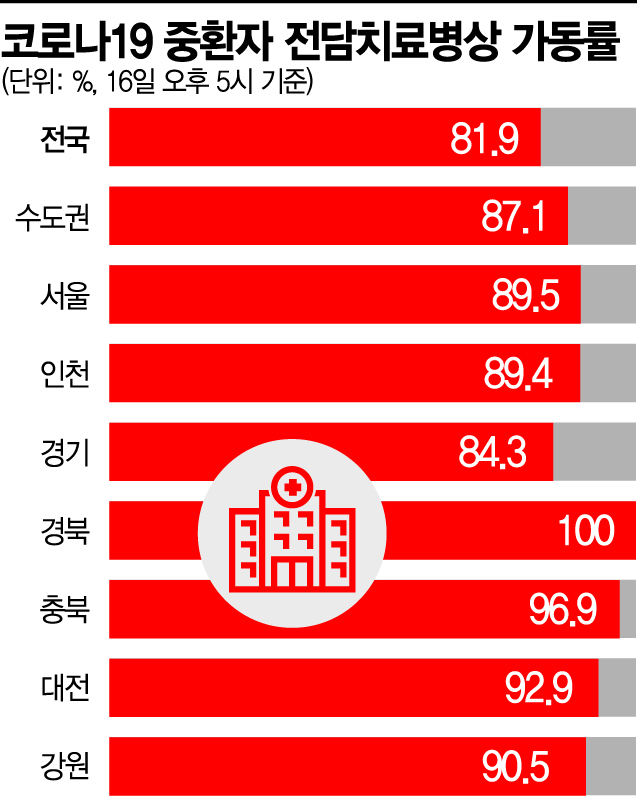
On the 17th, with 7,435 new COVID-19 cases reported for the third consecutive day above 7,000 and 971 critically ill patients nearing 1,000, medical facilities are facing an emergency in securing hospital beds. The government has decided to allow ICU stays for COVID-19 patients only up to 20 days after symptom onset to resolve the saturation of severe care beds, resulting in critically ill patients unable to find hospitals to transfer to.
Mr. Kang, a resident of Seoul, said, "My mother in her 70s, who is suffering from cerebral infarction, is in poor condition, but the nursing hospital says they have to wait at least two months until a PCR test shows negative because the virus remains in her body." He added, "I desperately need caregiving, but since I run a small business, I cannot take care of her at home, so it’s a difficult situation."
In particular, the economic burden has increased as hospitalization costs incurred after the isolation period are now fully borne by the patients themselves. Jung Hyung-jun, Public Medical Committee member of the Association of Doctors for Humanitarian Practice, pointed out, "Many patients in severe care beds are elderly with underlying conditions who require continuous treatment. Private hospitals, lacking medical staff, are reluctant to accept patients needing nursing care services, and nursing hospitals refuse admission fearing group infections, effectively forcing patients out." He criticized the system problem of insufficient beds for transferring patients even after COVID-19 recovery being unfairly labeled as a ‘moral hazard of patients occupying beds for too long.’
As the shortage of beds worsens, the Central Disaster and Safety Countermeasures Headquarters of the Ministry of Health and Welfare announced that from this day forward, compensation for medical institutions will be differentiated based on the length of patient hospitalization. Compensation rates will be higher in the early days of hospitalization and reduced in the later days. For up to 5 days of hospitalization, compensation rates increase up to 14 times; for days 6 to 10, the current rate of 10 times is maintained. However, for days 11 to 19, the compensation rate drops to 6 times, and no compensation is provided if isolation is lifted after 20 days.
A hospital official said, "The government has introduced differentiated compensation to improve turnover rates of severe care beds, but given the severe shortage of medical staff, it is difficult to secure beds dramatically under the current circumstances." He added, "The fundamental problem is that a step-up and step-down system for beds according to patient severity has still not been established."
The medical community also expressed immediate concerns. The Medical Association stated, "The 20-day isolation release standard for COVID-19 patients adopts the criteria of the U.S. Centers for Disease Control and Prevention (CDC) and the European Centre for Disease Prevention and Control (ECDC), but there is a significant difference from Korea, where ICUs consist of single and multi-bed rooms." They criticized, "If some infectious critically ill patients use general wards, it could lead to cluster infections in medical institutions."
Meanwhile, enhanced quarantine measures for religious facilities, which were excluded from the strengthened social distancing measures announced the previous day, will be implemented. The Ministry of Culture, Sports and Tourism announced today that for regular religious activities, unvaccinated participants will be limited to 30% of capacity (up to 299 people), and vaccinated participants can attend up to 70% capacity. This measure will be in effect from the 18th until the 2nd of next month.
© The Asia Business Daily(www.asiae.co.kr). All rights reserved.


















