KOSPI Turns Up After Falling Start
Focus on Resolution of Uncertainty Over Major Countries' Monetary Policy Shifts
SK Telecom Up 4%...Banks and Telecommunications Lead Gains
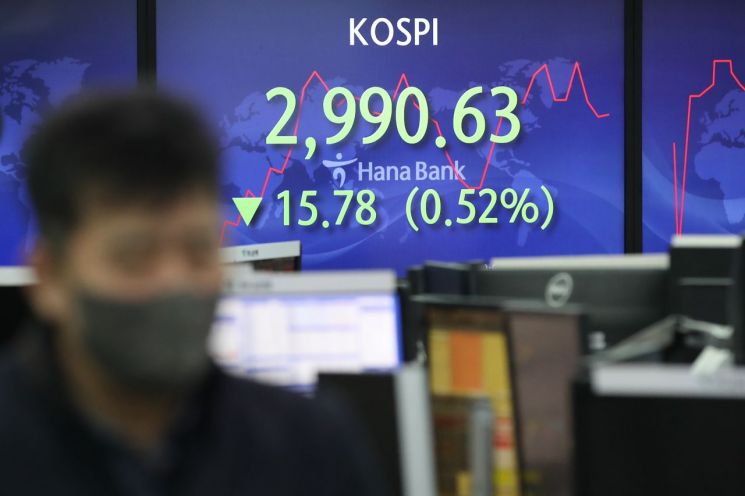
[Asia Economy Reporter Minji Lee] While the U.S. stock market showed a sharp decline centered on the Nasdaq index, the KOSPI continues its upward trend, focusing on the resolution of uncertainties surrounding tightening policies in major countries.
As of 10:18 a.m. on the 17th, the KOSPI stood at 3,013.90, up 0.23% (7.05 points) compared to the previous trading day. The KOSPI started the day sharply down by 0.71% (21.21 points) at 2,985.20 but reduced its losses early in the session and turned positive. Currently, foreigners and institutions have purchased stocks worth 172.2 billion KRW and 76.4 billion KRW respectively, while individuals have sold stocks worth 245.5 billion KRW alone.
The KOSPI's rise is analyzed to be due to the easing of policy uncertainties following the U.S. Federal Open Market Committee (FOMC) meeting in December, the European Central Bank (ECB), and the Bank of England (BOE) policy meetings. On the 16th, the FOMC delivered results in line with market expectations, and the ECB policy meeting announced the end of bond purchases (PEFF) by March next year, which did not cause significant market shocks, thus boosting the stock market's upward momentum. Although the BOE unexpectedly raised its base rate by 15 basis points (1bp=0.01%) for the first time in three years, causing the U.S. Nasdaq index to fall about 2%, market participants appear to be expanding their appetite for risk assets. Sangyoung Seo, a researcher at Mirae Asset Securities, said, “The decline in the U.S. Nasdaq index was partly due to supply-demand volatility related to the simultaneous expiration of futures and options on the 18th,” adding, “Despite the shock in the U.S. stock market, the impact on the domestic stock market is analyzed to be minimal.”
While the market is cautious that the pace of interest rate hikes in major countries may accelerate next year, some view this as a potential catalyst for further KOSPI gains, given that tightening concerns have suppressed the stock market so far. In Korea’s case, it is expected that the preemptive interest rate hikes will mitigate significant impacts even if tapering accelerates. Jungwon Kim, a researcher at Hyundai Motor Securities, said, “The KOSPI is currently relieved of valuation pressure amid inflation concerns and the Federal Reserve’s asset purchase reduction phase,” adding, “The resolution of supply chain disruptions that contributed to inflation is expected to enter a recovery phase next year, which is positive for the index.”
At this time, the market is seeing capital flow mainly into large-cap stocks expected to improve earnings next year and sectors with high dividend appeal. The telecommunications sector rose 2.99%, followed by steel and metals (2.16%), insurance (1.49%), securities (0.89%), and banking (0.60%). Among telecommunications stocks with expected stable dividends, SK Telecom rose 4.6%, followed by KT (1.57%) and LG Uplus (2.1%). Banking stocks reflected expectations of improved interest margins due to rate hikes. KakaoBank rose 0.63%, KB Financial Group (2.12%), Shinhan Financial Group (1.33%), and Hana Financial Group (1.37%) also increased. Meanwhile, major market cap stocks such as Samsung Electronics (-0.26%), SK Hynix (-2.02%), NAVER (-0.39%), Kakao (-0.84%), LG Chem (-0.85%), and Samsung SDI (-0.88%) declined.
At the same time, the KOSDAQ index is also narrowing its losses. The KOSDAQ started the day down 0.63% (6.35 points) at 1,001.51 but currently stands at 1,002.93, down 0.49% (4.93 points). Regarding investment trends, individuals alone bought stocks worth 98.2 billion KRW, while foreigners and institutions sold stocks worth 50.2 billion KRW and 43 billion KRW respectively.
Most of the top market cap stocks in the KOSDAQ market are showing declines. Celltrion Healthcare (-0.61%), EcoPro BM (-2.26%), Pearl Abyss (-1.21%), L&F (-3.24%), Kakao Games (-1.13%), Celltrion Pharm (-0.4%), and HLB (-0.87%) also fell.
© The Asia Business Daily(www.asiae.co.kr). All rights reserved.
![Clutching a Stolen Dior Bag, Saying "I Hate Being Poor but Real"... The Grotesque Con of a "Human Knockoff" [Slate]](https://cwcontent.asiae.co.kr/asiaresize/183/2026021902243444107_1771435474.jpg)
















