DGIST Research Team
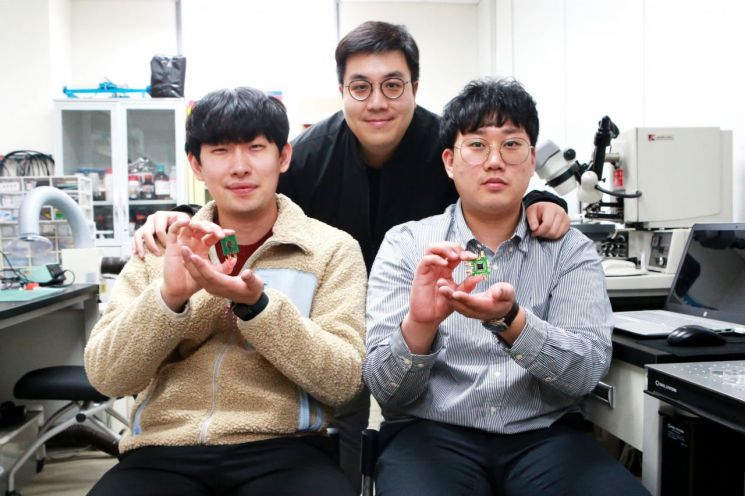 Professor Kim Hoejun (center) from the Department of Robotics at DGIST, who developed fine dust measurement technology, and his research team
[Asia Economy Reporter Kim Bong-su] Domestic researchers have developed an ultra-precise sensor that generates heat by itself to capture fine dust and accurately measure its concentration.
Daegu Gyeongbuk Institute of Science and Technology (DGIST) announced on the 16th that Professor Kim Hoe-jun's robotics team, together with Dr. Kim Sang-bok's team from the Environmental Machinery Research Division at the Korea Institute of Machinery and Materials, developed an ultra-small fine dust sensor using the thermoplastic plastic polymer polystyrene.
This sensor not only enables efficient capture of fine dust by adjusting the physical properties of the polymer through a micro heater, but also operates stably in high humidity environments, making it promising for various future applications.
Fine dust has worsened significantly in recent years due to domestic emissions combined with China's industrialization, severely impacting public health. Accurate measurement technology is also essential in various research fields such as semiconductor processes and aerosol studies, where maintaining a clean state is critical.
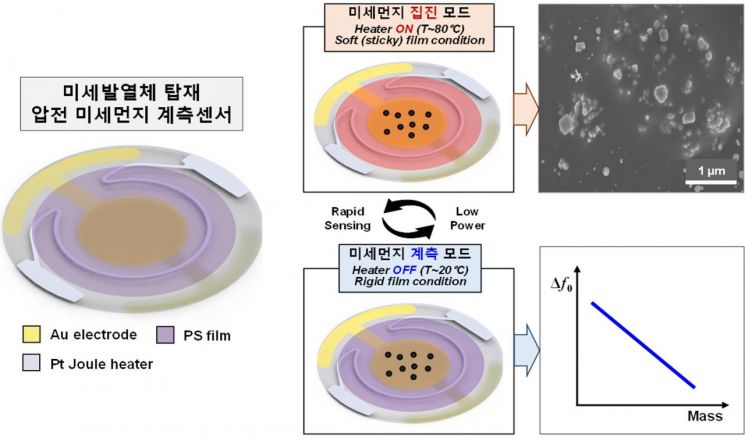
However, the quartz resonator sensors currently in use are expensive and have limitations in that complete contact between the particles to be measured and the sensor is difficult, resulting in inaccurate measurements. They also suffer from reduced reliability due to sensor errors caused by humidity.
The research team developed a new sensor that improves the contact force between particles and the sensor by utilizing polystyrene, a thermoplastic plastic material. Polystyrene varies its surface adhesion depending on the heating temperature, making it a material suitable for particle capture and sensing. The team also installed a micro heater system in the developed sensor so that the sensor can independently control heat generation without an external heat source, thereby controlling the adhesion of polystyrene. In addition to controlling the sensor's adhesion, it suppresses moisture condensation on the fine particle surface caused by external humidity, enhancing the sensor's measurement reliability. In other words, it has the advantage of being largely unaffected by external environmental factors (temperature, humidity), making it expected to be used in various industrial fields in the future.
Professor Kim said, "We will continue research aiming to develop fine particle sensors applicable in various environments through device improvements suited to actual application fields."
The research results were published online on October 20 in the international journal 'Journal of Hazardous Materials.'
© The Asia Business Daily(www.asiae.co.kr). All rights reserved.


















