[Asia Economy Reporter Kang Nahum] Although play-to-earn (P2E) games have become a global trend, they remain a “foreign” story in South Korea. This is because the Game Rating and Administration Committee (GRAC) classifies P2E games as gambling under the current Game Industry Promotion Act, wielding regulatory measures against them. Industry insiders point out that excessive regulation deprives domestic game companies of new market entry opportunities and hinders the development of the gaming industry.
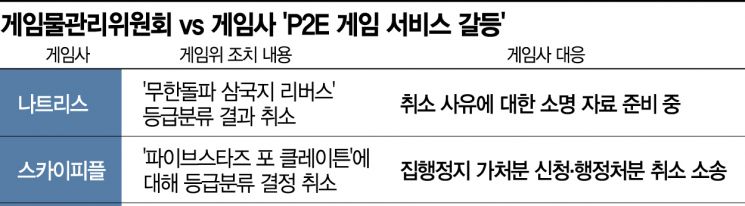
◆ Tense standoff between GRAC and game companies = According to the industry on the 15th, the game “Infinite Breakthrough Three Kingdoms Reverse,” developed by Natriss, recently received a notice from GRAC canceling its rating classification. Infinite Breakthrough Three Kingdoms is the first P2E game released domestically. Players can earn “Mudol Coins” through in-game quests and gameplay, which can then be exchanged for “Klay” listed on cryptocurrency exchanges. Shortly after its release, news spread that playing the game for one hour could earn about 10,000 KRW, propelling it to the top of the popular game rankings for a time.
The game was initially released through self-regulation by app market operators such as Google Play Store, but was caught during GRAC’s post-monitoring. Currently, Natriss is preparing explanatory materials regarding the reasons for the cancellation of the rating classification. If there is an objection to the rating classification or rejection decision, an appeal can be filed within 30 days. Therefore, it is expected to take about a month before the actual game service is suspended.
This is not the first time GRAC has regulated P2E games. In April, GRAC also canceled the rating classification of Sky People’s blockchain-based mobile game “Five Stars for Klaytn.” The issue was that game items could be turned into non-fungible tokens (NFTs). Sky People filed a provisional injunction to suspend enforcement and an administrative lawsuit against GRAC, winning the injunction in June. The administrative lawsuit is ongoing.
◆ “Gambling regulations must change now” = GRAC’s regulations are based on the current law that prevents games from promoting gambling. Article 32, Paragraph 1, Clause 7 of the Game Industry Promotion Act states that tangible or intangible results obtained in games cannot be exchanged for money because they may promote gambling. This law was established following the 2004 Bada Story scandal. GRAC views in-game assets exchangeable for virtual currency as similar to the “score certificates” used as exchange means in Bada Story.
The gaming industry is raising voices of dissatisfaction against GRAC’s regulatory moves. An industry insider said, “It is unreasonable to consider RPG games as ‘gambling games’ like Bada Story,” adding, “Excessive regulation can hinder innovation and industrial development.”
P2E games based on blockchain have become an unstoppable global trend, supported by the growth of the blockchain industry. Wemade is already on a successful path by launching the P2E game “Mir4 Global” in overseas markets, and major domestic game companies such as NCSoft and Netmarble have announced plans to release P2E games next year.
Domestic users, exhausted by probability-based items and pay-to-win systems, are also accepting the concept of P2E without resistance. Currently, some domestic users are attempting to bypass restrictions by using virtual private networks (VPNs) to access overseas servers of P2E games. Online communities are filled with detailed guides on how to bypass access.
Jang Hyun-guk, CEO of Wemade, said, “Simply allowing NFTs under the current game law regulations has its limits, and the gambling regulations themselves need to change,” adding, “No one, no company can stop the flow of games, and the challenge is how to turn that flow into quality growth.”
© The Asia Business Daily(www.asiae.co.kr). All rights reserved.
![Clutching a Stolen Dior Bag, Saying "I Hate Being Poor but Real"... The Grotesque Con of a "Human Knockoff" [Slate]](https://cwcontent.asiae.co.kr/asiaresize/183/2026021902243444107_1771435474.jpg)
















