Assistance with 'Market Expansion and Diversification' Aspects Upon Registration
[Asia Economy Reporter Jang Sehee] As the government decided on the 13th to discuss whether to join the Comprehensive and Progressive Agreement for Trans-Pacific Partnership (CPTPP), attention is focused on the potential impact on our economy.
According to the Ministry of Trade, Industry and Energy and industry sources on the 12th, the CPTPP is a multilateral free trade agreement (FTA) launched at the end of 2018 by the remaining 11 countries including Japan, Australia, and Mexico after the United States withdrew from the Trans-Pacific Partnership (TPP).
As of 2019, the CPTPP accounts for 15% of global trade and has a significantly higher level of openness compared to other FTAs. Furthermore, with China and Taiwan applying for membership last October, its strategic importance has increased.
The government has been preparing with a de facto focus on joining.
Accordingly, there is a possibility that the decision to join the CPTPP will be made at the Foreign Economic Ministers' Meeting chaired by Deputy Prime Minister and Minister of Economy and Finance Hong Nam-ki on the 13th.
The market openness of the CPTPP is quite high.
The CPTPP's level of tariff elimination on goods trade reaches up to 96%, which is much broader than the 17 other FTAs Korea has signed, as well as the RCEP. It also includes high-level provisions on standards and technical barriers, investment, services, intellectual property rights, and e-commerce.
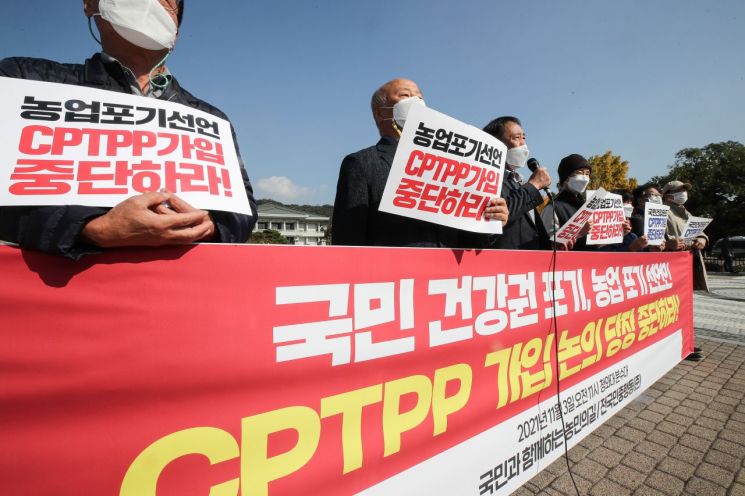
In particular, since many CPTPP member countries have developed agricultural sectors, significant damage to domestic agriculture is expected. This is why farmers' organizations have protested, demanding a halt to CPTPP discussions.
Joining the CPTPP would have the same effect as signing FTAs with Japan and Mexico, with whom Korea currently does not have FTAs. This raises concerns about worsening the trade deficit with Japan.
Some positive ripple effects are also expected. The industry views that joining the CPTPP would help in terms of market expansion and diversification.
According to the 'Future of CPTPP and Our Response Measures' report released by the Korea Institute for Industrial Economics and Trade earlier this year, the combined GDP of the 11 CPTPP member countries in 2019 was $11.2 trillion, accounting for 12.8% of the world's GDP, and their trade volume was $5.7 trillion, representing 15.2% of global trade.
In terms of population size, it is a huge market of about 500 million people, equivalent to 6.6% of the world's population.
The CPTPP member countries include Japan, Vietnam, Singapore, and other countries with which Korea has significant trade. China, which recently applied for membership, is Korea's number one economic trading partner.
Korea's exports and imports to and from CPTPP member countries account for 23.2% and 24.8% of total trade, respectively, indicating the significant share of CPTPP in Korea's trade.
With the Regional Comprehensive Economic Partnership (RCEP) set to take effect on February 1 next year, the effect of market diversification is expected to increase further.
It is also an opportunity to increase influence in ASEAN (Association of Southeast Asian Nations) countries, which are central to the New Southern Policy.
Additionally, it has the effect of signing FTAs with Mexico, with whom Korea has not yet concluded an FTA.
The CPTPP maintains the cumulative rules of origin adopted in the original TPP, whereby any intermediate goods produced in member countries are recognized as domestic products of the CPTPP exporting country. Therefore, joining the CPTPP could also help expand exports by small and medium-sized enterprises.
On the other hand, if Korea does not join the CPTPP, the non-application of cumulative rules of origin could lead to mid- to long-term damage, especially in exports of Korean intermediate goods, placing Korea at an economic disadvantage compared to Japan.
Besides China and Taiwan, the United Kingdom is also currently negotiating membership conditions. Voices calling for the necessity of CPTPP membership are growing even within the United States, suggesting the possibility of further expansion of the CPTPP, which supports the need for Korea's membership.
All 11 member countries must agree for a new country to join the CPTPP.
© The Asia Business Daily(www.asiae.co.kr). All rights reserved.

















