S&P "Profitability Improvement, Stable Credit Rating Maintained by Sound Asset Quality and Low Loan Loss Costs"
[Asia Economy Reporter Park Sun-mi] Domestic and international credit rating agencies are optimistic that the banking industry will maintain stable profitability and creditworthiness next year. However, they expressed concerns that Korea entering a period of interest rate hikes?being the first among the Group of Twenty (G20) countries to raise its benchmark rate since COVID-19?could lead to a deterioration in corporate debt repayment capacity, threatening bank soundness.
On the 9th, Standard & Poor's (S&P) and NICE Credit Rating projected at the ‘Financial Industry and Corporate Sector Credit Risk Outlook’ seminar that domestic banks will maintain stable credit ratings next year. Kim Dae-hyun, Director at S&P, stated, "While some European banking systems continue to experience low profitability due to COVID-19, domestic banks are expected to maintain stable creditworthiness through improved profitability, sound asset quality, and manageable loan loss expenses."
Director Kim explained, "We anticipate improvements in both the average Return on Average Assets (ROAA) and Net Interest Margin (NIM) for domestic banks this year and next. The ROAA is expected to approach 0.6%, which is higher than that of France, the UK, Germany, and Japan, and the non-performing loan ratio relative to total loans will remain below 1%, indicating sound asset quality."
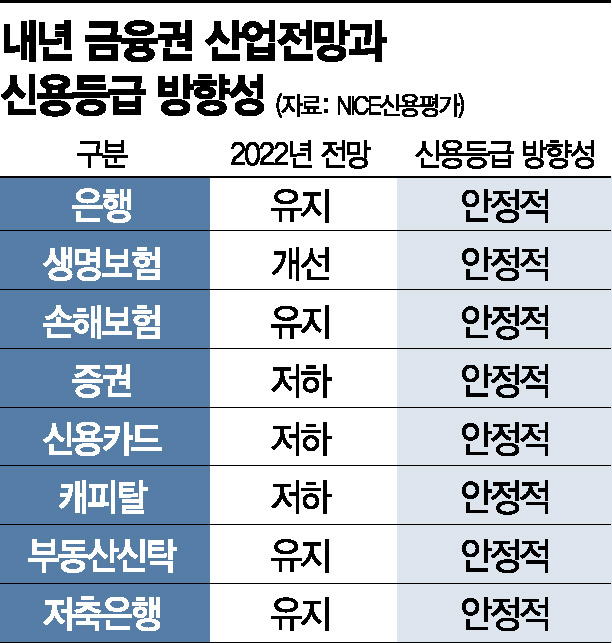
Lee Hyuk-jun, Executive Director at NICE Credit Rating, also assessed the credit rating outlook for eight financial sectors, including banks, as ‘stable,’ noting, "The rising benchmark interest rate environment is expected to improve profitability in the banking and insurance industries through margin expansion."
He pointed out that the current trend of benchmark rate hikes this year and next resembles the sharp increases seen during the economic recovery period of 2010?2011, stating, "During the 2010?2011 interest rate hike period, banks and insurance companies experienced significant net income growth." The most influential factor for the financial industry is the interest rate increase, and following two hikes in the benchmark rate by the Bank of Korea in the second half of this year, an additional two to three hikes are expected next year.
However, he reminded that the potential non-performing loan ratio within total bank loans, especially the combined portion of watch-listed loans and those with extended maturities or repayment deferrals, reached 5.8% as of the first half of this year, cautioning, "We must remain open to the possibility that accumulated potential non-performing loans may become visible after financial support ends."
Currently, asset quality is being maintained through policies such as loan extensions and principal and interest repayment deferrals, but the variable of rising interest rates means that future bank asset quality cannot be guaranteed?this is a common concern raised by both domestic and international credit rating agencies.
Ok Tae-jong, Senior Analyst at global rating agency Moody’s, also remarked at the recent ‘Korea Credit Outlook Conference,’ "Even after government support and regulatory easing normalize next year, it is important to observe whether banks maintain robust asset quality and stable profitability." He added, "Bank profitability is expected to remain stable due to NIM expansion from rising market interest rates, but entering an interest rate hike period amid rapidly increasing debt ratios raises principal and interest repayment burdens for households and corporations, which could become a core credit risk for the banking sector."
© The Asia Business Daily(www.asiae.co.kr). All rights reserved.

















