Major Reconstruction Complexes in Gangnam Area Prioritize Autonomy and Speed... Sequentially Joining Sintong Planning
Higher Aging Leads to Public Redevelopment... Clear Incentives Like Exemption from Subscription System
"Careful Attention Needed to Ensure Increasing Candidate Sites Translate into Housing Supply"
[Asia Economy Reporter Kim Hyemin] In an effort to revitalize housing supply, the public maintenance and rapid integrated planning initiatives promoted respectively by the government and Seoul City are showing different patterns depending on the region. Major apartment complexes in Seoul slated for reconstruction have chosen Seoul City's rapid integrated planning method, while redevelopment areas with severe aging have opted for the government's public maintenance. The division also falls along the lines of the Gangnam and Gangbuk areas. Ultimately, it is interpreted that the success of each maintenance project varies according to residents' needs.
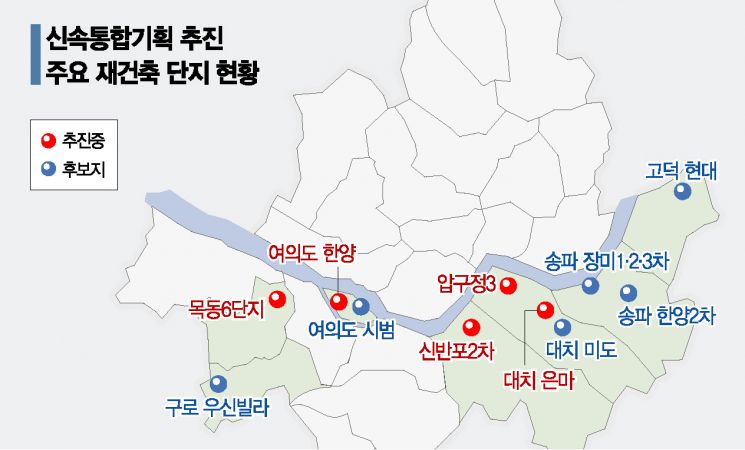
According to the maintenance industry on the 9th, major apartment complexes considered barometers of Seoul reconstruction are choosing Seoul City's rapid integrated planning method instead of the government's public maintenance method. In fact, the Shibeom Apartments, a representative reconstruction complex in Yeouido over 50 years old, Mido Apartments, one of the 'Useonmi (Useong, Seongyeong, Mido)' complexes considered the leader in reconstruction in Daechi-dong, Gangnam-gu, and Jangmi Apartments in Songpa-gu located along the Han River in Jamsil have all joined the rapid integrated planning.
The number of complexes pursuing reconstruction through rapid integrated planning is expected to increase. The largest reconstruction complex in Apgujeong, Gangnam-gu, Zone 3 (Hyundai 1-7, 10, 13, 15, Daerim Villate) submitted an application on the 7th. Seocho-gu's Shinbanpo 2nd complex, a prime location along the Han River, and the 6th complex in Mok-dong, the only one to pass the safety inspection, have also completed their applications. In addition, Eunma Apartments in Gangnam-gu and Apgujeong Zone 2 (Shinhyundai 9, 11, 12) are gathering residents' opinions.
On the other hand, the government's proposed public reconstruction and public direct implementation reconstruction, despite clear incentives such as zoning upgrades and exemption from the reconstruction surplus profit recovery system, failed to gain support from major complexes. This is because mandatory rental ratios regardless of floor area ratio increases or the in-kind method of entrusting housing to the government and receiving it back after reconstruction were seen as problematic clauses.
As a result, most major reconstruction complexes decided to pursue private reconstruction, and experts believe that the advantages of Seoul City's rapid integrated planning, such as shortened review periods compared to private reconstruction, have highlighted and attracted applications. Kim Hakryeol, head of SmartTube Real Estate Research Institute, said, "The higher the business feasibility of complexes in Gangnam, the less incentive there is to choose public maintenance. These complexes prioritize speed and have gravitated toward rapid integrated planning, which secures autonomy and shortens review periods."
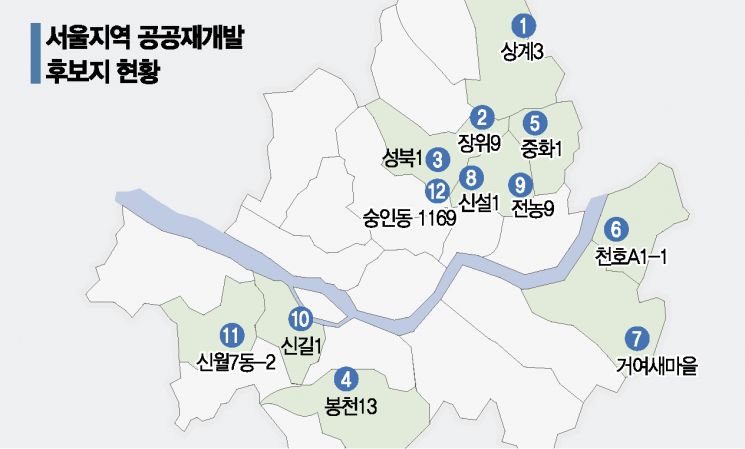
Public maintenance projects are gaining more support in redevelopment areas than in reconstruction. In the first round of candidate site applications held last year, about 70 sites applied, showing strong interest, and in the second round earlier this year, about 60 sites applied. The selected areas are concentrated in the outskirts of Seoul or the Gangbuk area. These are regions with relatively many aging houses where development is urgent.
Public redevelopment can be applied for with only 10% resident consent. Incentives such as raising the floor area ratio up to 120% of the legal limit to improve business feasibility and exemption from the price ceiling system have driven participation. Strengthened public aspects such as low-interest loans from the Housing and Urban Fund and loan support to help original residents resettle are also reasons why residents in these areas chose public redevelopment. In particular, redevelopment also succeeded in attracting 102 applications in Seoul City's rapid integrated planning redevelopment contest. It is evaluated that easing the aging criteria and opening participation to urban regeneration projects were effective.
An industry official said, "Residents want different methods depending on the region for redevelopment and reconstruction, so it is necessary to create various options like now. To achieve results, it is important not just to increase candidate sites but to carefully ensure that they lead to actual housing supply."
© The Asia Business Daily(www.asiae.co.kr). All rights reserved.


















