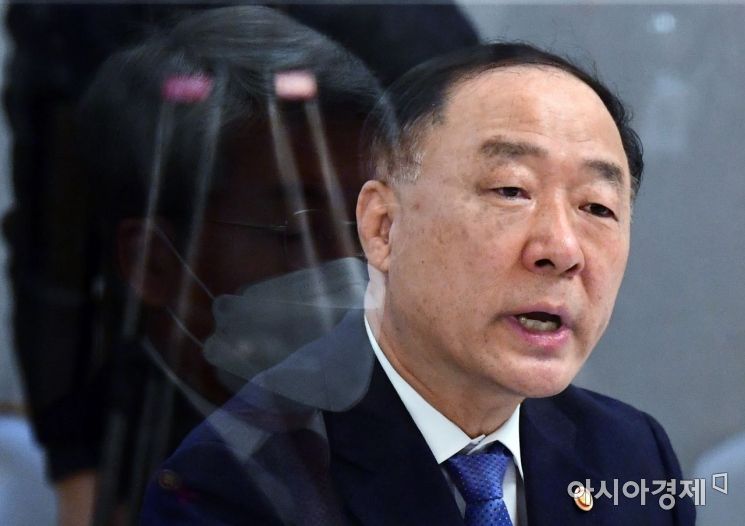
 Hong Nam-ki, Deputy Prime Minister and Minister of Economy and Finance / Photo by Hyunmin Kim kimhyun81@
[Sejong=Asia Economy Reporter Son Sunhee] Hong Nam-ki, Deputy Prime Minister for Economy and Minister of Strategy and Finance, commented on the Statistics Korea’s future population projection results indicating that South Korea’s population will begin to decline starting this year, stating on the 9th, "It once again raises awareness of the population cliff crisis we are facing," but also noted, "It is important to recognize that this result is significantly influenced by short-term factors such as the unprecedented COVID-19 crisis situation."
Deputy Prime Minister Hong wrote on his social media (SNS) on the same day, "The earlier timing of the total population decline and the lowered total fertility rate in this projection are largely due to the shocks caused by COVID-19 over the past two years, which have shaken our economy and society, including reduced international net migration and delays in marriage and childbirth decisions."
Previously, Statistics Korea forecasted that South Korea’s population, which recorded 51.84 million in 2020, would begin to decline starting this year. This means the population peak has already passed. In the 2019 projection, the population peak was expected in 2029, but this has been brought forward by eight years in just three years.
Regarding this, Deputy Prime Minister Hong said, "Once we overcome COVID-19 and return to normal daily life, the inflow of foreigners, marriage, and childbirth are likely to normalize, improving the population change trend." He added, "Among the scenarios announced by Statistics Korea, projections assuming a rapid recovery from COVID-19 estimate that the total population could increase to about 53 million by 2038."
He also stated, "Since 2019, the government has been operating the pan-government 'Population Policy Task Force (TF)' in three phases to closely respond to the three major population risks (natural population decline, imminent super-aged society, and regional extinction)." He continued, "We have prepared comprehensive resilience enhancement measures including quantitative expansion and qualitative improvement of the workforce, preparation for declining school-age population and a shrinking society, enhancement of social sustainability, and response to regional extinction."
Deputy Prime Minister Hong said, "Going forward, we will support about 9.5 trillion won over four years through the five major low birthrate response packages (such as establishing infant allowances, first meeting packages, and achieving 50% public childcare), while actively implementing and managing existing measures to ensure their effectiveness." He added, "Based on the institutionalization of key policies such as the revision of the Basic Low Birthrate and Aging Society Act and the Child Allowance Act this year, we plan to fully implement new low birthrate response projects starting next year." He further stated, "We will operate the 4th Population Policy TF and focus our capabilities on continuously discovering additional effective tasks."
© The Asia Business Daily(www.asiae.co.kr). All rights reserved.

















