CSAT Scoring Results Released... Highest Scores Up from Last Year
Korean 149 Points, Math 147 Points, Korean is Second Highest Ever
One Perfect Scorer in CSAT... Difficult Exam and Fairness Controversy Continue
Group Lawsuit by Examinees Related to Life Science II Question 20
Evaluation Institute: "No Premature Judgment on Results, Will Proceed as Scheduled"
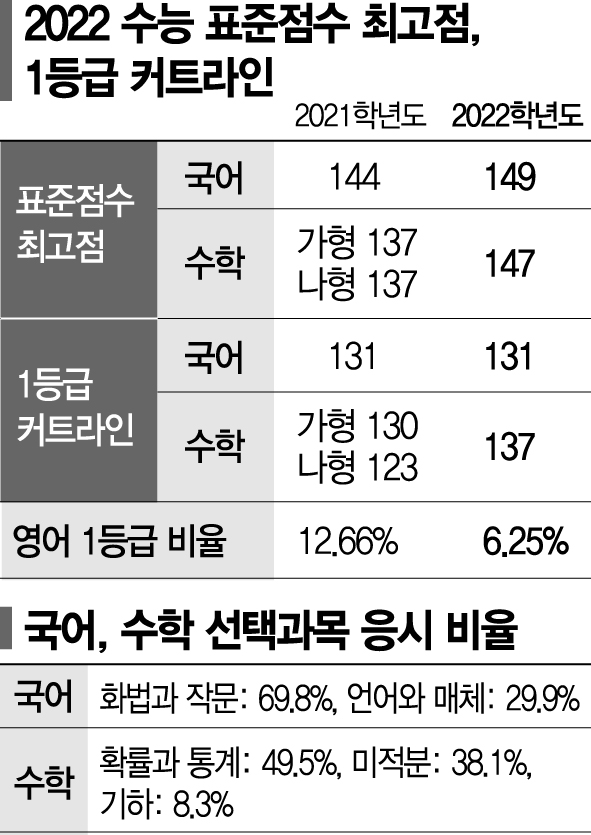
[Asia Economy Reporter Han Jinju] According to the grading results of the 2022 College Scholastic Ability Test (CSAT), the highest standard scores for both Korean and Mathematics increased compared to last year's CSAT, while the percentage of students achieving the top grade in English was halved. There was one perfect scorer, a graduate who took the social studies subject.
On the 9th, the Korea Institute for Curriculum and Evaluation (KICE) announced the CSAT grading results, revealing that the standard scores for Korean and Mathematics rose compared to last year's CSAT and this year's mock exams.
Lee Gyumin, the CSAT grading committee chair, explained, "Based on the grading results, the Korean section was likely perceived as more difficult than the June and September mock exams this year and last year's CSAT, but it was less difficult than the 2019 Korean CSAT," adding, "The Mathematics section changed its system from last year, making direct comparison difficult, but it maintained a similar difficulty level to the June and September mock exams this year."
He further stated, "Although the proportion of students who received the top grade in English decreased compared to last year, the cumulative percentage up to the third grade actually increased, making it easier than the June and September mock exams this year and overall similar in difficulty to last year's CSAT," and added, "The difficulty levels of the Korean history and inquiry sections were generally similar to last year's CSAT."
Highest Korean Score 149, Mathematics 147... Increased by 5 and 10 Points Respectively Compared to Last Year
The highest standard score in Korean was 149 points, 5 points higher than last year's 144 points. Korean was the second most difficult since the CSAT was introduced in 2005, closely approaching the highest Korean score of 150 points in the notoriously difficult 2019 CSAT. The highest Mathematics score was 147 points, a 10-point increase from last year's 137 points for both Type A and Type B. Compared to the June and September mock exams, Korean scores were 3 and 22 points higher, respectively, and Mathematics scores were 1 and 2 points higher. The standard score indicates the difference between a student's raw score and the average score; the more difficult the exam, the higher the top score.
The percentage of students achieving the top grade in English was 6.25%, half of last year's 12.66%. The second-grade percentage was 21.64%, an increase of 27,390 students compared to last year. The cutoff for the top grade in Mathematics was 137 points, 7 points higher than last year's Type A and 14 points higher than Type B. The Korean top-grade cutoff remained the same as last year at 132 points.
The proportion of students with the highest standard scores was 0.006% (28 students) in Korean, significantly lower than last year's 0.04% (151 students). In Mathematics, it was 0.628% (2,702 students), lower than last year's Type A 0.70% (971 students) but slightly higher than Type B's 0.53% (1,427 students).
The highest score in the inquiry section was in Earth Science II (77 points). In social studies, Ethics and Ideology and Society & Culture (68 points) had the highest scores, while Politics and Law (63 points) had the lowest. In science inquiry, Chemistry I and Physics II (68 points) had the lowest scores. Social studies were relatively easier, whereas science inquiry was more difficult, likely creating differentiation among science-track students in science inquiry subjects.
The CSAT grading results did not disclose standard scores by subject choice in Korean and Mathematics. It is analyzed that the highest scores came from subjects mainly taken by top-ranking students.
Lim Seongho, CEO of Jongro Academy, said, "The number of perfect scorers in Korean sharply decreased compared to last year. It is presumed that all top scorers took Language and Media, making Korean differentiation absolute in the humanities track," adding, "All perfect scorers in Mathematics are presumed to have taken Calculus, with an increase of 1,731 students compared to last year's Type A perfect scorers, suggesting a fierce competition among perfect scorers. There was a significant gap between humanities and sciences in Mathematics, raising concerns about cross-application from humanities to sciences."
The number of test-takers this year was 448,138, 27,104 more than last year's 421,034. Among them, 318,693 were current students, and 129,445 were graduates or those who passed the qualification exam. Students will receive their individual score reports on the 10th.
One Perfect Scorer in CSAT... Record-Level Difficult Exam and Controversies Over Advantages and Disadvantages
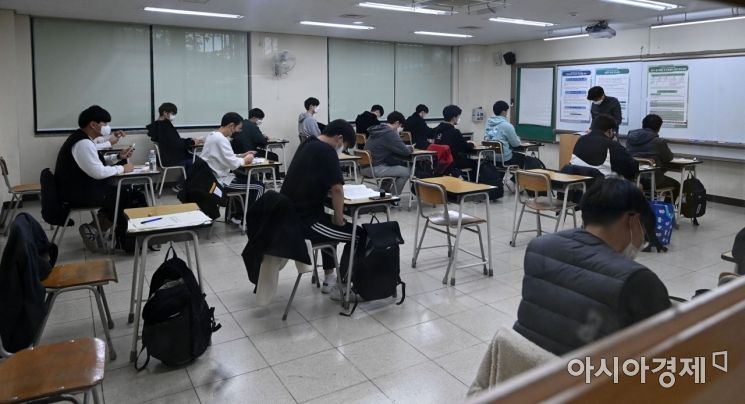 On the morning of the 18th, when the 2022 College Scholastic Ability Test was held, examinees were preparing for the exam at Gyeongbok High School in Jongno-gu, Seoul.
This year's perfect scorer was one graduate who took the social studies subject. Kang Taejung, president of KICE, stated, "The perfect scorer is a student who scored full marks in Korean and Mathematics, received top grades in the absolute evaluation subjects English and Korean history, and also achieved full marks in the remaining inquiry subjects. Only one student met these conditions."
Contrary to the expectations of the question committee, this CSAT was more difficult than anticipated, leading to evaluations labeling it a 'difficult CSAT.' Regarding this, KICE responded that difficulty cannot be judged solely by the highest standard score and that the second and third grades must also be considered.
Kang Taejung said, "If we focus on students in the top grade range, it is plausible they felt it was difficult, but considering up to the second and third grades, we can question whether it was only difficult," adding, "Looking at the distribution of test scores, more students are clustered around the average, and overall, the differences among students have narrowed."
From this year, the CSAT was integrated for humanities and sciences, with Korean and Mathematics conducted as 'common + elective subjects,' but scores by elective subjects are not disclosed on the score report. This has sparked controversy that humanities students might be disadvantaged.
Regarding this, President Kang said, "It is difficult to hastily judge advantages or disadvantages based on elective subjects or intended career paths, and to determine advantages or disadvantages in the final college admissions results, we must consider how universities utilizing CSAT scores apply them."
In schools, there are concerns that not disclosing scores by elective subjects makes it difficult to devise admission strategies. In response, the president said, "We were not confident that disclosing such information would be helpful without error educationally, socially, or for students."
Jo Hunhee, director of the College Admission Policy Division at the Ministry of Education, said, "Common and elective subjects are combined into one scoring system, and universities decided to use this score to create conversion formulas for admissions. It is important not only how high the scores are but also the application trends by each university's recruitment unit, so these aspects must be comprehensively considered."
Biology II Question in Litigation... KICE "Will Faithfully Follow Scheduled Timeline"
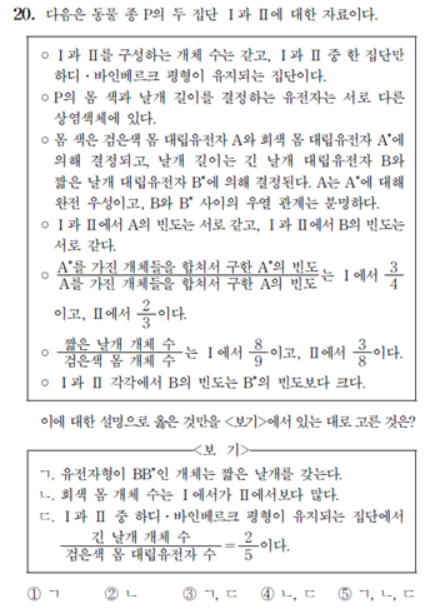
Ninety-two test-takers have filed a class-action lawsuit against KICE regarding an error in question 20 of Biology II. The court is currently reviewing a suspension of execution related to KICE's answer decision, and if the request is accepted, the distribution of score reports may be delayed. KICE has issued a principled response to adhere to the schedule.
President Kang said, "We do not prejudge the outcome and will adhere to the schedule expected by students and universities," adding, "We sincerely apologize for the controversy that has arisen."
Regarding the reason for maintaining the answer, President Kang explained, "There are about seven conditions provided to help solve this question, and we acknowledged that one of these conditions was not directly helpful for solving the problem," but added, "Experts and teachers judged that even acknowledging this, the other conditions sufficiently lead to the correct answer. Considering this, maintaining the answer is meaningful for fairness."
When asked how much the score report distribution might be delayed if the court accepts the suspension request, President Kang said, "We did not anticipate the outcome and would need to simulate to answer, but we have not gone through such procedures."
Jo Hunhee from the Ministry of Education explained, "If the subsequent procedures are disrupted, the impact on students would be significant. Since the suspension review is ongoing, we are fully explaining to the court and doing our best in the current situation."
© The Asia Business Daily(www.asiae.co.kr). All rights reserved.
![Clutching a Stolen Dior Bag, Saying "I Hate Being Poor but Real"... The Grotesque Con of a "Human Knockoff" [Slate]](https://cwcontent.asiae.co.kr/asiaresize/183/2026021902243444107_1771435474.jpg)













