Production Cost Linkage → Differential Revision by Usage
Government's Final Persuasion at Meeting on 13th
Uncertainty Over Dairy Industry Board Meeting
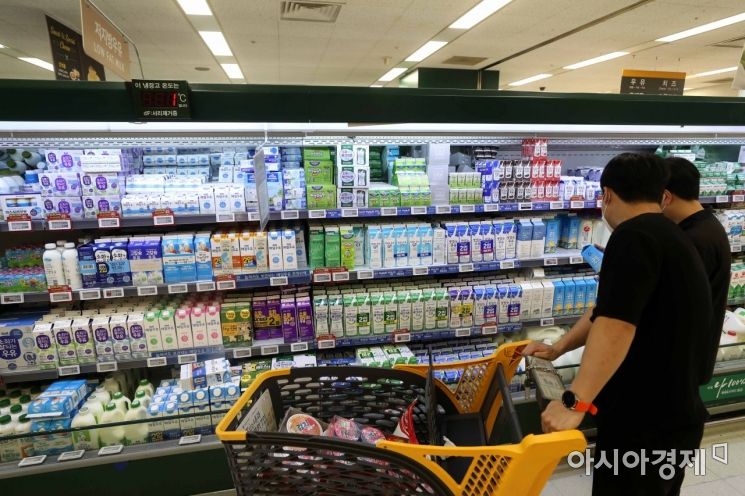 Dairy companies are consecutively raising the prices of dairy products. Namyang Dairy Products increased the prices of milk products by an average of 4.9% on the 14th. Seoul Milk also raised the prices of milk products by an average of 5.4% on the 1st. The photo shows a customer selecting products at a milk sales stand in a large supermarket in Seoul on October 15.
 Photo by Moon Honam munonam@
[Sejong=Asia Economy Reporter Moon Chaeseok] The government's plan to reform the raw milk price system, which affects milk prices, is expected to extend beyond this year. The proposal by the government to set different per-liter prices for drinking milk such as white milk and processed milk used for butter and cheese, considering market demand, has been repeatedly rejected by producers (farmers), making an agreement within this year increasingly uncertain. The government's plan to rationalize consumer prices by leaving raw milk prices to market supply and demand and to strengthen the competitiveness of the dairy industry has inevitably encountered setbacks.
According to the government and industry sources on the 9th, the Ministry of Agriculture, Food and Rural Affairs plans to hold the 4th Dairy Industry Development Committee meeting on the 13th to discuss the differentiated pricing reform plan. This meeting, involving government, industry, and experts, is intended to hear opinions from various sectors and to persuade dairy industry stakeholders until the last moment ahead of the Dairy Promotion Board's board resolution scheduled for the end of this month. A senior government official said, "We plan to hold as many such meetings as possible until the end of the year to persuade industry stakeholders, but the dairy industry is not showing any movement," adding, "The Dairy Promotion Board meeting to decide on the price system should be held by the end of this month, but it is highly likely that it will not happen."
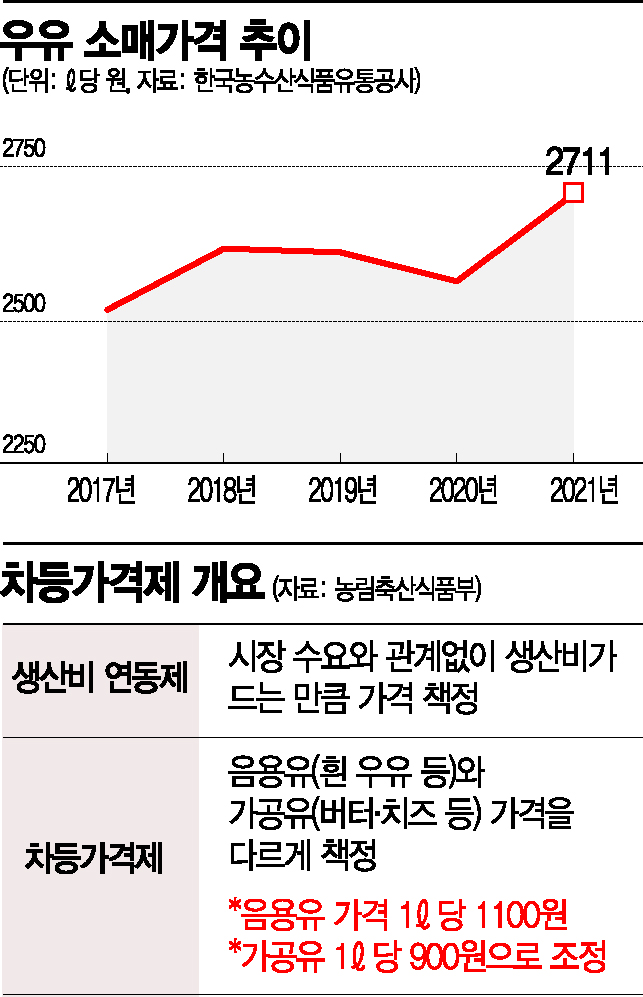
The Ministry of Agriculture, Food and Rural Affairs prepared the reform plan because milk prices have been continuously rising regardless of supply and demand conditions. When dairy farmers raised the raw milk price from 926 won to 947 won per liter citing increased production costs, the dairy industry also raised consumer prices accordingly. The government decided to intervene in the 'production cost-linked system,' which immediately raises raw milk prices based on production costs regardless of market demand.
The government's price system reform aims to maintain the current drinking milk price at 1,100 won per liter while lowering the processed milk price by 200 won to 900 won per liter. The government will support dairy companies with 100 to 200 won per liter for purchasing processed milk from producers. In return, the processed milk quota will be increased to compensate producers' income. Accordingly, the milk quota will increase from 2,049,000 tons to a total of 2,175,000 tons, including 1,868,000 tons for drinking milk and 307,000 tons for processed milk.
The industry expresses concern that domestic raw milk prices are about twice as expensive as imported raw milk, which costs 400 to 500 won per liter, resulting in reduced price competitiveness. From the dairy industry's perspective, purchasing imported raw milk is more advantageous.
However, the government insists that reform is inevitable despite opposition from the dairy industry. Prices that do not consider supply and demand conditions are incompatible with the market economy and ultimately weaken the competitiveness of the dairy industry. A senior official from the Ministry of Agriculture, Food and Rural Affairs pointed out, "In 2001, raw milk prices in the US and Europe were in the 400 won range per liter, while ours were 650 won, a difference of about 250 won. This year, the gap has widened to over 600 won," adding, "Overseas dairy industries have gained price competitiveness through competition, but we have not."
The Ministry of Agriculture, Food and Rural Affairs believes that producers' income will actually increase even with the introduction of differentiated pricing by use. Production volume is expected to expand from 2,049,000 tons in 2019 to 2,218,000 tons, and the raw milk self-sufficiency rate will increase from 48.5% to 50.4%, with income rising from 161.87 million won to 163.58 million won per household. Park Beomsu, Director of Livestock Policy at the Ministry, said, "If the government supports dairy companies' purchases of processed milk, the average purchase price for dairy companies will decrease, potentially improving their profitability."
The government is expecting the Dairy Promotion Board meeting to be held by the end of this month. The meeting must be held to finalize next year's business plan, and it is expected that the price system reform can be approved at the same time.
A Ministry of Agriculture, Food and Rural Affairs official said, "If next year's plan is not finalized within this year, it will carry over to the next year, so producer members are likely to participate in the board meeting considering this," adding, "The government plans to announce a proposal that includes prior notification of raw milk purchase plans during direct transactions between producers and dairy companies and presents a mid- to long-term price improvement system."
The producer side has not yet expressed their intention regarding whether the board meeting will be held within this year.
© The Asia Business Daily(www.asiae.co.kr). All rights reserved.


















